# BrightLocal vs Search Atlas (2026): Specialist vs Platform
URL: https://www.getrankonmap.com/blog/brightlocal-vs-search-atlas
Published: 2026-08-21
## Specialist or Platform, in Short
- These two aren't really competitors — they're different categories that overlap on one feature. BrightLocal is a **local SEO specialist**; Search Atlas is a **full-stack SEO platform** with local capability included.
- The second organic result for this comparison is Search Atlas's own step-by-step guide to migrating off BrightLocal. That tells you who's chasing whom, and it's worth reading with that in mind.
- Search Atlas publishes tiers at **$99, $199, $399 and $999 per month** as of 2 August 2026. BrightLocal bills **per location**, which means the two price sheets can't be compared directly at all.
- The deciding question is scope, not features: do you need local SEO, or do you need SEO and happen to also have local locations?
- Neither is a grid-first measurement tool. Both include map rank tracking as one module among many.
---
## The Comparison Almost Nobody Frames Correctly
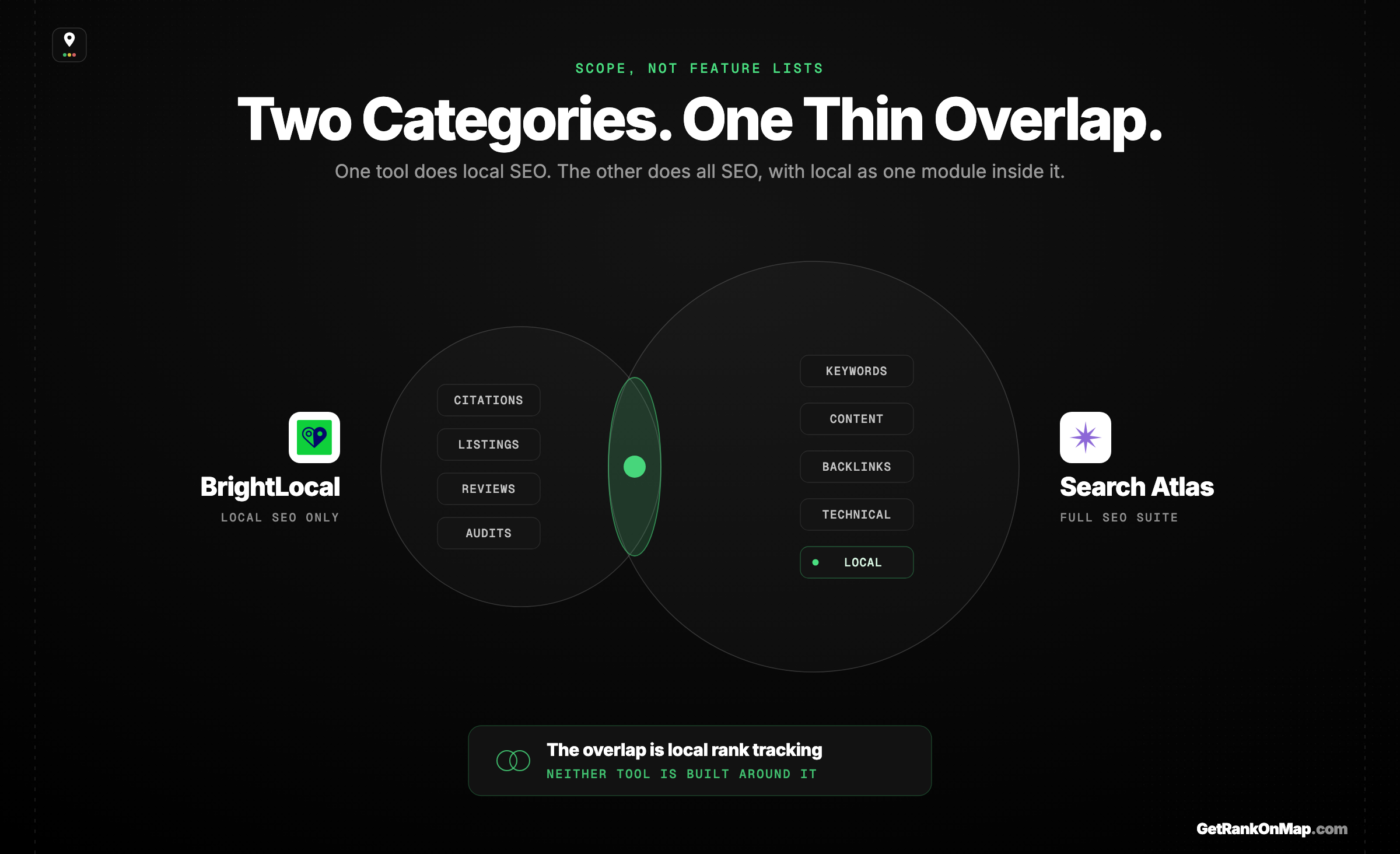
Infographic showcasing a local SEO specialist against a full-stack SEO platform, with the overlap shown as a single shared feature.
BrightLocal and Search Atlas get compared because they both appear when someone searches for SEO software and both mention local rankings. That's roughly where the overlap ends.
**BrightLocal is a local SEO specialist.** Everything in it exists to serve businesses with physical locations or service areas — citations and listings management, review monitoring, local audits, map rank tracking, and white-label client reporting. It does one category thoroughly and doesn't pretend to do national organic SEO.
**Search Atlas is a full SEO platform.** Keyword research, content optimisation, backlink analysis, site auditing, and AI-assisted execution tooling, with local SEO as one module inside that. Its natural competitor is Semrush or Ahrefs — which is why the SERP for this comparison keeps surfacing "Semrush vs Search Atlas" pages alongside it.
So the real question isn't which tool is better. It's whether you're buying local SEO or buying SEO.
If you run a dental practice with three locations, national organic SEO is largely irrelevant to you and you'd be paying for a lot of machinery you'll never start. If you run an agency handling ecommerce clients alongside a few local ones, buying a local specialist means you still need a second platform for everything else.
## A Word About What Ranks for This Search
Something worth knowing before you read anyone's comparison of these two, ours included.
The second organic result for "brightlocal vs search atlas" is a page on searchatlas.com titled *"How to Migrate from BrightLocal to Search Atlas."* Not a comparison — a migration guide. Search Atlas is actively marketing to BrightLocal's customers and has built content specifically to capture people at the moment they're wavering.
That's completely legitimate marketing, and it's also useful context: a meaningful share of the material you'll find comparing these two is written by one of them. Read it for the feature details, which are usually accurate, and discount the conclusion, which is never in doubt.
Our own disclosure, since we're applying that standard: RankMap is building a GeoGrid rank tracker and is pre-launch as of this writing. We compete with the local rank-tracking slice of both these products and not with anything else in either.
## What Each One Charges, and Why the Numbers Don't Compare
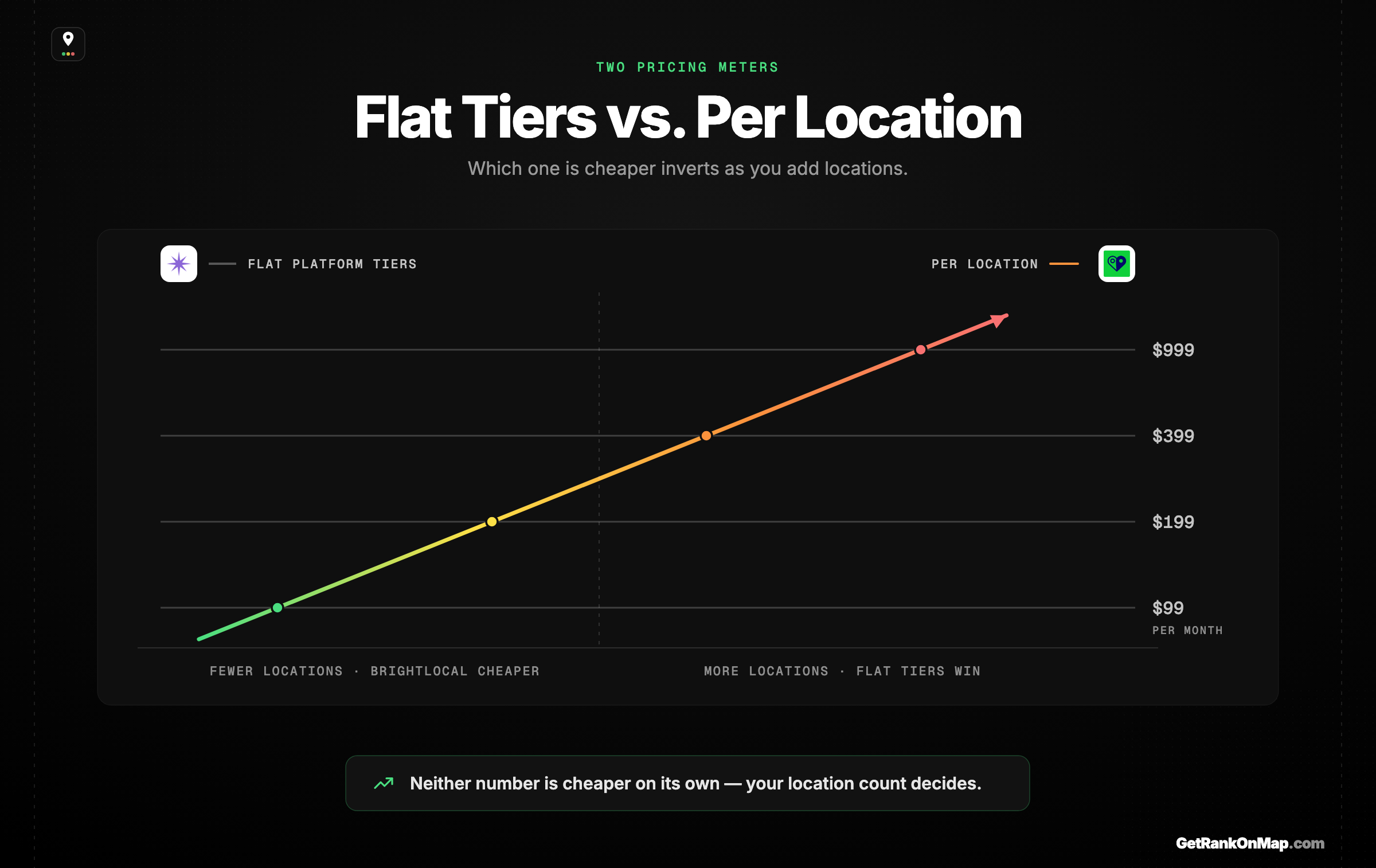
Infographic showcasing flat platform pricing against per-location pricing and the point at which they cross over.
**Search Atlas** publishes tiers at **$99, $199, $399 and $999 per month**, read from [its own pricing page](https://searchatlas.com/pricing/) on 2 August 2026. Flat platform pricing, scaling by feature access and usage limits rather than by how many businesses you're tracking.
**BrightLocal** meters **per location**. Your cost is a function of how many business locations you track, read first-hand from [its pricing page](https://www.brightlocal.com/pricing/) on the same date.
Those are structurally different units, and that has a practical consequence people miss. At one or two locations, BrightLocal's per-location model is inexpensive and Search Atlas's entry tier looks expensive by comparison. At forty locations, the calculation can invert completely — flat platform pricing stops scaling while per-location pricing keeps climbing.
Neither is a better deal in the abstract. Count your locations first, then look at the price sheets, and the answer usually becomes obvious. We've written about [the billing models running through this whole category](https://getrankonmap.com/blog/what-local-rank-trackers-charge-for) if you want the fuller picture — it's the single most under-examined thing in local SEO purchasing.
## Where Each One Genuinely Wins
### BrightLocal wins on
**Depth in local.** Citation building, listings accuracy, local audit tooling and review management are the product rather than a module of it, and it shows in the detail.
**Client reporting for local agencies.** White-label reports built around local metrics. If your deliverable is a monthly report for a plumber or a clinic, this is what it's designed to produce.
**Simplicity at small scale.** A single-location business can subscribe and be useful within an hour. Platforms take longer to become worth their price.
### Search Atlas wins on
**Scope.** If your work spans local and national, one subscription covers both rather than two.
**Content and technical SEO.** BrightLocal doesn't compete here at all. If you need content briefs, on-page optimisation and technical crawling, that's a whole side of the work BrightLocal simply isn't for.
**Backlinks.** Same — outside BrightLocal's remit entirely.
## What Neither Does Well
Both include map rank tracking. Neither is built around it.
That distinction matters more in local search than people expect. If a tool reports one position from one location, the number is close to meaningless, because [Google Maps results change with the searcher's physical position](https://getrankonmap.com/blog/why-google-maps-ranking-varies-by-location). You can sit third from your own office and be entirely absent four miles away, and a single-point tracker will report "position 3" both times. That's why [grid-based tracking exists](https://getrankonmap.com/blog/what-is-geogrid-rank-tracking) and why BrightLocal sells Local Search Grid as an add-on layer rather than including it in the base number.
If the map is the thing you're actually trying to see, you're likely buying a platform for a feature that neither platform is organised around. Our [comparison of local rank trackers](https://getrankonmap.com/blog/best-local-rank-trackers-2026) covers the tools that are.
## Who Should Pick Which
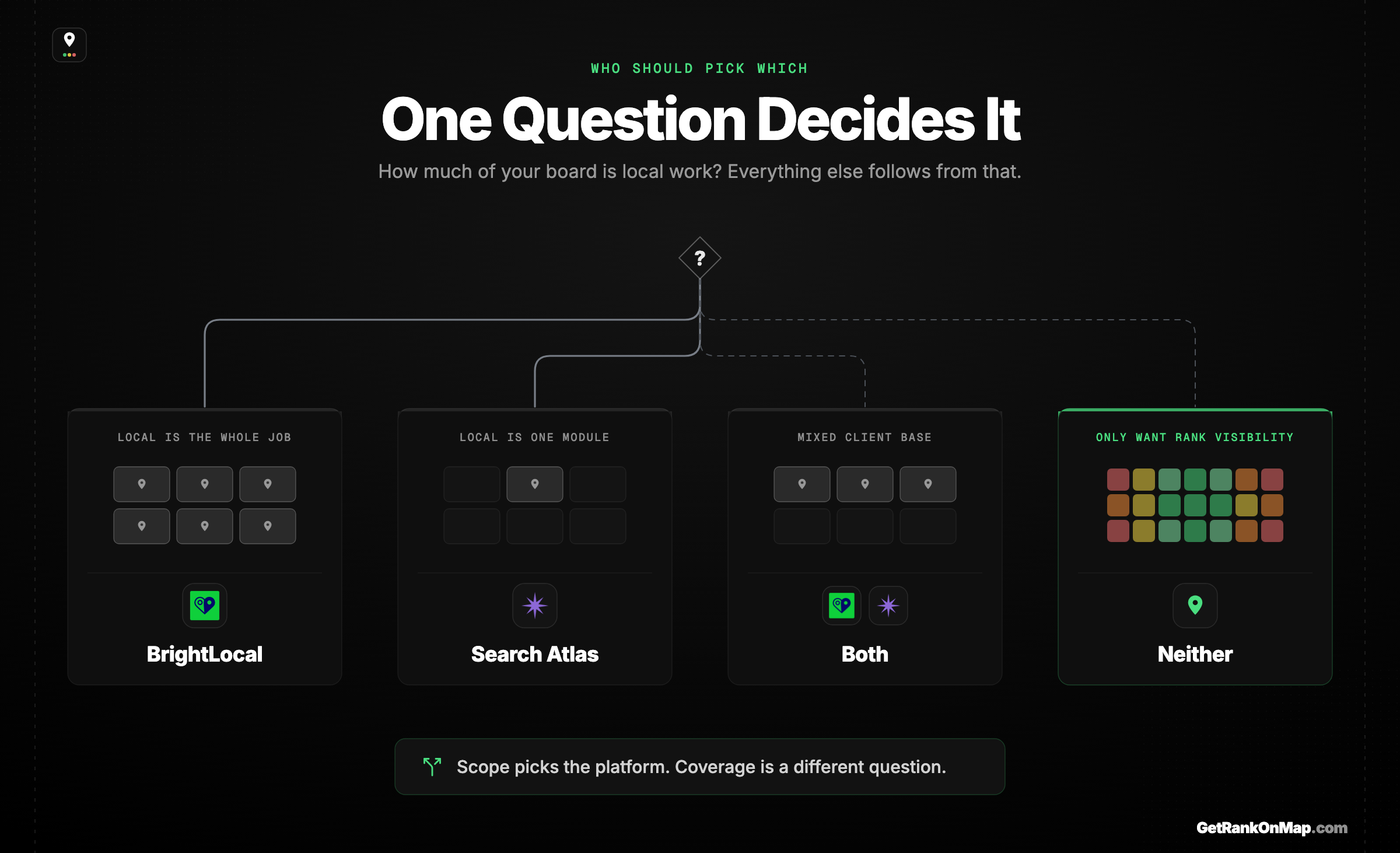
Infographic showcasing the scope question that decides between a local specialist and a full SEO platform.
**Pick BrightLocal** if local SEO is the whole job — single or multi-location businesses, agencies serving local clients, anyone whose reporting is about map pack visibility and review health rather than organic traffic.
**Pick Search Atlas** if local is one part of a wider SEO practice, if you need content and technical tooling in the same subscription, or if you're already paying for a national SEO platform and would rather consolidate than add a second vendor.
**Pick both** only if you're an agency with genuinely split client types and can attribute the cost. It's a defensible stack; it shouldn't be an accident.
**Pick neither** if what you need is to know where you rank across your service area, precisely enough to tell whether your work is landing. That's a measurement problem, and both of these solve management problems with measurement attached.
## Conclusion
This comparison feels harder than it is because the two products are being lined up on the strength of a feature they both happen to have, rather than on what they're each built to do.
Answer the scope question and it resolves in about a minute. Local only? Buy the specialist. Local plus everything else? Buy the platform. The feature tables will then confirm what the scope question already told you, and you'll have saved yourself an afternoon of comparing checkmarks that don't decide anything.
And whichever you pick, be clear-eyed that the map rank number inside it is a module rather than a measurement instrument. That's a fine trade if the map isn't your main question — and a costly one if it is.
RankMap is building in exactly that gap, so we're not neutral and we won't pretend to be. We're pre-launch and we're not asking you to postpone a decision you need to make now. But if the honest answer to "where do I actually rank across my service area?" is a shrug, [join the early-access waitlist](https://getrankonmap.com/waitlist) and we'll show you what we've built when it's ready.