# Local Falcon vs Local Viking (2026): One Credit Pool or Two
URL: https://www.getrankonmap.com/blog/local-falcon-vs-local-viking
Published: 2026-08-26
## One Credit Pool or Two
- **Local Viking's pricing page now renders under the name Local Optics** as of 2 August 2026, while its marketing site still says LocalViking. Any comparison that doesn't note this is quoting a stale source.
- Both products meter by credit rather than by location, so this is the rare comparison where the billing *shape* matches. The difference is in the plumbing.
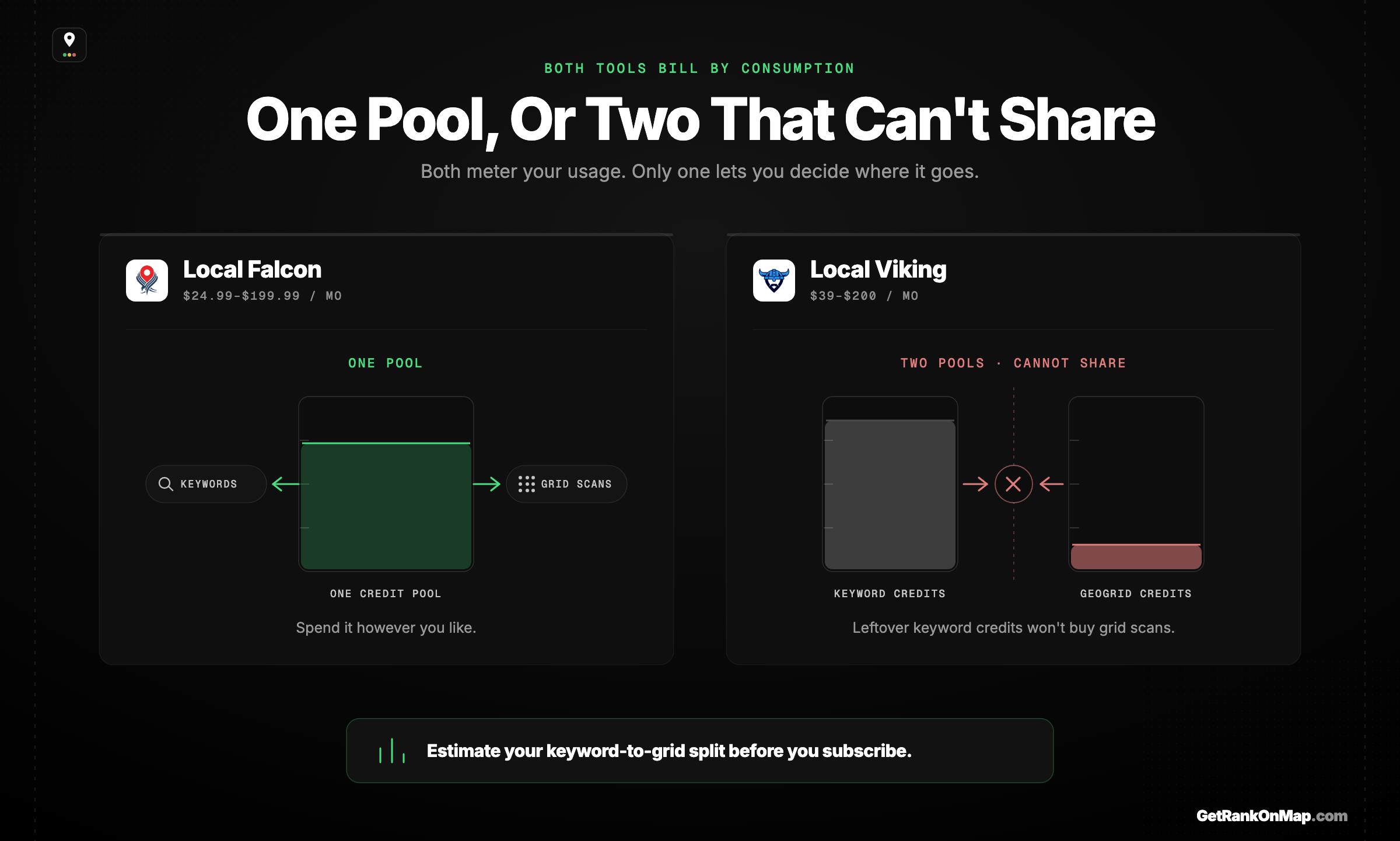
- **Local Falcon runs one credit pool. Local Viking runs two** — keyword credits and GeoGrid credits, metered separately, with no way to move value between them.
- Local Falcon is a **measurement instrument**: scan-on-demand grid audits, published from $24.99/month, grids from 3×3 to 17×17. Local Viking is a **GBP workbench** with grid tracking attached, published from $39 to $200/month.
- If you only want the heatmap, Local Falcon is the more direct purchase. If posting to Google Business Profile is part of your week, Local Viking earns the difference.
---
## The Name Thing, First
Load `localviking.com/pricing/` in a browser today and the page renders under the brand **Local Optics**. The marketing pages still carry the LocalViking name. That is what the pricing page showed on 2 August 2026.
We can't tell you from outside whether that's a completed rebrand, one in progress, or two products sharing a domain. What we can tell you is that if you're evaluating this tool you should expect to see a name you didn't search for, and that articles reprinting "Local Viking's plans" from older sources may be describing a package that's since been repackaged.
We'll use "Local Viking" below, because that's the name in circulation and the one you searched for.
## Two Metered Tools, Two Different Meters
Infographic showcasing Local Falcon's single credit pool against Local Viking's two pools that cannot share value.
Most comparisons in local SEO tooling are settled by the billing unit — one vendor charges per location, another per scan, and the arithmetic decides before you've read a feature list.
This pairing is unusual because **both meter by consumption**. Neither charges you per location. In both cases your bill is a function of how much you look, not how many businesses you own. So the usual shortcut doesn't work, and you have to look at how each meter is built.
### Local Falcon: one pool, spend it how you like
Local Falcon's published plans start at **$24.99 per month** and rise through tiers to **$199.99**, with annual billing offered at a discount, read from [its own pricing page](https://www.localfalcon.com/pricing) on 2 August 2026. Documented grid sizes run **3×3 to 17×17**.
The model is straightforward: you have credits, scans consume them, bigger grids consume more. If you want to spend your entire allowance on one enormous grid or on fifty small ones, that's your call. The pool doesn't care what you spend it on.
### Local Viking: two pools, and they don't share
[Local Viking's published plans](https://localviking.com/pricing/), read the same day:
| Plan | Price | GMB listings | Keyword credits | GeoGrid credits |
|---|---|---|---|---|
| Single | $39/mo | 1 | 1,600 | 7,500 |
| Starter | $59/mo | 10 | 3,200 | 8,100 |
| Pro | $99/mo | 20 | 5,600 | 16,200 |
| — | $149/mo | — | 17,700 | 24,300 |
| — | $200/mo | — | 26,600 | 32,400 |
Look at the last two columns. **Keyword credits and GeoGrid credits are separate**, and value doesn't move between them.
That's the single most consequential difference between these two products. If your work is grid-heavy and keyword-light, you'll exhaust the GeoGrid pool while thousands of keyword credits sit idle — and you'll be topping up one while wasting the other, every month, structurally. The plan works well if your usage happens to match the ratio it was designed around, and works badly in direct proportion to how far you sit from it.
Before you subscribe to Local Viking, estimate your own split. It's the arithmetic most likely to change your mind, and it takes five minutes.
## Instrument vs Workbench
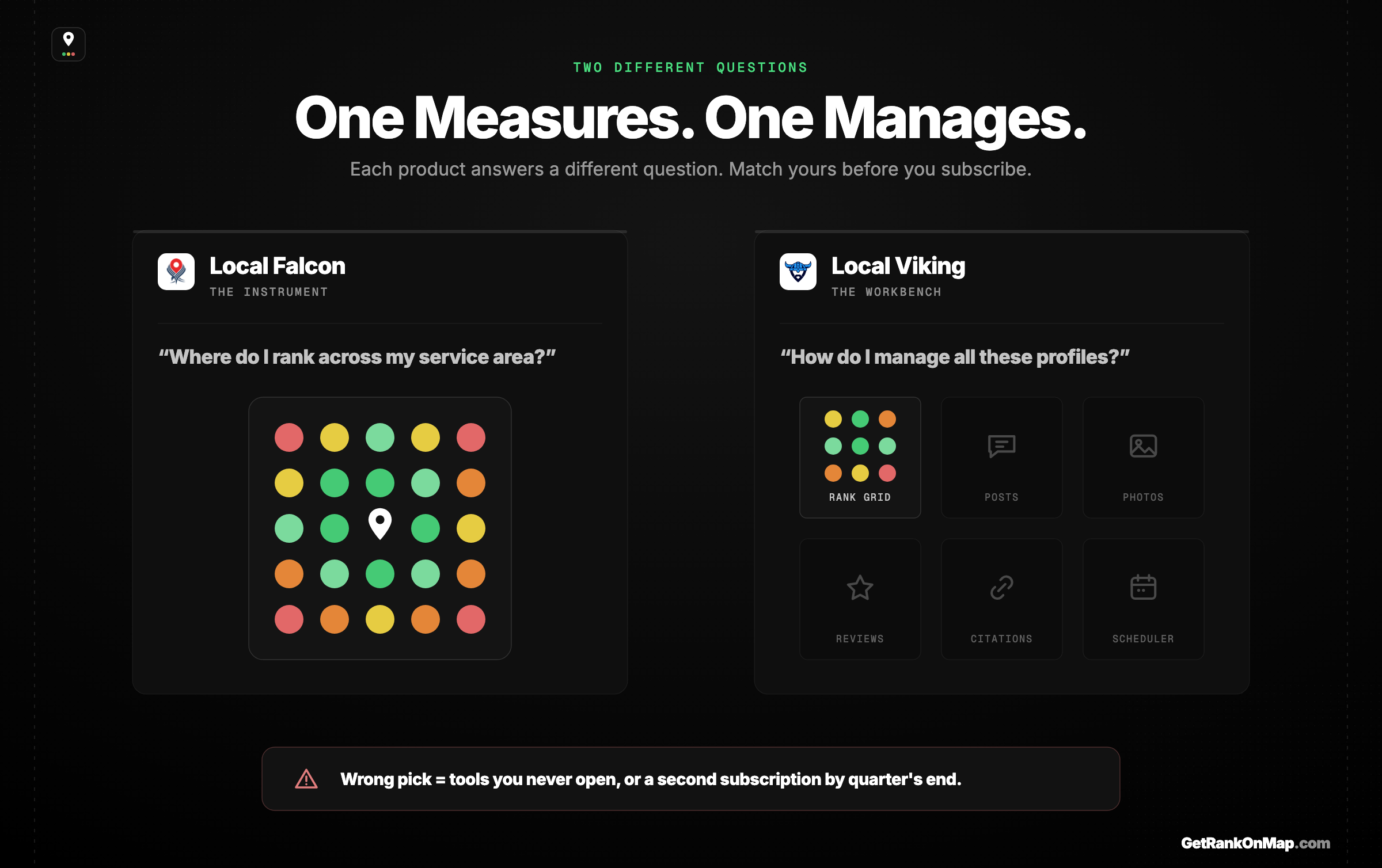
Infographic showcasing Local Falcon as a measurement instrument against Local Viking as a profile management workbench.
Billing aside, the two products have different centres of gravity, and that's the other half of the decision.
**Local Falcon is a measurement instrument.** Its purpose is to run a grid and show you a heatmap. It doesn't manage your Google Business Profile, doesn't build citations, doesn't produce your monthly client deck. What it does, it does as the main event — and that focus is why it's the tool most often recommended when someone specifically wants to *see* where they rank.
**Local Viking is a GBP workbench with a grid attached.** Posting, scheduling and managing Google Business Profile is core to it, with grid tracking as a first-class feature rather than an add-on. If profile management is genuinely part of your weekly routine, you're getting two jobs from one subscription.
Neither framing is better. They answer different questions:
- *"Where do I rank across my service area?"* → instrument.
- *"How do I manage these profiles and also see where they rank?"* → workbench.
Buying the workbench when you needed the instrument means paying for posting tools you never open. Buying the instrument when you needed the workbench means you'll be back for a second subscription within a quarter.
## Grid Capability, Compared Honestly
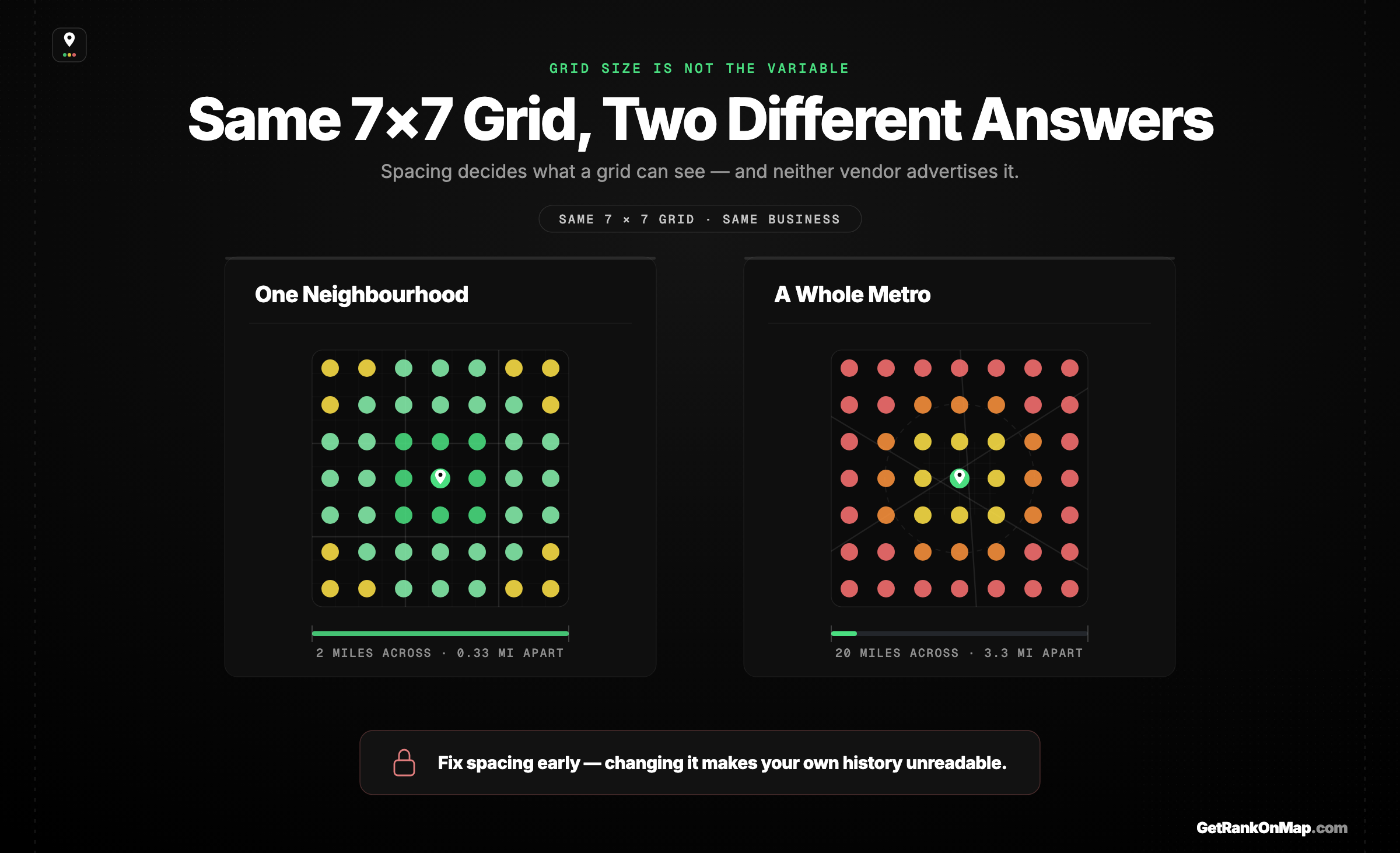
Infographic showcasing how grid spacing changes a measurement even when grid size stays the same.
Both draw grids. Both let you configure size. Local Falcon's published range runs 3×3 to 17×17.
The variable that matters more than either tool advertises is **spacing** — the physical distance between pins. A 7×7 grid across two miles is a dense read of one neighbourhood; the same 7×7 across twenty miles samples a metro area coarsely. Identical grid size, identical cost, completely different measurement.
Whatever you pick, fix your spacing early and leave it alone. Changing it mid-stream makes your own history uninterpretable, and it's the most common reason people conclude a tool is inaccurate when the tool is fine. If the underlying concept is new, [what GeoGrid rank tracking is](https://getrankonmap.com/blog/what-is-geogrid-rank-tracking) covers it properly, and [how far your ranking actually reaches](https://getrankonmap.com/blog/how-far-does-my-google-maps-ranking-reach) shows what the variation looks like in practice.
One more shared caution: both tools will compress a grid into a summary score so you have something to trend. Those scores are proprietary and not comparable between products — a 42 in one means nothing in the other. Worse, averaging hundreds of pins into one figure can hide a red zone on one side of your service area entirely, which is exactly the failure [a single rank number](https://getrankonmap.com/blog/one-rank-number-lies) produces and the grid was bought to prevent. Use the score for direction; read the map for decisions.
## Which One Fits Your Week
**Pick Local Falcon** if the heatmap is what you came for, if you run occasional deep audits rather than constant monitoring, if you want a single credit pool you can spend freely, or if you're an SEO who already has profile management handled elsewhere.
**Pick Local Viking** if GBP posting and scheduling is real work in your week, if you manage a number of listings and want them in one place, and if your keyword-to-grid usage ratio actually fits one of the published plans.
**Pick neither** if you need citations, reviews or white-label client reporting — those are suite jobs, and both of these will leave you buying a second product. We've compared [BrightLocal and Local Viking](https://getrankonmap.com/blog/brightlocal-vs-local-viking) and [Local Falcon and BrightLocal](https://getrankonmap.com/blog/local-falcon-vs-brightlocal) for readers going that direction, and if you've already ruled one out, there are dedicated pieces on [Local Falcon alternatives](https://getrankonmap.com/blog/local-falcon-alternative) and [Local Viking alternatives](https://getrankonmap.com/blog/local-viking-alternative).
## The Ten-Minute Version
This comparison usually gets written as a feature contest, and the features are genuinely close enough that the contest ends in a shrug.
The two things that actually separate these products are simpler. One meters you from a single pool you can spend however you like; the other splits your allowance in two and won't let the halves help each other. And one is built to measure while the other is built to manage, with measurement included.
Work out your keyword-to-grid ratio and answer the instrument-or-workbench question, and this decides itself in about ten minutes. Skip that and you'll spend an hour on comparison tables and still be guessing.
Our disclosure, as everywhere on this site: RankMap is building a GeoGrid tracker and is pre-launch, so we compete with both of these and we're not neutral. You have a decision to make now and it shouldn't wait on us. But if you want to see what we're building when it's ready, [join the early-access waitlist](https://getrankonmap.com/waitlist).