# Local Keyword Research: Volume Is the Wrong Metric
URL: https://www.getrankonmap.com/blog/local-keyword-research
Published: 2026-07-21
## Why Volume Misleads Here
* **Most local keyword research is national keyword research with a city name bolted on** — find terms, sort by volume, pick the biggest, add "near me" and a place name. It imports an assumption that doesn't hold locally
* **The imported assumption is that a keyword has one value** — nationally, ranking for a term is roughly a single fact. Locally it isn't: [your position changes across your area](https://getrankonmap.com/blog/why-google-maps-ranking-varies-by-location), so the same keyword is worth different amounts in different places
* **A keyword you win across your whole catchment can beat a higher-volume one you win only at your door** — the second looks better in a research tool and delivers less
* **Volume tells you how often a term is searched, not how much of it you can capture** — locally, the capturable share depends on how far your ranking [reaches](https://getrankonmap.com/blog/how-far-does-my-google-maps-ranking-reach)
* **"Near me" isn't a keyword to target so much as a behaviour to understand** — the phrase is a signal that Google should localise, and it collapses into the same map problem
* **Keyword research and geography are one problem in local search** — every guide treats them as sequential steps, and that's the error
Local keyword research guides are plentiful and largely consistent. Brainstorm seed terms, expand them with a tool, filter by search volume and difficulty, add location modifiers, group by intent, done. It's a sound process, and it's borrowed wholesale from national SEO — which is where the problem starts. The process assumes a keyword has a value you can look up. In local search it doesn't, and building a keyword list as though it does is how businesses end up targeting terms that look strong in a spreadsheet and deliver very little.
## The Assumption Local Search Breaks
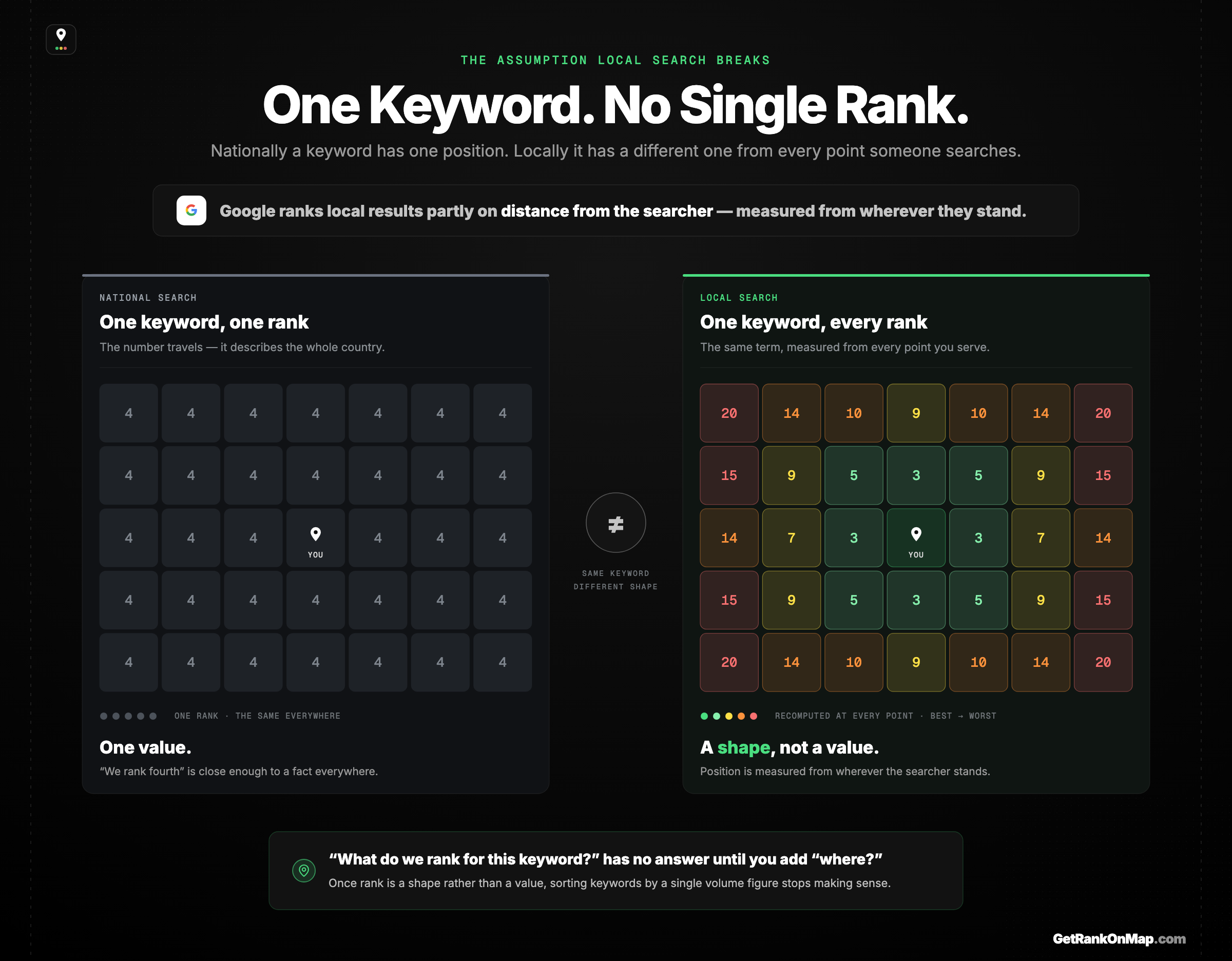
Nationally a keyword has one rank. Locally it has a different rank from every point someone searches.
> In national search, "we rank fourth for this term" is close enough to a fact. In local search it's meaningless without a location attached, because the answer changes continuously across your area — which means a keyword's value changes too.
National keyword research works because ranking is roughly a single value. If you rank fourth for a term, you rank fourth — near enough, for most purposes, everywhere. So volume is a reasonable proxy for opportunity: more searches, more available traffic, more reason to target it.
Local search doesn't behave that way. [Google ranks local results partly on distance from the searcher](https://support.google.com/business/answer/7091?hl=en), measured from wherever that person is. So your position for a single term isn't one number — it's a different number for every place someone might search from. Strong near you, weaker further out, gone past a certain point.
Which means the question "what do we rank for this keyword?" has no answer until you add "where?" And the follow-on question — "what is this keyword worth to us?" — has no answer either, for the same reason. It's worth a great deal in the area where you actually win it, and nothing at all beyond that.
This is [the single-number problem](https://getrankonmap.com/blog/one-rank-number-lies) applied to keyword selection. Once a keyword's ranking is a shape rather than a value, valuing your keywords by a single volume figure stops making sense.
## Volume Tells You About Demand, Not About Your Share
Volume x the share of your area you can hold it across — not volume alone.
> Search volume measures how often a term is searched in a market. It says nothing about how much of that market your business can realistically appear in — and locally, that share is set by geography.
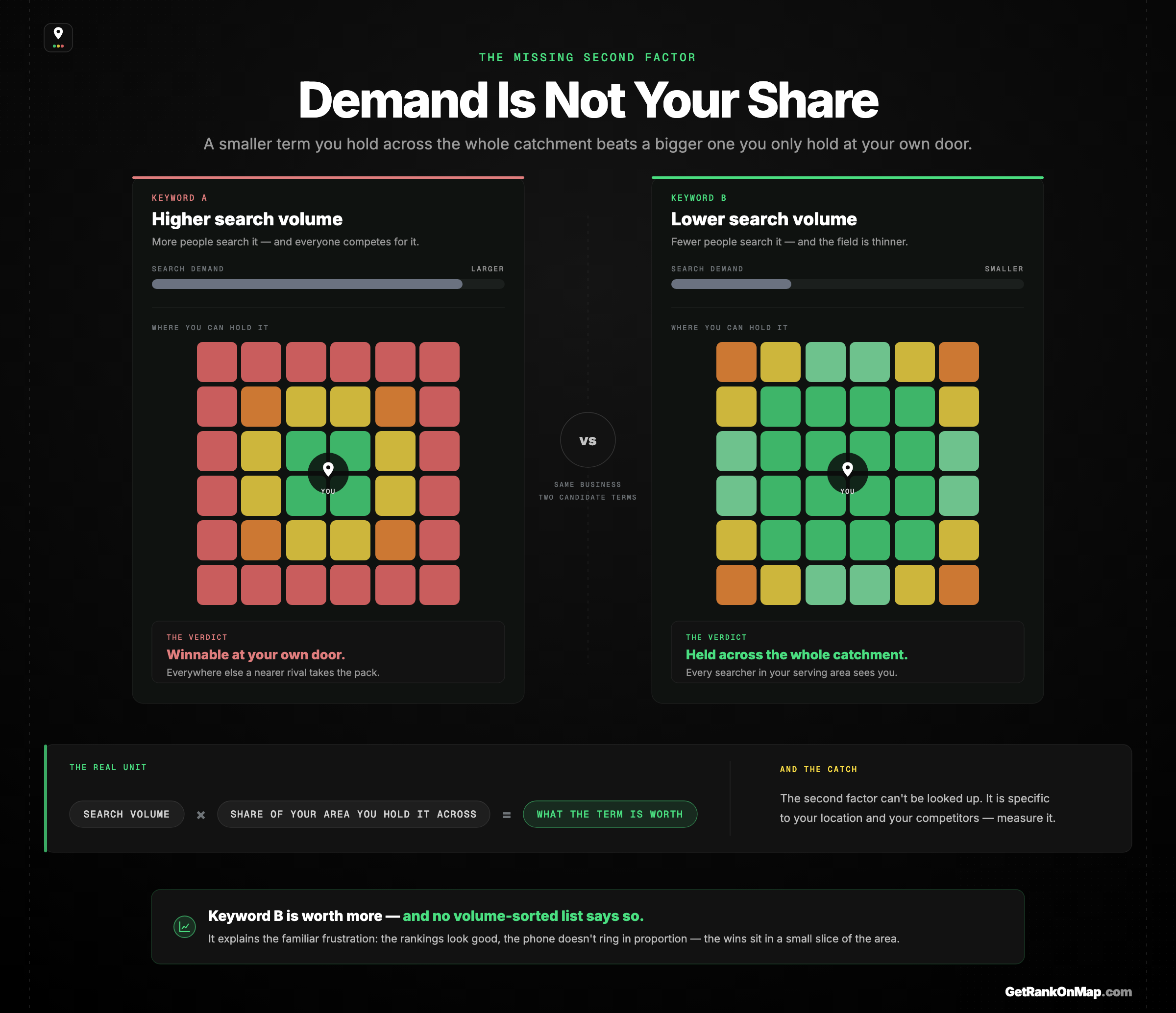
Imagine two terms. One has substantially more monthly searches than the other. Standard research says target the bigger one.
Now add the geography. The high-volume term is competitive, and the competition is concentrated near you — several strong businesses hold it in the dense part of your area. You can win it immediately around your own location and nowhere else. The lower-volume term is one you hold comfortably across your entire catchment.
Which is worth more? Almost certainly the second, and no volume-sorted list will ever tell you that. Its searches are spread across your whole serving area and you capture them. The first term's searches are mostly happening in places where you don't appear.
The useful unit for a local keyword isn't its volume. It's **volume × the proportion of your serving area where you can actually hold a position for it.** You can't look the second factor up — it's specific to you, your location and your competitors. It has to be measured.
This also explains a familiar frustration: a business follows a well-built keyword list, ranks respectably for the terms on it, and the phone doesn't ring proportionally. The rankings are real. They're just concentrated in a small part of the area the business hoped to serve.
## What Actually Makes a Local Keyword Worth Targeting
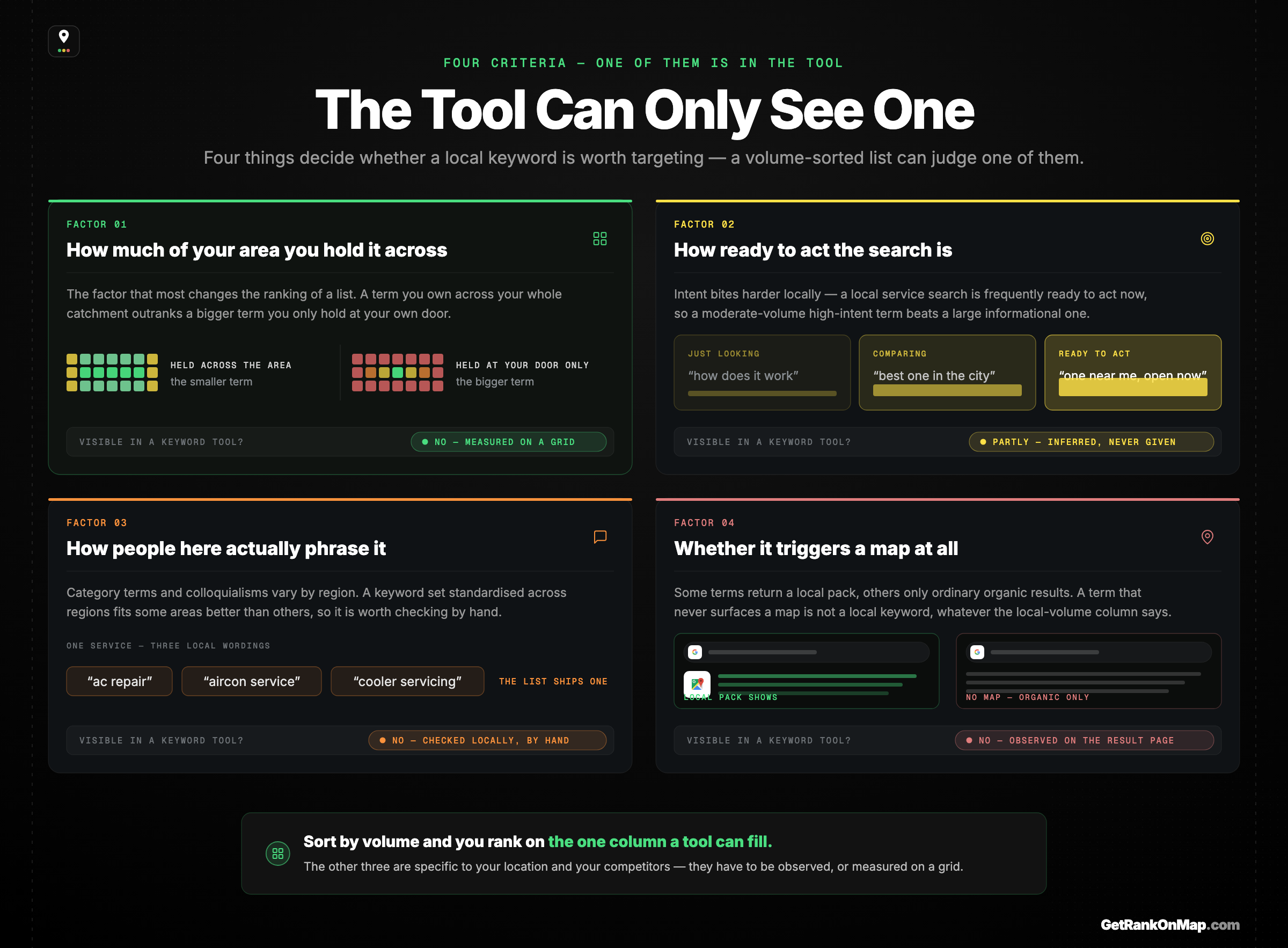
Four factors decide a local keyword's worth. Only one of them shows up in a keyword tool.
> Four things, and only one of them appears in a keyword tool: how far you can hold it, how commercially serious it is, whether it matches how people locally actually speak, and whether it triggers a map at all.
**How much of your area you can hold it across.** The factor above, and the one that most changes the ranking of a keyword list. A term you own across your catchment outranks a bigger term you own at your door.
**Commercial intent.** Standard advice, but it bites harder locally. Someone searching a service term with local intent is frequently ready to act now. A moderate-volume term with strong intent will usually outperform a large informational one.
**How people locally actually phrase it.** Search language isn't uniform across regions. Category terms, colloquialisms and even the words used for the service itself vary, and a keyword set standardised across regions will fit some areas better than others. This is one of the few things worth checking manually — what do people here actually call this?
**Whether it triggers a map at all.** Some terms return a [local pack](https://getrankonmap.com/blog/how-to-rank-in-the-google-map-pack); others return ordinary organic results. They're [different surfaces with different ranking behaviour](https://getrankonmap.com/blog/google-search-vs-google-maps-ranking), and a term that never surfaces a map isn't a local keyword at all, whatever a tool's local volume column says. Check the actual result before committing to a term.
## How "Near Me" Actually Works
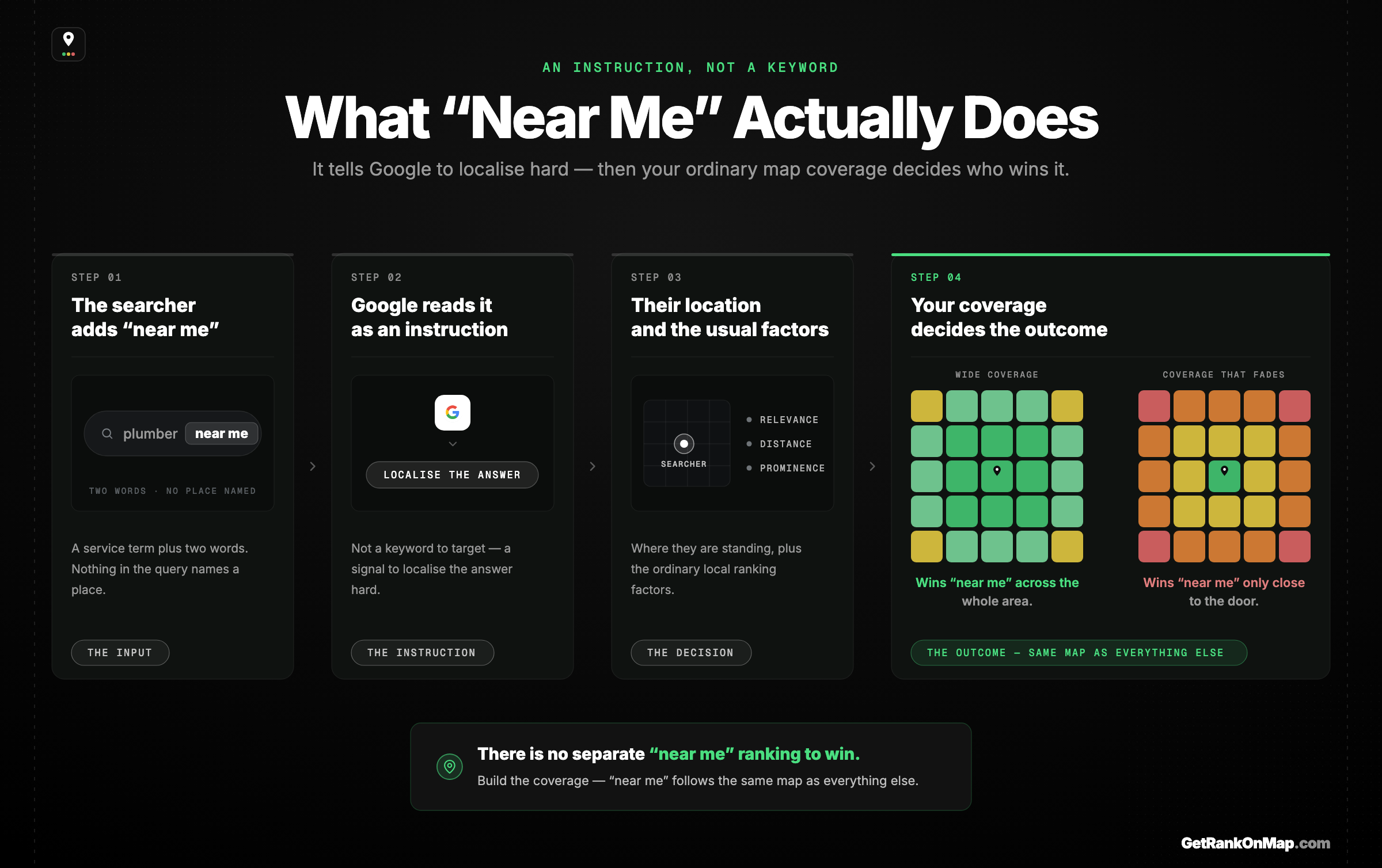
"Near me" isn't a keyword to win. It's an instruction to localise — after which your ordinary map coverage decides the result.
> "Near me" isn't a keyword you optimise for directly. It's a signal to Google that the searcher wants a localised answer — and once localised, the result depends on where they are. It collapses into the same geography problem.
"Near me" terms come up in every local keyword guide, usually with advice to target them explicitly.
Treat the phrase for what it is. Adding "near me" tells Google to localise the answer strongly. The results are then determined by the searcher's location and the usual local factors. There's no separate "near me" ranking to win — there's your ordinary local ranking, evaluated from wherever that person happens to be standing.
Which means "near me" performance isn't a keyword problem at all. It's the same question again: how far does your visibility extend? A business that appears strongly across a wide area does well on "near me" searches throughout that area, automatically. A business whose visibility fades quickly does well on them only close by. Neither outcome is changed much by putting the phrase in your content.
The practical read: don't build a separate strategy for "near me". Build the visibility, and the "near me" searches follow the same map as everything else.
## A Local-First Research Process
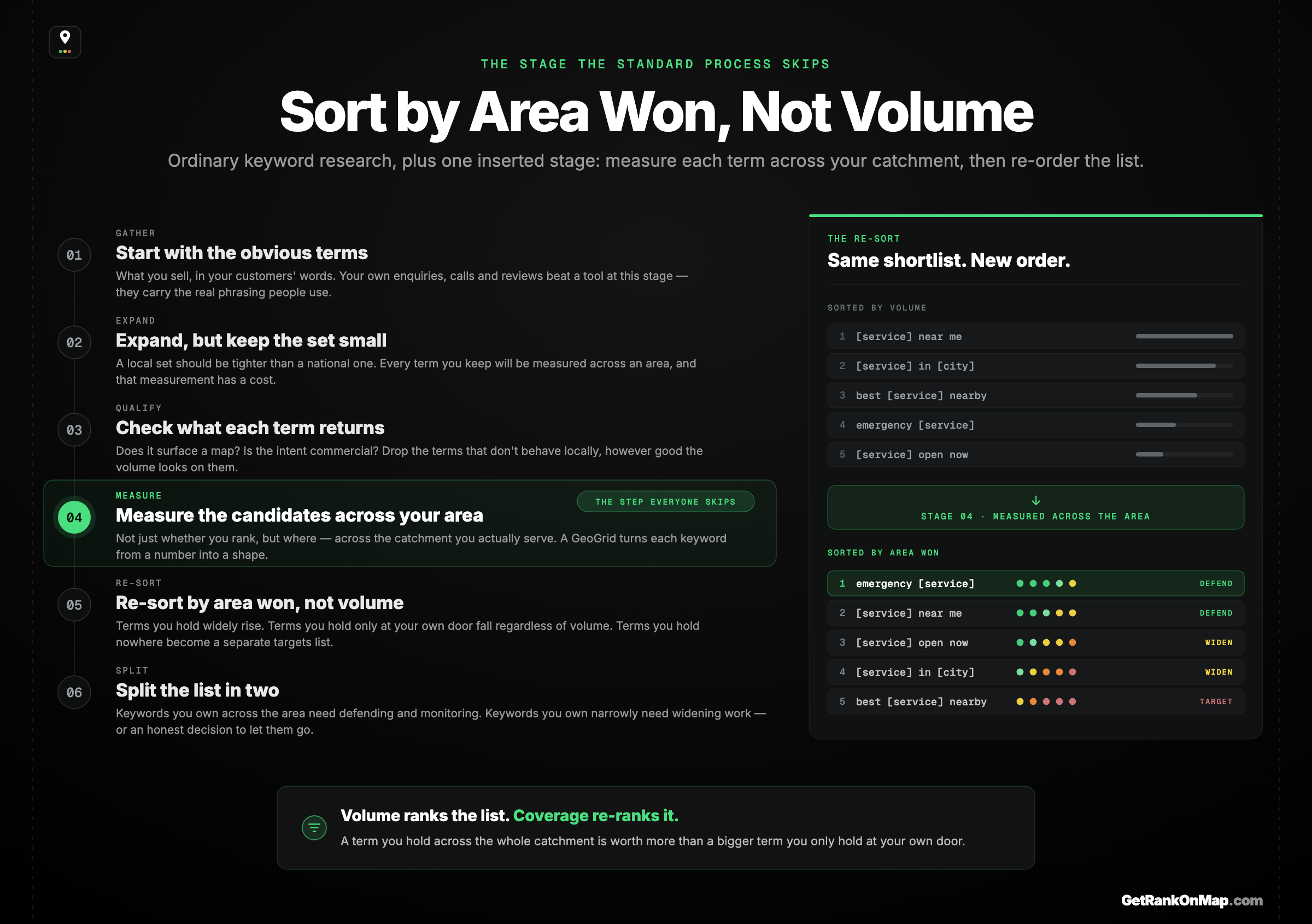
The ordinary process, plus the stage everyone omits — measure each term across your area, then re-sort.
> Same first steps as any keyword research — then one extra stage that changes the ranking of the entire list: measure where you can actually hold each candidate term across your area, and re-sort by that.
**Start with the obvious terms.** What you sell, in the words customers use. Your own enquiries, calls and reviews are better sources than a tool at this stage, because they contain real phrasing.
**Expand, but keep it small.** Local sets should be tighter than national ones. A handful of genuinely relevant service terms plus their realistic variants beats a list of hundreds, because you'll be measuring each one across an area and that has a cost.
**Check what each term actually returns.** Does it surface a map? Is the intent commercial? Drop terms that don't behave locally, however good their volume looks.
**Then measure the candidates across your area.** The step everyone omits. For each shortlisted term, establish not just whether you rank but where — across the catchment you're trying to serve. Measuring across a spread of points rather than from one is what a [GeoGrid](https://getrankonmap.com/blog/what-is-geogrid-rank-tracking) does, and it turns each keyword from a number into a shape.
**Re-sort by area won, not volume.** This is where the list changes. Terms you hold widely rise. Terms you hold only at your door fall, regardless of volume. Terms you hold nowhere become a separate list — targets, not assets.
**Split the list in two.** Keywords you already own across your area need defending and monitoring. Keywords you own narrowly need either the work to widen them or an honest decision to let them go. These are different jobs and shouldn't sit in the same spreadsheet.
## What a Local Keyword Rank Checker Can and Can't Tell You
> A keyword tool and a rank checker answer different halves of this. The keyword tool tells you what people search. The rank checker tells you where you stand for it. For local terms, the second half is where most tools quietly give you a national answer to a local question.
Both instruments are worth having, and both have a specific blind spot here.
**Local SEO keyword tools** report volume for a term across a country or a region. That's the number this whole page argues against reading too literally — it describes total demand, not the demand inside your catchment, and it has no idea how many of those searches happen close enough to you to be winnable.
**Keyword rank checkers** report your position for a term. For an organic result that's a fair summary. For anything that returns a map pack it isn't, because the answer changes with where the query is asked from. A checker that reports "position 4" for a local term is reporting position 4 at one unnamed point — usually a city centroid or the middle of a postcode. Your customers aren't standing there.
**The question that separates the two kinds of tool.** Ask what the tool samples from. A single location, however precisely named, gives you one reading. A grid of coordinates gives you a distribution, and a distribution is the only honest description of local visibility.
**What free checkers are genuinely good for.** Establishing whether you appear at all for a term before you invest in it. That's a yes/no question and one sample answers it. Deciding whether a keyword is worth targeting, or whether last month's work paid off, needs more than one point.
Use the keyword tool to build the candidate list. Use a grid to find out which of those candidates you can actually win in the area you serve — which, on a local term, is usually a much shorter list than the volume column suggests.
## Small Volumes, Real Customers
The reason borrowed keyword research underperforms locally isn't that the techniques are wrong. Seed terms, expansion, intent grouping — all fine. It's that the borrowed process ends with a list sorted by a metric that assumes something local search doesn't provide: that a keyword has one value, the same everywhere.
It doesn't. Locally, every keyword's value is bound to geography — the area across which you can actually hold it. Two terms with identical volume can be worth wildly different amounts to the same business, and the difference is invisible in every research tool because it depends on your location and your competitors rather than on the term.
So the extra stage is the one that matters: after you've built the shortlist the ordinary way, measure where each term actually holds across the area you serve, and re-sort by that. The list you get out is usually meaningfully different from the one you put in — and it's the one worth working from.
RankMap is being built to make that stage practical: mapping where you rank for each of your terms across your catchment, so you can value keywords by the ground they actually win. We're pre-launch; [join the early-access waitlist](https://getrankonmap.com/waitlist) for first access.