# How to Rank a Healthcare Business on Google Maps
URL: https://www.getrankonmap.com/blog/rank-healthcare-business-google-maps
Published: 2026-07-13
## What Patients Actually See
* **For healthcare, the Google Map Pack is the patient-acquisition surface** — "dentist near me," "urgent care near me," and "physio in [area]" are immediate, high-intent searches, and the local three-pack is what people act on
* **Google ranks local businesses on three factors** — [relevance, distance, and prominence](https://support.google.com/business/answer/7091?hl=en) — and for healthcare, **distance** carries unusual weight because patients overwhelmingly choose somewhere close and convenient
* **Trust is the ranking currency:** prominence is built largely on reviews and reputation, and for a health decision people lean on reviews harder than almost any other category — so review work is ranking work
* **Your Google Business Profile, not just your website, is the asset** — accurate categories, services, hours, and a complete profile are what put a clinic in the running for the pack
* **Multi-location practices rank per location** — each clinic, branch, or surgery has its own local ranking that changes by neighbourhood, so a group can't be tracked as a single number
* **Map Pack visibility for healthcare can only be read as a map, not a position** — because it [changes from neighbourhood to neighbourhood](https://getrankonmap.com/blog/why-google-maps-ranking-varies-by-location), the honest measure is coverage across your catchment, not one rank
When someone needs a dentist, a physiotherapist, or an urgent-care clinic, they rarely scroll. They search "near me," glance at the little map with three businesses on it, and pick from those — often within seconds. That box, the Map Pack, is where most local healthcare decisions are made, and where most local healthcare practices quietly lose patients they never knew were looking. This piece is about how a healthcare business actually earns a place in that box, why proximity and trust matter more here than in almost any other category, and why you can't know where you stand without seeing it as a map.
## Why the Map Pack Decides Where Patients Go
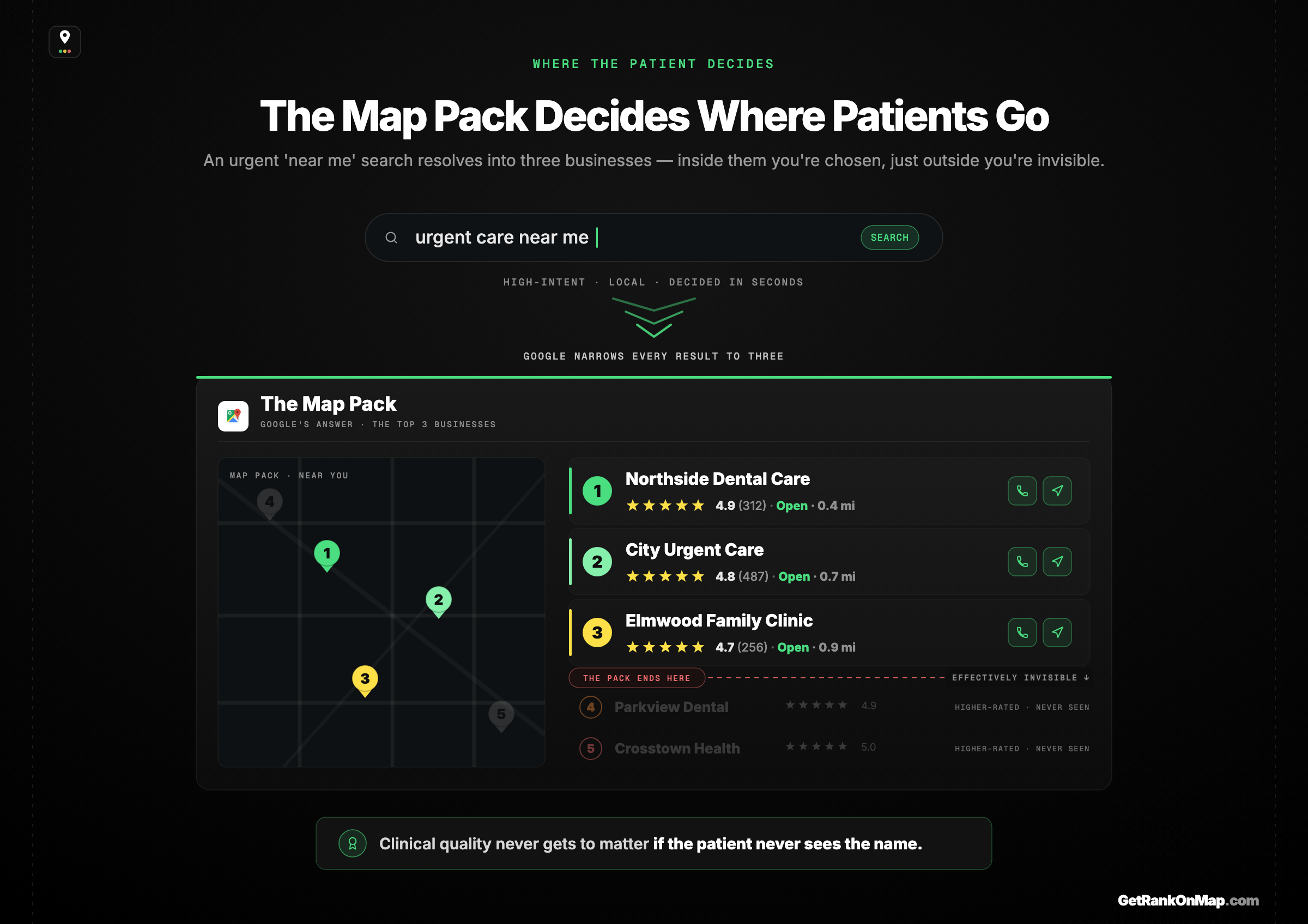
Health searches are local, urgent and action-driven — almost all of them funnel through the three-business Map Pack, not the organic links beneath it.
> Health searches are local, urgent, and action-oriented. People searching for care want somewhere near, open, and trusted — now. That behaviour funnels almost all of them through the Map Pack, the three-business local result, rather than the organic links beneath it. For a clinic, being in that pack is the difference between being considered and being invisible.
Think about how a real patient searches. They don't research for a week — they type "walk-in clinic near me" or "emergency dentist [town]," and they choose fast. What Google shows them at the top of that search is the **Map Pack**: a map with three businesses, their ratings, hours, and a tap-to-call or tap-for-directions button. It is built for exactly this moment — a local, immediate, "I need this near me" decision.
That's why, for healthcare, the Map Pack isn't one channel among many — it's usually *the* channel. A practice ranking in the local three for its core terms gets found, called, and visited. A practice sitting just outside it, in fourth or fifth, is effectively invisible at the instant the patient is choosing, no matter how good the care is. The clinical quality never gets a chance to matter if the patient never sees the name.
This is also why a beautiful website alone doesn't save you. The website is the organic-results game; the pack is a different competition with its own rules. Winning one [doesn't win the other](https://getrankonmap.com/blog/google-search-vs-google-maps-ranking). For patient acquisition, the pack is the one that pays the bills.
## Proximity Carries Extra Weight in Healthcare
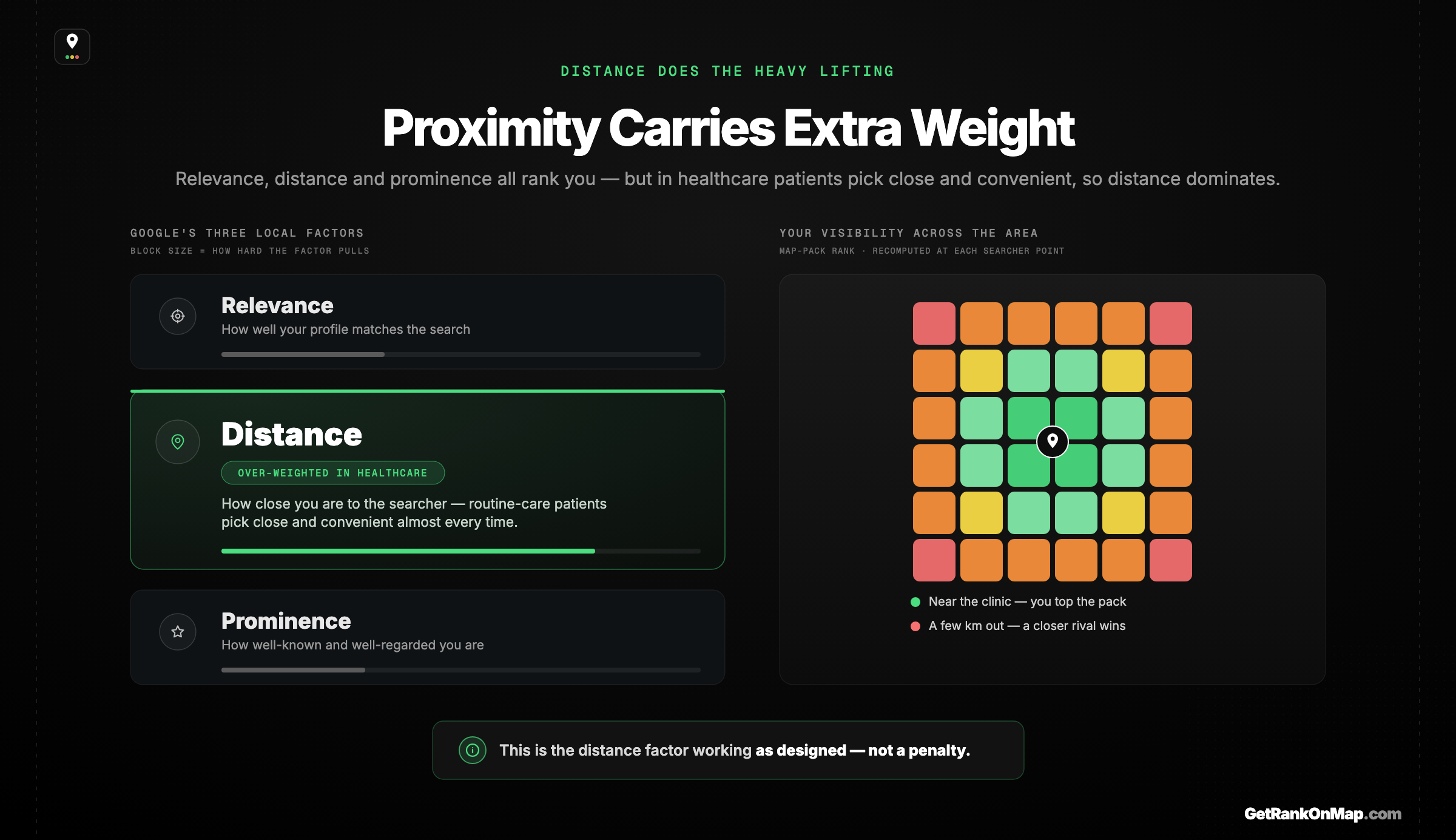
Relevance, distance and prominence all rank you — but in healthcare distance does the heaviest lifting, because patients pick close and convenient.
> Google ranks local results on relevance, distance, and prominence. In healthcare, distance does unusually heavy lifting, because patients self-select for convenience — they choose the clinic that's close and easy to reach. That makes your local ranking genuinely different from one neighbourhood to the next, more so than in categories where people will travel.
Google is open about how local ranking works: it weighs **relevance** (how well your profile matches the search), **distance** (how close you are to the searcher), and **prominence** (how established and well-reviewed you are). [The full breakdown of those factors is here.](https://getrankonmap.com/blog/google-maps-ranking-factors-2026)
For healthcare, distance is the factor to respect. People will drive across a city for a specialist they were referred to — but for routine care, a dentist, a GP, a physio, an optician, a walk-in clinic, they choose close and convenient almost every time. Google knows this, and it surfaces nearby options accordingly. The practical effect: your clinic might top the pack for searchers in its own neighbourhood and drop out of it entirely a few kilometres away, where a competitor is now the closer, more convenient option.
That isn't a glitch, and it isn't something you've done wrong — it's the distance factor working exactly as designed, and it's [why Maps ranking varies by location](https://getrankonmap.com/blog/why-google-maps-ranking-varies-by-location). For a healthcare business, it means your "ranking" isn't one fact. It's a different answer in every part of the area you serve, strongest near the clinic door and fading as you move away.
## Trust Is the Ranking Currency
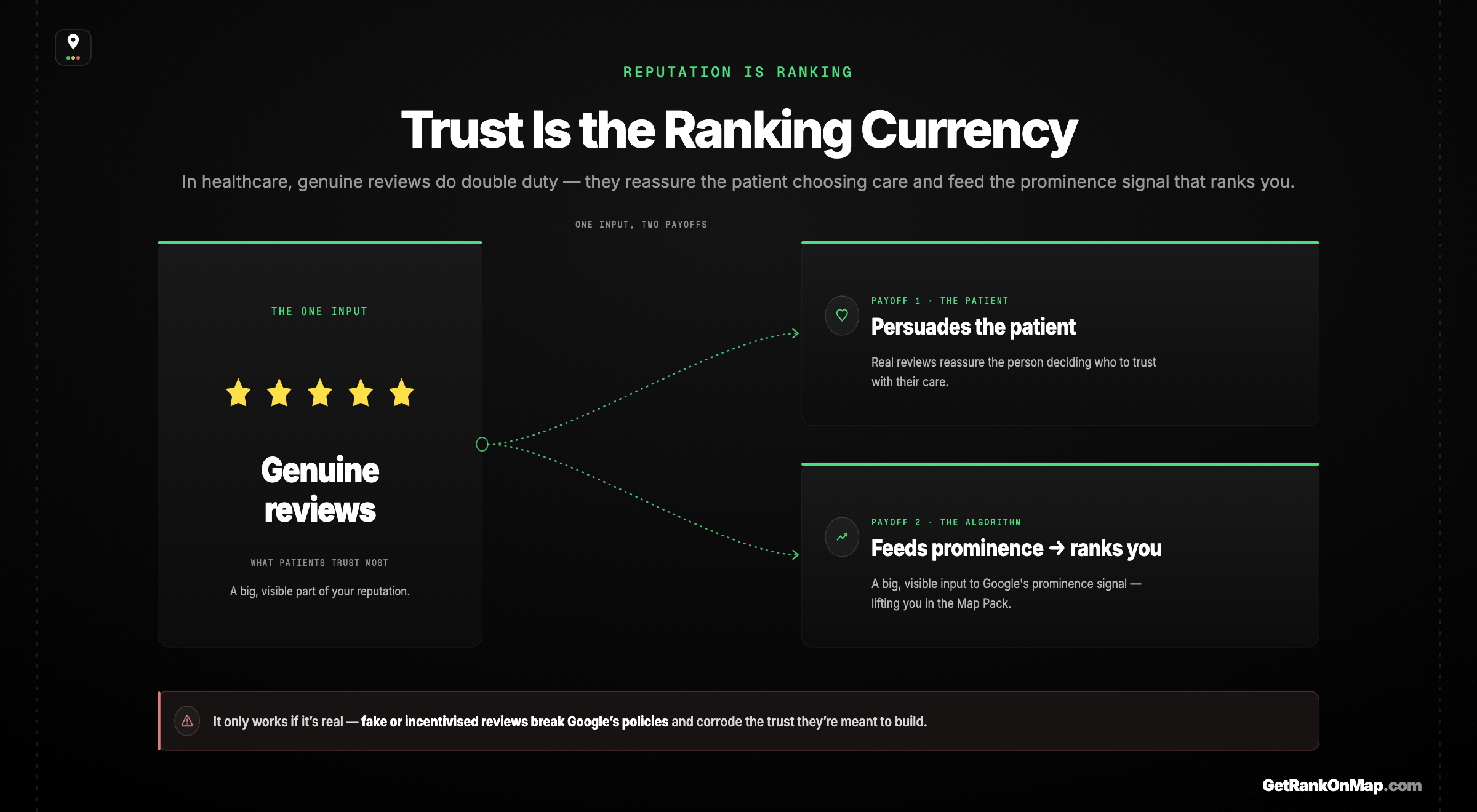
In healthcare, reviews pull two ropes at once: they reassure the patient choosing care and they feed the prominence signal that ranks you.
> Prominence — Google's third factor — is built largely on reviews and reputation. Healthcare is the category where people lean on reviews the hardest, because they're choosing who to trust with their health. That makes reviews do double duty: they persuade the patient and they feed the ranking. For a clinic, reputation work and ranking work are the same work.
The third local factor, prominence, is essentially how well-known and well-regarded your business is — and reviews are a big, visible part of how Google reads it. In most categories reviews matter; in healthcare they matter more, because the stakes of the choice are higher. A patient picking a clinic is deciding who to trust with their body, their child, or their parent, and they read reviews accordingly.
So for a healthcare practice, reviews pull two ropes at once. They reassure the human who's choosing — a strong, recent, responded-to review profile is often what tips someone toward your clinic over the one next to it. And they feed the prominence signal that helps you rank in the pack in the first place. Steadily earning genuine reviews, keeping your profile complete and accurate, and responding professionally isn't separate from SEO here. It *is* the local SEO.
The honest caveat: [ranking factors](/blog/google-maps-ranking-factors-2026) don't move on a fixed exchange rate, and you can't buy your way up with fake reviews — that's against Google's policies and corrodes the trust you're trying to build. The work is real reputation, earned over time. But in this vertical, that work is unusually well rewarded, because trust is exactly what Google is trying to surface for a health query.
## Multi-Location Practices Rank Per Location
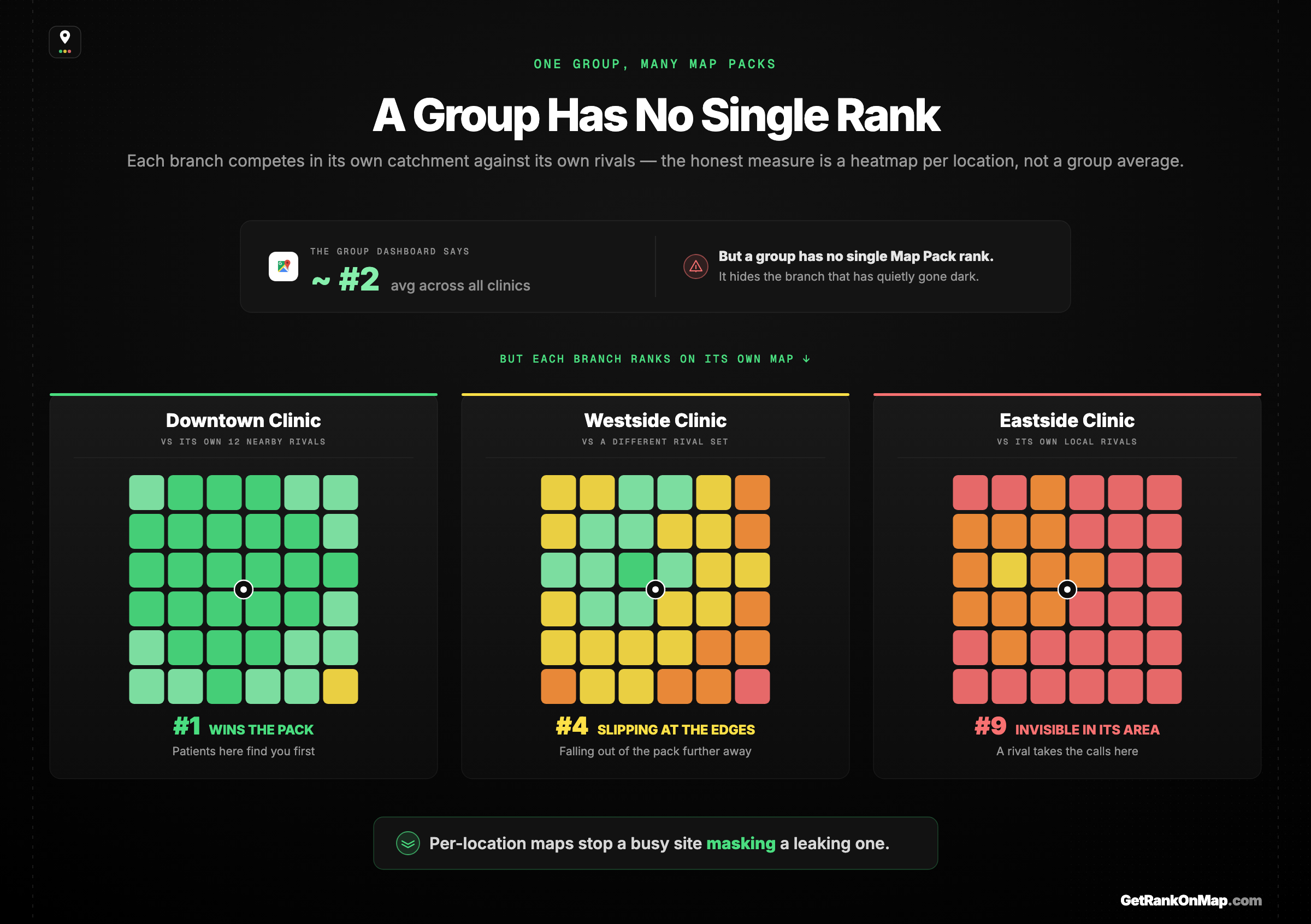
A group doesn't have one ranking — each branch ranks in its own catchment, so the honest measure is a heatmap per location, not a single number.
> A dental group, a physio chain, or a multi-site clinic doesn't have "a ranking." Each location has its own, anchored to its own address and its own neighbourhood of searchers. Rolling them into a single number hides the branches that are quietly underperforming in their own catchment — which is usually where the lost patients are.
If you run more than one site, the picture gets more important, not simpler. Because distance is measured from the searcher, each of your locations competes in its own local area against its own set of nearby rivals. Your flagship branch might dominate its neighbourhood while a newer site three suburbs over barely makes the pack in its own — and a single, group-level "how are we ranking?" will never show you that.
This is the trap for any growing practice: success at the busy location masks invisibility at the quiet one. The quiet branch isn't necessarily worse; it may simply be losing the local visibility contest in its own catchment, and no one can see it because the group's averages look fine. Each location needs to be looked at on its own ground, for its own searchers, the way patients actually experience it.
That's a measurement problem, and it's the one most multi-site healthcare businesses get wrong — they ask one question of a thing that has a different answer at every address.
## How to Actually Measure It: A Heatmap, Not a Position
So how should a healthcare business track where it really stands? Not with a single rank. Because Map Pack visibility changes across your catchment — strongest at the clinic, fading with distance, different at every branch — one position can't represent it. You'd be measuring a map with a thermometer.
The right tool is a **GeoGrid**: a grid of points laid across your [service area](/blog/local-seo-for-service-area-businesses), your Map Pack rank checked at each one, and the result drawn as a colour-coded heatmap — green where you're winning the pack, red where you've dropped out of it. [Here's how a GeoGrid scan works.](https://getrankonmap.com/blog/what-is-geogrid-rank-tracking) For a clinic, that map is the truth: it shows the neighbourhoods where patients can find you, the ones where a competitor is taking the calls you should be getting, and exactly how far your visibility reaches from your front door. For a group, it does the same for every location, so the quiet branch can't hide behind the busy one. [It's the surface where local patient decisions actually happen](https://getrankonmap.com/blog/why-your-google-maps-ranking-matters) — so it's the one worth measuring properly.
That's exactly what **RankMap** is built for: tracking your Map Pack visibility as real coverage across every neighbourhood you serve, the way local healthcare search actually behaves. **RankMap isn't live yet — we're pre-launch.** **[Join the waitlist](https://getrankonmap.com)** for early access and be first in line the day the map is ready.
## Conclusion
If spend is the blocker, start with [how to rank on Google Maps with no budget](/blog/rank-on-google-maps-no-budget).
For a healthcare business, the Google Map Pack isn't a vanity metric — it's where patients decide. Health searches are local, urgent, and trust-driven, which puts unusual weight on distance and reviews, and means your visibility is strongest at your door and different in every neighbourhood you serve. A single rank number can't capture that, and for a [multi-location](https://getrankonmap.com/blog/local-seo-for-multi-location-businesses) group it actively hides the branches that are losing patients in their own catchment.
The honest measure is coverage: a heatmap of where, across your whole service area, patients can actually find you in the pack — and where a competitor is quietly taking the calls. That's the gap **RankMap** is built to close, by tracking your Map Pack visibility the way local healthcare search really behaves. We're not live yet, but when we are, you'll see your clinic's local visibility as the map it always was. **[Join the waitlist](https://getrankonmap.com)** to be first in line.