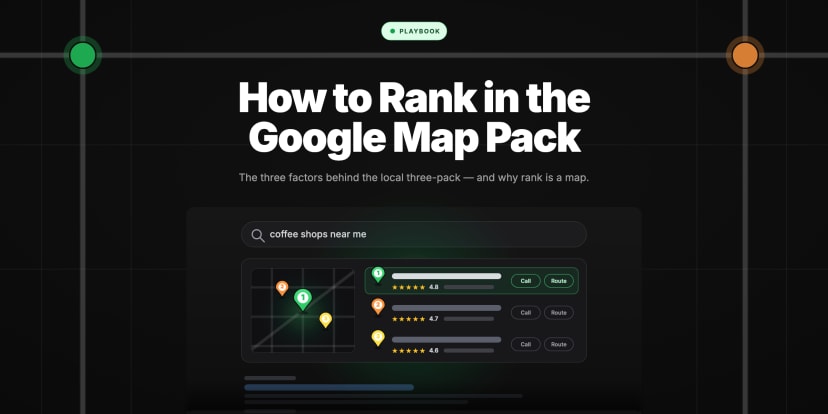
Local SEO Audit: The Step Almost Every Checklist Skips
A local SEO audit checks your inputs — profile, categories, citations. Almost none measure the outcome. How to run one that ends with visibility, mapped.

SummaryMost local SEO audits check inputs — categories, citations, NAP — then stop before measuring what those inputs produced. How to add the stage that ends with your actual visibility across the area you serve.
Read moreShow less
The Step Everyone Skips
-
Almost every local SEO audit is an input checklist — verify your details, check your categories, count your citations, review your profile. All necessary. None of it tells you whether any of it worked
-
An audit that never measures the outcome isn't an audit — it's an inventory of work performed, and it can come back completely clean while your visibility is poor
-
The missing final stage is measuring actual visibility across the area you serve — not whether the inputs are correct, but where you're genuinely appearing and where you aren't
-
Checking your ranking from one place doesn't count as measuring — a single check reports one point, and your visibility isn't one point, it's an area
-
The gap between the two halves is the actual finding — good inputs plus poor visibility means competition, not error, and that's a completely different action list from fixing a broken profile
-
Run it in two stages — inputs first, because they're cheap to fix; outcome second, because it tells you whether the inputs were ever the problem
Search for a local SEO audit and you'll find a great many checklists. They're mostly good, and they mostly agree: verify your business details are consistent, check your categories, audit your citations, review your profile completeness, look at your reviews, check your site's local pages. Work through one properly and you'll fix real problems. But notice what happens at the end. You finish the list, everything is ticked, and you still don't know the one thing you started the audit to find out — whether any of it is actually working.
What Most Local SEO Audits Actually Measure
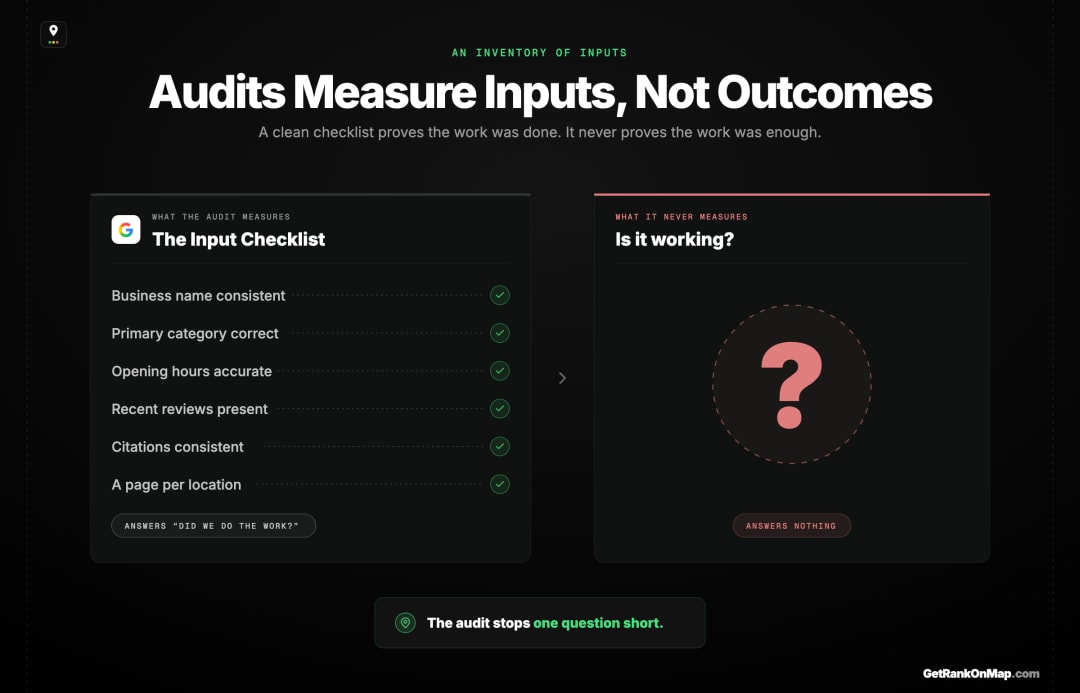
A checklist audit measures inputs: the things you control and have done. That's genuinely useful, and it's only half an audit. Inputs tell you whether the work was performed correctly — not whether it produced anything.
Every audit checklist is a list of inputs. Is the business name consistent everywhere? Is the primary category right? Are opening hours accurate? Are there enough recent reviews? Are citations consistent? Does the site have a proper page per location?
These are worth checking. Inputs are cheap to fix, and a genuinely broken input — a wrong category, an unverified profile, inconsistent details across directories — will hold you back regardless of anything else. Our profile optimisation checklist covers this stage properly, and you should run it.
But be clear about what a clean input audit does and doesn't prove. It proves the work was done correctly. It says nothing about whether it was enough. Two businesses can pass an identical checklist and have completely different visibility, because the checklist doesn't look at the thing that separates them: what everyone else nearby is doing, and how the map around them is shaped.
An audit that stops at inputs answers "did we do the work?" The question you actually have is "is it working?" Those aren't the same question, and one doesn't imply the other.
Why Inputs Can Be Perfect and Visibility Still Poor
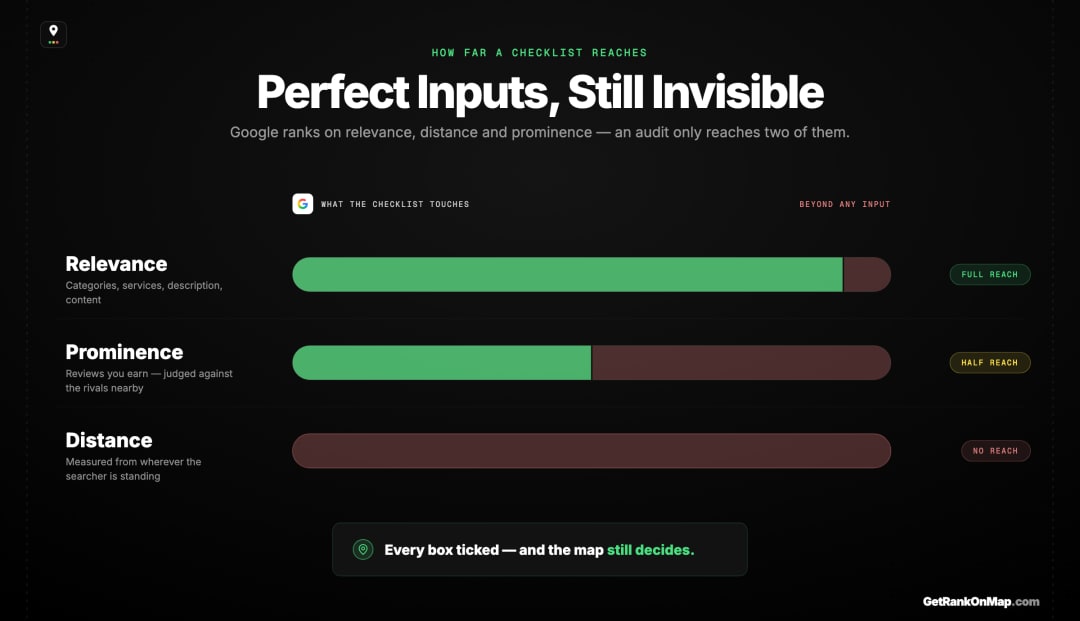
Google ranks local results on relevance, distance and prominence. A checklist audit can only reach the first — and part of the third. The rest is set by where you are and who else is nearby, and no amount of input work changes it.
Google's own explanation of local ranking rests on relevance, distance and prominence. Map an audit checklist onto those three and the limitation becomes obvious.
Relevance is largely yours. Categories, services, description, site content — the checklist reaches this well.
Distance is not yours at all. It's measured from wherever the searcher happens to be, and no input fixes it. Your visibility will always be strongest near you and weaker further out.
Prominence is partly yours and partly the market's. Reviews and reputation you influence. But prominence is judged relative to the alternatives nearby, and you don't control who those are or how strong they've become.
So a business with a flawless profile in a dense, competitive area can be genuinely hard to find a short distance away — not because anything is wrong, but because several strong rivals sit between it and the searcher. Nothing on a checklist detects this. Every box is ticked. The visibility still isn't there.
This is why input-only audits produce a frustrating outcome so often: the audit comes back clean, the recommendation is "keep going," and nobody can explain why the phone isn't ringing.
The Missing Stage: Audit the Outcome

The second half of an audit measures what the inputs produced — actual visibility across the area you serve. Not "do we rank?" but "where do we rank, how far does it extend, and where does it stop?"
The stage nearly every audit omits is measuring the result.
The reason it gets omitted isn't laziness — it's that it's genuinely harder than checking a box, and the obvious way of doing it doesn't work. Most people, asked to check their visibility, search for their own term and see where they come. That's a single reading from a single place, and it's the least reliable number in local SEO: personalised, dependent on where you happen to be standing, and describing one point in an area where the answer changes continuously.
What an outcome audit actually needs to establish:
Where you're genuinely visible. Not one position — the area across which you hold a strong position.
How far that extends. Your visibility radiates from your location and fades. The audit question is where the fade begins and where it cuts out entirely.
Whether that matches the area you serve. This is the finding that changes decisions. Most businesses assume a catchment considerably larger than the one they actually hold.
Who takes over past your edge. The competitors winning the searches just outside your reach are your real competitive set — often not the ones you'd have named.
Practically, this means measuring across a spread of points around your location rather than at one, which is what a GeoGrid does — sampling across an area and rendering the result as a map, so the shape of your visibility is visible rather than inferred.
Reading the Two Halves Together

The finding isn't in either half alone — it's in the relationship between them. Whether your inputs are clean or broken changes what poor visibility means, and completely changes what you should do about it.
Run both stages and you get one of four readings. This is the actual output of an audit.
Inputs broken, visibility poor. The straightforward case. Fix the inputs first — they're cheap, they're yours, and you can't diagnose anything else until they're clean. If a profile is unverified, miscategorised or not appearing at all, start there and re-measure afterwards.
Inputs clean, visibility poor. The most common surprise, and the one input-only audits can never produce. Nothing is broken; you're being out-competed. The action isn't fixing errors — it's building genuine prominence, or accepting a smaller realistic catchment and competing hard inside it. Completely different work, and you'd never have known from the checklist.
Inputs broken, visibility fine. You're carried by something else — an established reputation, a thin local market, a strong physical position. Fix the inputs anyway, because this is fragile, but it isn't urgent.
Inputs clean, visibility good. Verify it's good across the area you actually serve and not just near your door, which is the failure mode this reading hides. Then re-measure periodically, because it's a competitive position, not a permanent one.
Notice that the second reading — clean inputs, poor visibility — is both the most common real situation and the one no checklist audit can ever return. That's the whole argument for the outcome stage.
A Two-Stage Audit, in Order

Inputs first because they're cheap and unambiguous. Outcome second because it tells you whether the inputs were ever the constraint. Doing it in this order stops you optimising something that was never the problem.
Stage one — inputs. Work a checklist properly. Verify the profile is claimed and verified, the primary category is correct, details are consistent across directories, hours are accurate, reviews are current, and there's a real page per location on your site. Fix everything broken before measuring anything, so you're not diagnosing around a known fault.
Stage two — outcome. Measure visibility across the area you serve. Choose the terms that genuinely matter, then measure them across a spread of points around your location rather than from one. Note where you're strong, where you fade, and where you disappear.
Then read them together. Use the four-way reading above. The gap between "inputs correct" and "visibility achieved" is the finding — it tells you whether your constraint is execution or competition, and those demand different responses.
Re-measure on a sensible interval. Inputs change slowly and only when someone changes them. Outcome changes on its own, because competitors act, Google adjusts, and new businesses open nearby. An input audit is a periodic exercise; outcome is closer to a monitoring problem than an audit problem — which is the gap most local reporting leaves open.
What a Local SEO Audit Tool Does — and What It Leaves to You
Audit tools are good at stage one and mostly absent from stage two. They automate the input checklist — profile completeness, category selection, citation consistency, on-page signals — and then hand you a score. The score describes your inputs. It does not describe your visibility.
That's not a criticism of the category, it's a description of what these products are built to read. An input audit can be automated because inputs are single, checkable facts: the category either is right or it isn't, the phone number either matches across directories or it doesn't. Visibility can't be read the same way, because it has no single value — it changes with where the search happens.
What an audit tool reliably gives you. A consistency sweep across directories, missing or wrong profile fields, thin or absent location pages, technical problems on the site, and a review summary. Running one saves hours of manual checking and catches the broken input that was quietly costing you.
What it hands back to you. Whether any of it is enough. A tool can report a 92/100 and a clean citation profile for a business that appears in the map pack across three streets and nowhere else in its city. Both statements are true at once, and only one of them is the reason the phone isn't ringing.
On white-label audit reports. Most agency-facing tools sell the report as the deliverable — your logo, your colours, the client's name. That's a genuine time saving, and it inherits the same ceiling: a branded PDF full of green ticks is a stronger-looking document than an honest one that says the inputs are fine and the market is the problem. If you're sending audits to clients, the second half is what makes the report worth reading, because it's the half that says what to do next.
Use a tool for stage one. Do stage two with a grid, and put the grid in the report.
An Audit That Ends With an Answer
The reason local SEO audits so often feel unsatisfying isn't that the checklists are wrong. They're fine. It's that they stop one stage early — at the point where you've confirmed the work was done, and just before the point where you'd find out whether it produced anything.
Add that stage and the audit changes character. It stops being an inventory of tasks completed and becomes a genuine diagnosis: here's what we control and whether it's right, here's what we actually achieved, and here's the gap between them. The gap is the finding. It's what tells you whether you're facing an execution problem you can fix this week or a competitive problem that needs a different strategy entirely — a distinction no checklist can make.
RankMap is being built for the second half of that audit — mapping where you actually appear across the area you serve, so the outcome stage stops being the one everyone skips. We're pre-launch; join the early-access waitlist to be among the first to run it.
Start here: The Google 3-Pack: What It Is and How Businesses Get In — the full guide this page sits under.
Frequently asked questions
- 01What should a local SEO audit actually include?
- Two stages. An input review — profile verification, categories, detail consistency, reviews, citations, local landing pages — and an outcome measurement of your actual visibility across the area you serve. Most published checklists cover the first thoroughly and omit the second entirely.
- 02How often should I run a local SEO audit?
- The input half only needs revisiting periodically, or when something changes — new location, rebrand, category change. The outcome half benefits from being checked far more regularly, because it moves without you doing anything: competitors improve, new businesses open, and your visibility shifts in response.
- 03Can I audit my local SEO for free?
- The input stage, yes — it's mostly careful checking against your own profile and site. The outcome stage is where free approaches break down, because searching for yourself from your own device returns a personalised result from a single location, which isn't a measurement of anything.
- 04My audit came back clean but I'm still not getting found. Why?
- That's the clean-inputs-poor-visibility case, and it's common. A clean checklist means the work was done correctly, not that it was sufficient. Distance and relative prominence aren't things a checklist can reach, so if strong competitors sit between you and your searchers, you can do everything right and still be hard to find.
- 05What's the difference between a local SEO audit and a rank check?
- A rank check is one reading from one place at one moment. An audit is a structured review of your inputs plus a measurement of your visibility across an area. A rank check can be part of an audit, but on its own it's the single most misleading number in local SEO.
Explore with AI
Share this
Map your real rank across the city.
Free for the first 50 scans. No credit card.
Join the waitlist