Why a Competitor Outranks You With Worse Reviews
They have fewer reviews and a worse rating, and they're still above you. The usual answer isn't what you think, and it isn't really about reviews.
Why Reviews Aren't the Answer
- You are almost certainly not looking at one ranking. Google Maps produces a different result depending on where the person searching is standing — so "they're above me" is usually "they're above me from where I searched."
- Most owners check their ranking from inside their own business, which is the single least representative place to check it from.
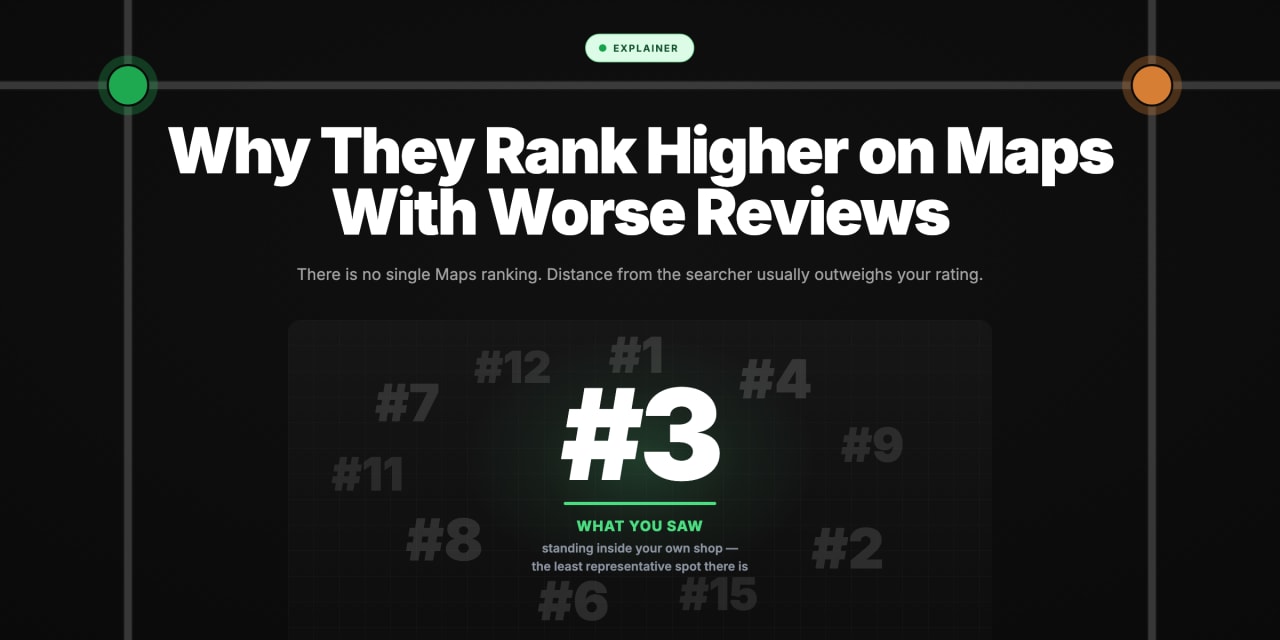
- Reviews matter, but they are one input among several and they are not the strongest one. Google weighs relevance, distance and prominence together, and distance from the searcher usually outweighs reviews.
- A competitor with a 4.1 and forty reviews can genuinely outrank a 4.9 with three hundred — if they're closer to the person searching, or if their profile matches the search more exactly.
- Before changing anything, find out whether you're actually losing everywhere or only in part of your area. Those are different problems with different fixes.
The Short Answer
You searched for something your business does. Your competitor came up above you. Their rating is lower than yours and they have fewer reviews, and it doesn't make sense.
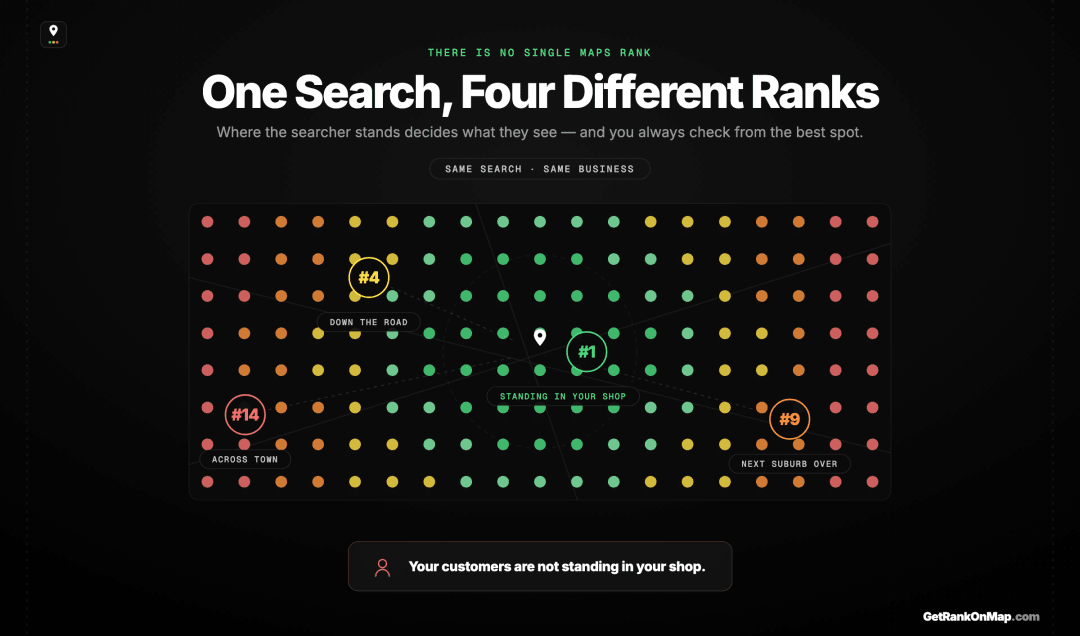
Here's the thing that resolves it for most people: there is no single Google Maps ranking to be above or below.
When someone searches on Maps, Google builds the results around where that person is at that moment. Someone standing two streets from you gets one set of results. Someone four miles away, searching the same words at the same second, gets a different set. Both are real. Neither is "the" ranking.
So when you look and see your competitor above you, what you've actually learned is that they're above you from the specific spot you were standing in when you checked. That's useful information. It just isn't the whole picture, and it's usually a much smaller piece of it than it feels like.
Why This Trips Almost Everyone Up
Here's the part that makes it worse: most owners check their ranking from inside their own business.
It's the natural thing to do. You're at work, you're curious, you pull out your phone. But your own premises is the least representative place you could possibly check from, because you are at the exact centre of your own service area. If there's one location on Earth where you should look strong, it's that one — and if a competitor beats you there, that's actually significant news.
Meanwhile, the customers you're worried about losing aren't standing in your shop. They're at home, at their office, in a car three miles away. And that's where you have no idea what's happening.
We wrote about how much a Maps ranking changes from place to place in more detail, because for most local businesses the swing is much wider than they expect — first place in one neighbourhood and nowhere at all in the next one over.
What Google Is Actually Weighing

Google has been fairly open that local results come down to three things. Understanding the order they tend to matter in explains most of what looks unfair.
1. Distance from the person searching
How close you are to whoever is doing the searching. This is frequently the heaviest factor, and it's the one you can do the least about.
If your competitor is physically nearer to the person searching, they have an advantage that no amount of review-gathering reliably overcomes. This is the single most common reason a business with worse reviews sits above one with better ones. It isn't a flaw in the system; it's the system working — someone searching for a plumber generally wants a nearby plumber more than they want a highly-rated plumber twenty minutes away.
2. How well you match what was searched
Whether your business genuinely matches the words typed. Your primary category, your secondary categories, the services listed on your profile, what your business actually says it does.
This is the most fixable of the three and the most commonly neglected. A competitor whose primary category is an exact match for the search will often beat a better-reviewed business whose category is close but not quite right. If you haven't looked at your own profile categories recently, that's the highest-return hour available to you — our Google Business Profile checklist walks through it.
3. How well-known you are
Reviews, yes — but also how much the wider internet talks about you. Mentions, links, citations, general presence. Reviews are part of this factor rather than the whole of it, which is why review count alone doesn't settle a ranking.
"But They Have Worse Reviews Than Me"
Right. And that's genuinely frustrating, so it's worth answering directly rather than deflecting. It is also one of the most repeated sentences in the owner rooms. A June 2026 thread put it in nine words:
A competitor with HALF the number of reviews is ranking above me in Google Maps.
r/GoogleMyBusiness, June 2026
Another, in August 2026, added the part that makes it feel unfair:
What's baffling is the number one spot is held by a business with significantly less reviews and a comparatively incomplete profile.
r/localseo, August 2026
Reviews do matter. They influence the third factor above, and they influence whether someone chooses you once they can see you. What they don't do is override the first two. A 4.1-star business with forty reviews that sits closer to the searcher and has a precisely matching category can legitimately outrank a 4.9-star business with three hundred reviews that's further away with a vaguer category.
There's a further wrinkle worth knowing: past a certain point, more reviews stop moving the needle much. The difference between five reviews and fifty is substantial. The difference between two hundred and three hundred is close to nothing, as far as ranking goes. If you've been grinding for review count as your main strategy and rankings haven't moved, this is probably why. We've written more on what reviews actually do for Maps ranking.
The short version: your reviews are working. They're just not the lever you think is stuck.
How to Find Out What's Really Happening
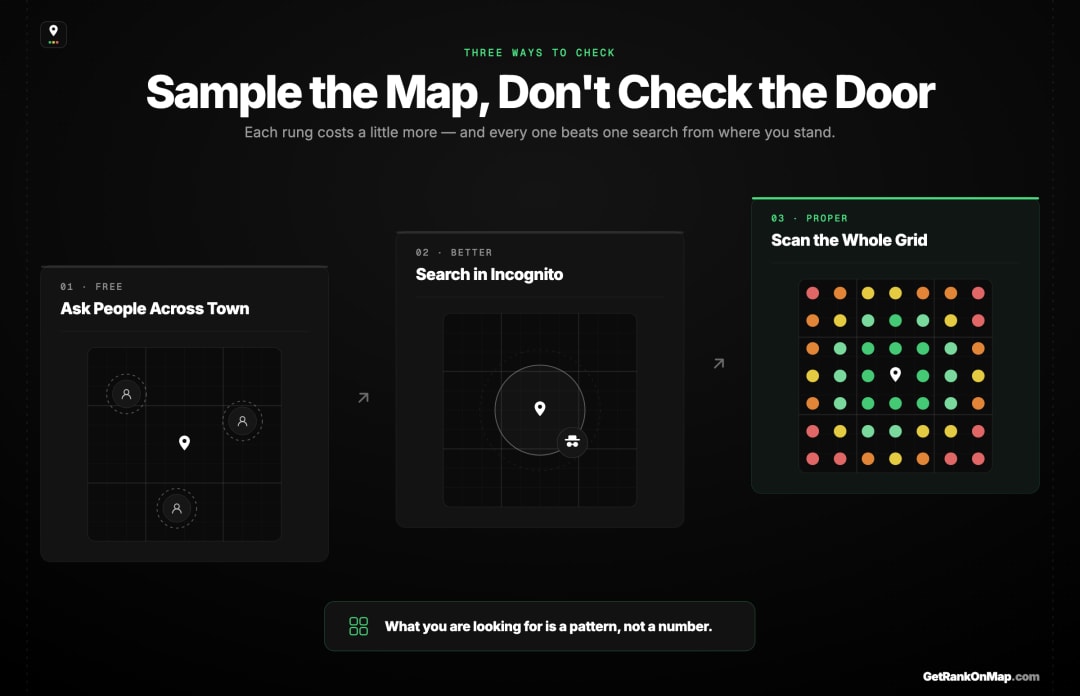
Before you change anything, find out whether you're losing everywhere or only somewhere. These are different problems and they have different answers.
The free version. Ask a few people in different parts of your area to search the term and screenshot what they see. A friend across town, a family member on the other side, someone near the edge of where you'd still travel. Compare. It's crude and it works, and it takes an afternoon.
The slightly better free version. Search in an incognito window rather than your normal browser, so your own history isn't shaping what comes back. It won't change your physical location, but it removes one layer of distortion. Our guide to checking a Maps ranking for free covers what's genuinely possible without paying.
The proper version. A grid-based tracker runs the same search automatically from dozens of coordinates around your business and shows you the result as a map — green where you're winning, red where you're not. That's what GeoGrid tracking is, and it's what turns "I think we're doing badly" into "we're invisible north of the river."
Whichever route you take, what you're looking for is a pattern. Are you strong near your premises and fading with distance — which is normal and expected? Or are you weak everywhere including nearby, which is a different and more urgent problem? Are you losing consistently to one competitor, or to different ones in different places? How far your ranking actually reaches is the shape you're trying to see.
What to Actually Do, in Order
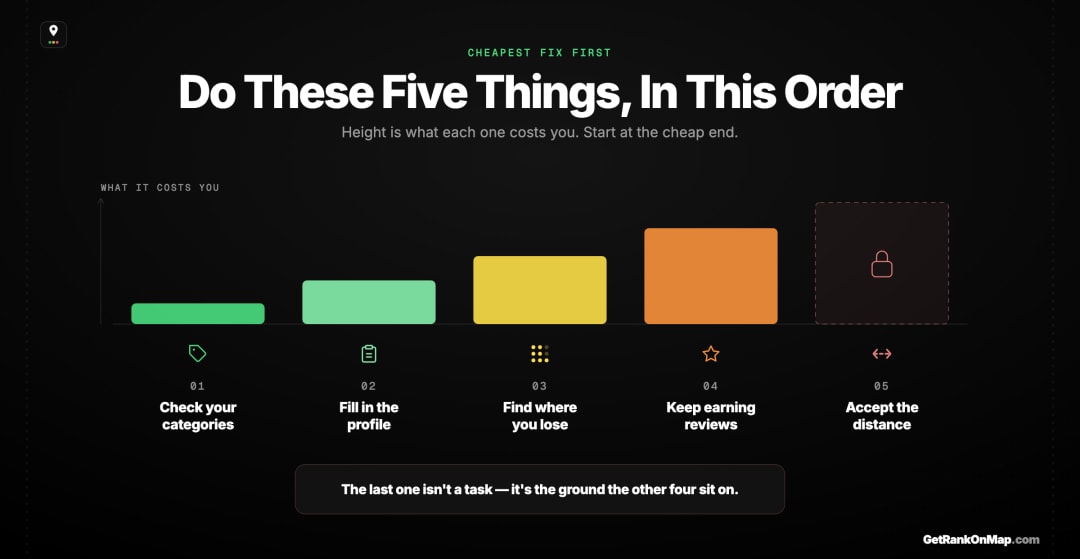
First, check your categories. Primary category especially. It's free, it takes ten minutes, and it's the most common fixable cause of losing to a business that seems weaker than you. Match it to what people actually search for, not to how you'd describe yourself professionally.
Second, fill in the profile properly. Services, attributes, description, hours, photos. Google can only match you to a search on information it has. An incomplete profile is a business that's hard to match.
Third, look at where you're losing. If you're strong nearby and weak far away, that's proximity doing what proximity does, and the fix is content and presence aimed at those outer areas — not more reviews. If you're weak nearby too, something more basic is wrong and it's worth working through a full local SEO audit.
Fourth, keep gathering reviews — but stop expecting them to fix this. They matter for conversion even where they don't move ranking. Someone who can see both of you will usually pick the better-reviewed one. That's worth a great deal; it just isn't the ranking lever.
Fifth, accept the part you can't change. If a competitor is physically closer to a dense residential area than you are, you will lose some of those searches permanently. The productive response is to work out which areas you can win and get properly strong there, rather than fighting geography.
Reviews Are One Factor of Three
The question feels like it's about fairness — they've got worse reviews, so why are they winning? But the premise is usually the thing to examine first, because there isn't one ranking to win or lose. There are as many rankings as there are places to stand, and you've probably only looked at one of them, from the least representative spot available.
Find out what's actually happening across your area before you change anything. Fix your categories, because that's free and it's the most common real cause. Keep collecting reviews, because they help you convert even where they don't help you rank. And be honest about the geography you can't argue with.
The businesses that get this right aren't the ones with the most reviews. They're the ones who know where they're actually visible, and who put their effort into the places where effort can still change the answer.
One note on who's writing this: RankMap is building a tool that maps exactly this — where you're visible across your service area and where you're not. It's not launched yet. If you want to see it when it is, join the early-access waitlist. Everything above works without it.
Frequently asked questions
- 01Why does my competitor rank higher when I have more reviews?
- Most often because they're closer to whoever is searching, or because their profile matches the search more precisely. Reviews are one factor and rarely the decisive one.
- 02Does my competitor rank higher everywhere, or just where I looked?
- Almost certainly just where you looked, unless you've checked from several places. Maps results change with the searcher's location, so a single check tells you about a single spot.
- 03Can I outrank a business that's closer to the customer than I am?
- Sometimes, if your profile matches the search much better or your overall presence is much stronger. But distance is a heavy factor and you should expect to lose some searches near a closer competitor no matter what you do.
- 04Do fake or bought reviews explain this?
- Occasionally, and it's worth reporting if you're confident. But it's the explanation people reach for first and it's usually not the answer. Check proximity and categories before assuming foul play — those account for the great majority of these cases.
- 05How often do Maps rankings change?
- Constantly, and partly at random. Small day-to-day movement is normal and doesn't mean anything happened. What matters is the trend over weeks, which is why [how often you check](https://getrankonmap.com/blog/daily-vs-periodic-map-rank-tracking) matters as much as what you see when you do.
- 06Should I just pay for ads instead?
- Ads will put you in front of people regardless of distance, so they're a genuine answer to a proximity problem. They stop working the moment you stop paying, which is the trade. Most local businesses end up doing some of both.
Explore with AI
Share this
Map your real rank across the city.
Free for the first 50 scans. No credit card.
Join the waitlist