A Plain-HTML Reviews Page Became the Model's Source
A practitioner published a client's Google reviews as a plain-HTML page. ChatGPT and Gemini then used that page when asked what customers think.
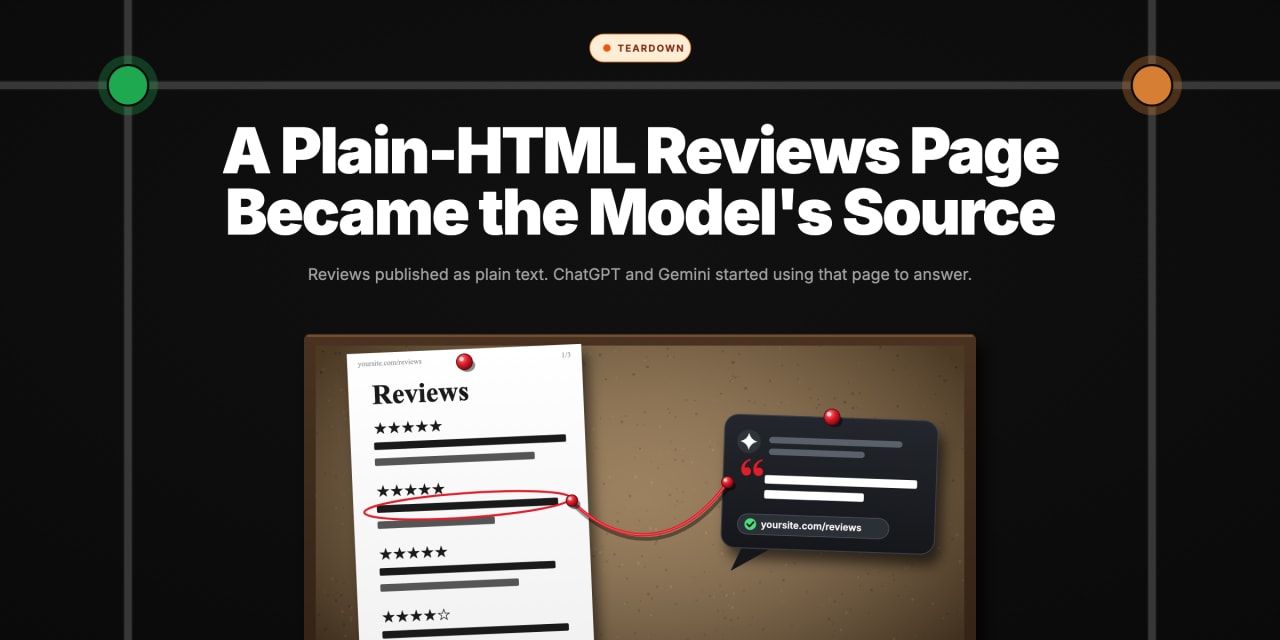
Publishing a business's reviews as plain text on its own website can turn that page into the source AI assistants use when asked what customers think. As of September 2026 assistants often can't see a full set of Google reviews, and they fall back on directories and whatever the homepage shows. On 2 August 2026 a practitioner told r/localseo that ChatGPT and Gemini weren't giving proper answers about what customers said of one of their clients. They pulled the reviews through the Business Profile API into a static HTML testimonials page. Afterwards, both assistants use that page to find relevant reviews and answer with better context. It's one practitioner's report, and there's one catch in how they built it.
now, when i ask chatgpt or gemini about customer experiences with different treatments or use different related keywords, they use this page to find the relevant reviews and answer with better context.
r/localseo, August 2026
  BEFORE                                 AFTER
  ChatGPT: directories, third-party      ChatGPT and Gemini: the new
  review sites, homepage with ~4–5       testimonials page, answering by
  testimonials                           treatment and related terms
  Gemini: Google Maps, but the same
  ~4–5 reviews
  ──────────────────────────────────────────────────────────────────
  the change: every review in plain HTML on one first-party page
The Assistants Had Too Little to Work With
The poster's diagnosis was simple: the assistants "didn't have access to all my reviews in google business profile". ChatGPT leaned on directories and third-party review sites. Gemini seemed to pull from Google Maps but kept returning the same handful of reviews. Another practitioner described the same limit in April 2026. A gym with 100 Google reviews got answers built from other sources, or from reviews that seemed out of date.
Our own archive fits this. In 114 recorded ChatGPT answers to local SEO and Business Profile questions, only 46% cited any google.com page. For Google's own AI Overviews it was 94% of 524. ChatGPT, in particular, relies on other pages.
Plain HTML Was the Point
The poster made sure the review text was "available directly in the html", not loaded by a widget after the page opens. That matters because an assistant's retrieval needs text it can read. A testimonials carousel filled in by a third-party script can leave the page close to empty for whatever fetches it.
The result, in the poster's words, was answers about "customer experiences with different treatments" drawn from the page. The page turned a pile of reviews into something the assistant could search by topic.
First-Party Pages Are the Part a Business Controls
Most of what an assistant reads about a local business sits on other people's sites: directories, review platforms, forums, food and trade blogs. The business can influence those, slowly. Its own site it controls completely, and the same week. That's why this case is worth attention even as a single report. It moved the one input the business owns. The page didn't invent anything. It took text that already existed on the profile and put it where an assistant could read and search it.
The poster's own conclusion was that part of AI visibility is "simply preparing your first-party information in a format" the systems can use.
The Catch: Only Four and Five Stars
The poster called it "a clever trick" that the page showed reviews "rated above four stars only". That's the part to question. A page that shows only the best reviews gives the assistant a curated picture and presents it as what customers say. It may work for a while. But the answers will then disagree with the full review set on Google. A prospect who checks, and prospects do check the worst review on purpose, sees the gap.
We'd publish all reviews, or a clearly labelled recent sample. Replies to the critical ones do more for a prospect than hiding them.
One Report, Worth Testing
This is a single practitioner's before-and-after, with no dates, no run counts and no named client. It fits how retrieval works, and it's cheap to test. Run the same customer questions several times before the page goes live and again after, and count how often the assistant cites it.
Building a Reviews Page Assistants Can Use
- Put every review, or a labelled recent sample, in the HTML, with date, rating and text. No script-only widgets.
- Group or tag by service or treatment, so questions about one service find the right reviews.
- Include your replies to critical reviews. See no one has measured the ROI of review replies yet.
- Check the terms for how you may display reviews pulled from the Business Profile, before you publish.
- Measure it with a fixed question set before and after. For why assistants favour well-described competitors, see AI can't see your regulars, and for the starting point, local businesses invisible to ChatGPT.
Frequently asked questions
- 01How do I get ChatGPT to use my customer reviews?
- Publish them as plain text in the HTML of a page on your own site, dated and grouped by service. As of September 2026 assistants often can't see a full set of Google reviews and fall back on directories and a few homepage testimonials.
- 02Should a testimonials page show only 5-star reviews?
- We'd advise against it. A curated page skews what assistants say, and prospects who check the full Google reviews will see the gap. Publish all reviews or a labelled recent sample, with replies to critical ones.
- 03Do review widgets work for AI visibility?
- Script-loaded widgets can leave the page close to empty for whatever fetches it. Put the review text directly in the HTML.
Sources
Primary data, collected by us
- Google-page citation share: recorded AI answers to local SEO and Business Profile questions (US, English) from the DataForSEO AI-optimisation archive pulled 20 September 2026. ChatGPT: 52 of 114 cited a google.com page (46%). Google AI Overviews: 495 of 524 (94%). Counted 21 September 2026.
Cited Accessed September 2026.
- r/localseo, 2 August 2026, better review context, and AI started citing the page reddit.com. Supports the case; before and after; GBP API to static HTML; 4+ stars only; quoted phrases.
- r/GoogleMyBusiness, 21 April 2026 reddit.com. Supports assistants not reading live Maps reviews.
- r/localseo, 6 August 2026 reddit.com. Supports prospects look for the worst review on purpose.
Explore with AI
Share this
Map your real rank across the city.
Free for the first 50 scans. No credit card.
Join the waitlist