Most Local Businesses Are Invisible to ChatGPT
One test ran 20 companies through ChatGPT, Gemini, Perplexity and AI Overviews. 14 were never named, including some ranking top 2 on Google.
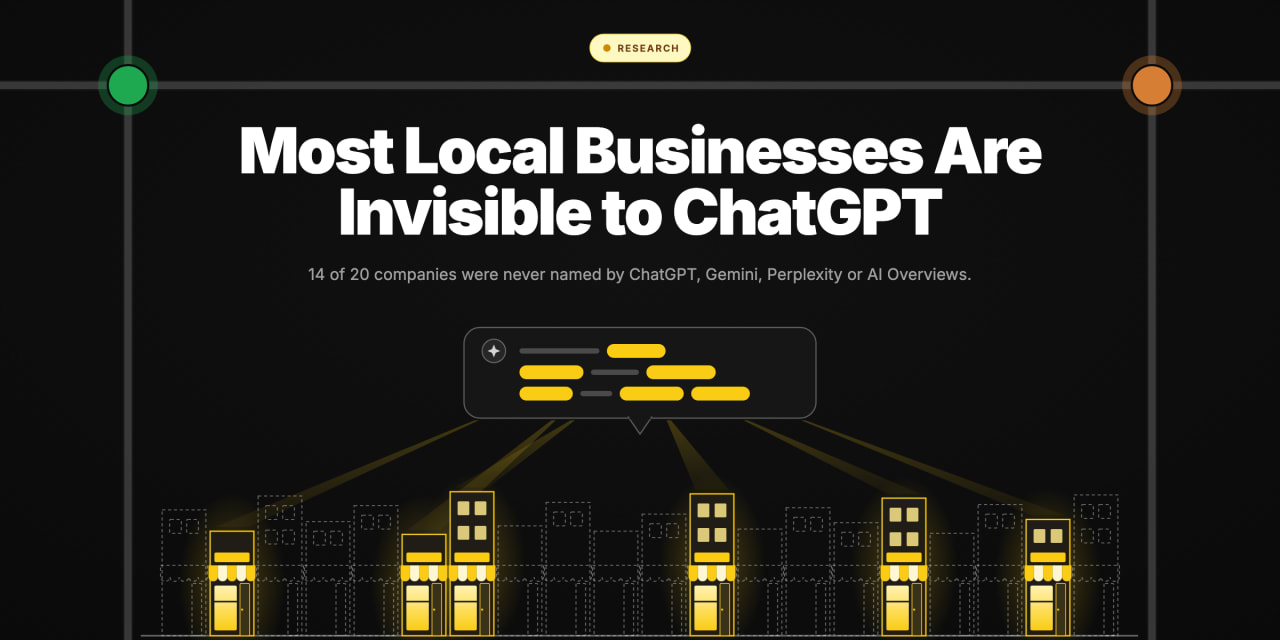
Customers are starting to ask an AI assistant for a local recommendation instead of scrolling a map, and most local businesses are not named when they do. In August 2026 a practitioner ran the questions their clients' customers would actually ask through ChatGPT, Gemini, Perplexity and Google's AI Overview for twenty companies. Fourteen of the twenty were never mentioned by any of the four. Several had a competitor named instead. A couple were described with outdated information — old pricing, dead products still being cited. The detail that matters most for anyone selling local SEO is the last one: some of those invisible companies ranked first or second on Google for the same query.
  TWENTY COMPANIES, FOUR SYSTEMS — Aug 2026
  ┌───────────────────────────────────────────────┬───────┐
  │ never mentioned on any of the four            │ 14/20 │
  │ had a competitor named instead                │ several│
  │ described with outdated pricing or dead lines │ a few │
  │ ranked #1-2 on Google for the same query      │ some  │
  └───────────────────────────────────────────────┴───────┘
  one practitioner's test · see the honesty note in Sources
Ranking Well and Being Recommended Are Two Different Games
The test's own conclusion is the useful one:
So ranking well ≠ getting recommended by AI. Two totally separate visibility games right now.
r/localseo, August 2026
That is consistent with how the two systems work rather than a surprise about them. The map pack ranks a Google Business Profile on relevance to the words typed, distance from the searcher, and prominence. An AI answer is assembled from pages the system retrieved and judged capable of supporting the specific claim it is about to make. One reads a profile and a location. The other reads text it can quote.
So a business can hold the top of the pack and be absent from the answer, and the reverse happens too — a business can be named repeatedly by a model while sitting outside the local three. Neither result tells you anything about the other, in the same way that ranking in Google search does not win you the map pack.
Absence Is the Default, Not the Exception
The test started from something clients were already saying:
Been hearing more clients say they found a competitor "on ChatGPT" instead of Google, so I actually tested it.
r/localseo, August 2026
Fourteen out of twenty is the number worth carrying into a client conversation, with the caveats attached. It reframes the question an agency gets asked.
  THE QUESTION CLIENTS ASK      "how do we rank in ChatGPT?"
  THE QUESTION TO ANSWER FIRST  "are we mentioned at all, for anything?"
Most of the AEO advice being sold answers the first. The measurement almost nobody has taken answers the second, and it is the one that decides whether there is anything to optimise yet. A business that is never named for any phrasing of its category has a presence problem. A business that is named for some questions and not others has a positioning problem. Those need opposite work.
Why a Business Gets Named
Nothing here is settled, and anyone claiming otherwise is selling. What the mechanics imply, and what the test is consistent with:
| what the model needs | what that means in practice |
|---|---|
| Retrievable text about the business | Pages, listings and mentions a crawler can read — not a claim sitting inside an image or a JavaScript-only page |
| Text that supports a specific claim | "Open late" or "does emergency callouts" stated in words, near the entity it describes |
| Corroboration across more than one source | A single self-published page is weak evidence for a recommendation |
| Freshness | Two of the twenty were cited with dead pricing, which is what stale sources look like from the outside |
Notice what is not on that list: map pack position, review count, and proximity to the searcher. They are the three levers local SEO is built around, and none of them is an input here.
The Model Does Not Search for What the Customer Typed
This is the part that changes what you write, and it is measurable rather than theoretical. When a search-connected assistant answers a local question, it rewrites the question into one or more search queries first, then reads the results, then answers. The customer's sentence is almost never the query that gets run.
We pulled the recorded question-and-rewrite pairs for Google Business Profile questions from the DataForSEO AI-optimisation archive in September 2026. The pattern is consistent:
| what the customer asked | what the model actually searched |
|---|---|
| how do i advertise my home salon? | how to market a home salon social media google business profile beauty business tips |
| how do i get into the map pack? | google business profile improve local ranking relevance distance prominence official |
| how do you advertise yourself as a plumber? | plumber advertising google business profile local services ads plumbing marketing |
| how to attract customers as a barber? | barber attract customers marketing google business profile referrals social media barber shop marketing |
| does local seo still work? | does local SEO still work 2026 google business profile local search trends |
Two things follow from that table, and both are actionable.
The rewrite is longer and more technical than the question. It adds the category words — google business profile, local services ads, referrals, 2026. A page written only in the customer's plain language is not what gets retrieved; a page that also contains the vocabulary the rewrite uses is.
The rewrite adds a currency marker. "2026", "latest", "trends" turn up repeatedly. A page with no visible date is competing against pages that state one, for a query that explicitly asked for current information.
  WHAT YOU OPTIMISE FOR
    NOT   the customer's sentence
    BUT   the query the model writes after reading it
          = plain question + category vocabulary + a year
Neither of those requires a tool, a subscription, or a theory about how models rank. They require knowing what the retrieval query looks like, which is exactly what almost nobody writing AEO advice has looked at.
Why It Names the Competitor Instead
Given the above, the common case stops being mysterious. A competitor gets named because more retrievable text describes them in the terms the rewritten query used — not because they are better, closer, or better reviewed.
  WHAT THE MODEL COMPARED
    your page        "we are a family-run salon in town"
    their page       "home salon marketing, google business profile,
                      pricing, opening hours, serving <town>, updated 2026"
  the rewrite asked for the second. it found the second.
This is the AI-answer version of a pattern local businesses already know from the map pack, where a competitor with worse reviews can still sit above you. The signal that decided it is not the one the owner was working on.
The Outdated-Information Finding Is the Underrated One
A business being described with old pricing or discontinued products is worse than not being mentioned. An absence costs a possible customer. A wrong description costs a customer who was ready to buy and now believes something untrue about the business.
It also points at a cause that is fixable without any AEO theory: the model is citing whatever text about the business it can find, and the most quotable text about most local businesses is not on their own site. It is on a directory page, an old listing, or a third-party profile nobody has updated since it was created. Which makes auditing what is already published about a business the cheapest first move available, and the one least likely to be sold to you.
Measure Before You Buy Anything
The category is new enough that the tooling is mostly unproven, and some of the
loudest recommendations do not survive contact with the vendor's own documentation.
Google has stated plainly that the llms.txt convention does nothing for
appearing in its AI answers, and three studies are reported to have found no
effect — the evidence is laid out in
llms.txt and local SEO.
A first measurement does not need a product:
- Write the questions a customer would actually ask. Not the keyword. The sentence — "who does emergency plumbing in [town] on a Sunday?"
- Use several phrasings of each, because models rewrite the question before they search, and two phrasings of the same intent can return different businesses.
- Fresh sessions, no existing chat history. A model that has been talking to you about the business will name the business.
- Record the model, the date, the location setting and the exact prompt. These change underneath you. A result with none of that recorded cannot be compared to anything later.
- Record whether the business was named at all, before recording where it appeared. Named or not named is the finding at this stage.
That produces a number a client can understand and an agency can repeat next month, which is more than most of the category currently offers.
What This Does and Does Not Change
It does not change the map pack. Nothing in an AI answer feeds local ranking, and a business that is invisible two streets from its own door still has that problem whatever ChatGPT says about it. The measurement that answers where do we actually rank is still a grid across the area.
What it changes is the completeness of the picture. An agency reporting only map pack position in late 2026 is reporting one of at least two surfaces a customer might arrive through, and is likely to be asked about the other one by a client who has already heard a competitor's name come out of a chatbot.
Frequently asked questions
- 01Why doesn't ChatGPT mention my local business?
- AI answers are built from pages the system can retrieve and quote. If little readable text describes your business, or it only lives in images or a map listing, there is nothing for the model to cite. In the August 2026 test, 14 of 20 companies were never named.
- 02Does ranking #1 on Google get me into AI answers?
- Not by itself. Some of the invisible companies in the test ranked first or second on Google for the same query. The map pack and AI answers read different inputs.
- 03What does ChatGPT actually search when a customer asks a local question?
- A rewritten query, not the customer's sentence. In the DataForSEO archive we reviewed in September 2026, rewrites added category words like 'google business profile' and often a year, such as 2026.
- 04How do I check if AI assistants mention my business?
- Ask the questions your customers would ask, in their words, on each assistant, several times, and write down which businesses get named. Test presence across many phrasings before worrying about position.
- 05Why does AI describe my business with old information?
- It is quoting whatever stale sources it can find, such as an old directory listing or an outdated page. Two of the twenty companies in the test were cited with dead pricing. Update the pages that describe you and keep a visible date on them.
Sources
Primary data, collected by us
- Question-to-rewrite pairs
- recorded ChatGPT questions on Google Business Profile topics and the search queries the model generated from them, pulled from the DataForSEO AI-optimisation archive on 20 September 2026. 171 distinct rewrites across 238 questions. The five in the table are verbatim; the pattern they show — added category vocabulary and an added year — holds across the set.
Cited Accessed September 2026.
- r/localseo, 18 August 2026, tested 20 companies reddit.com. Supports the 14/20 absence rate; competitors named instead; outdated pricing and dead products cited; some invisible companies ranking #1-2 on Google.
- Google, improve your local ranking support.google.com. Supports relevance, distance and prominence as the map pack's inputs — none of which are inputs to an AI answer.
Explore with AI
Share this
Map your real rank across the city.
Free for the first 50 scans. No credit card.
Join the waitlist