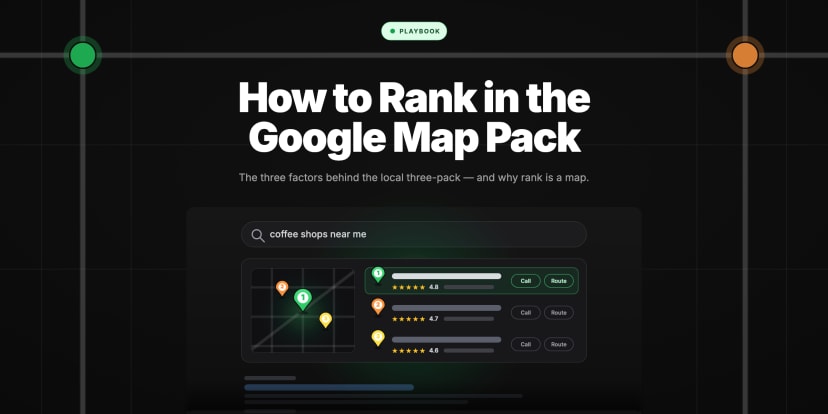
Google Search vs Google Maps Ranking: What's the Difference?
Google Search and Google Maps ranking are two different games with two rule sets. How the Map Pack differs from organic — and why winning one isn't both.

Two Rankings, One Search Box
- Google Search ranking and Google Maps ranking are two separate systems — one orders the organic "blue link" results, the other orders the local Map Pack, and they're decided by different factors
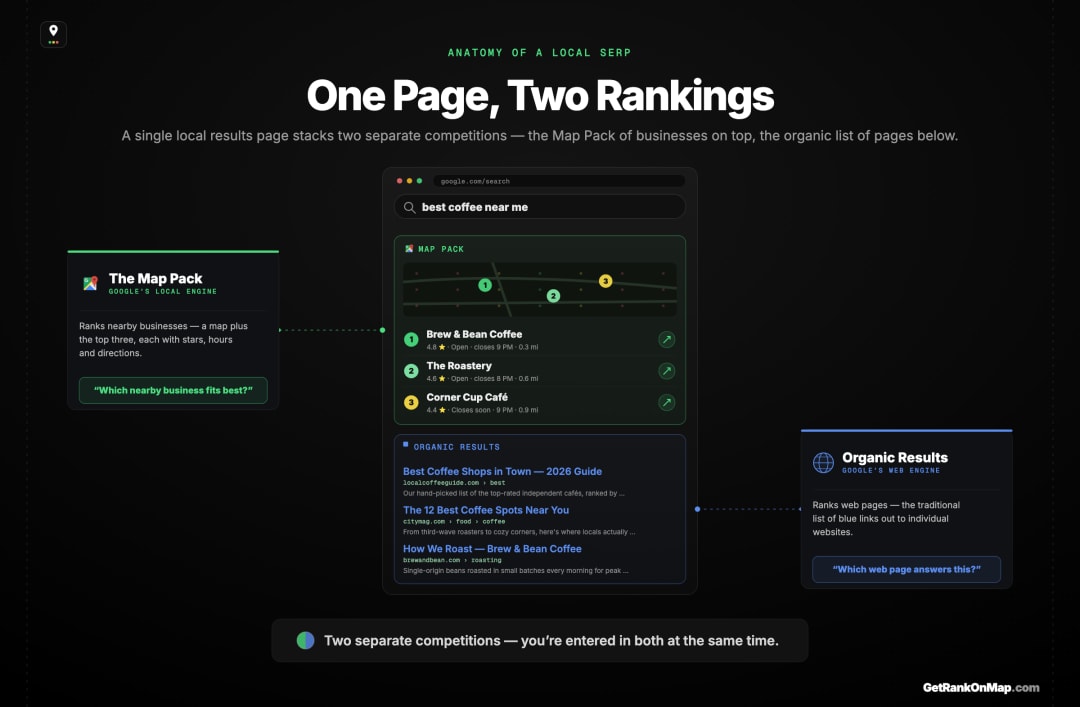
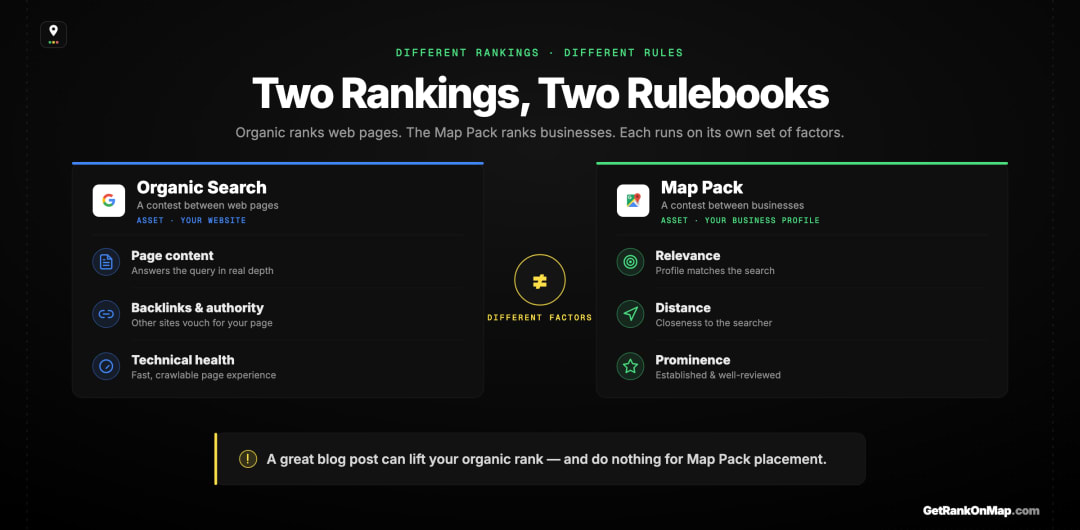
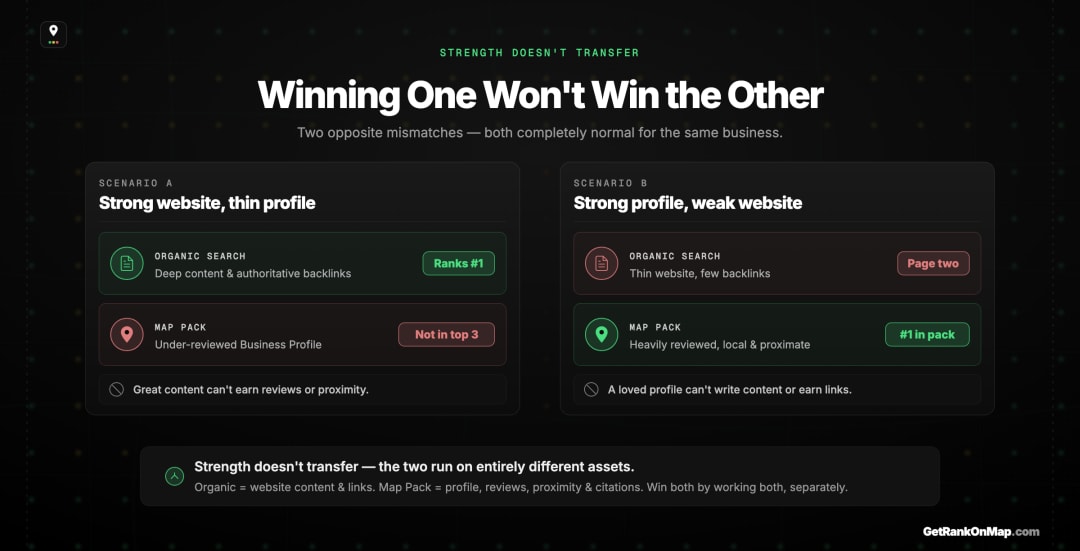
**Organic Search ranking** is driven mainly by content, links, and site authority, and is largely the same result for everyone searching the same query in the same broad region * **Google Maps / Map Pack ranking** is driven by Google's three local factors — [relevance, distance](/blog/google-maps-ranking-factors-2026), and prominence — and changes by location, because distance is measured from each searcher * **Winning one doesn't win the other:** you can rank #1 organically and be invisible in [the Map Pack](https://getrankonmap.com/blog/how-to-rank-in-the-google-map-pack), or own the Map Pack while your website sits on page two — they're earned differently * The biggest practical gap is **measurement**: organic rank can be sensibly tracked as a position, but Maps rank [varies by location](https://getrankonmap.com/blog/why-google-maps-ranking-varies-by-location) and needs a map, not a number * If you're a local business, the Map Pack is usually the surface that drives calls and visits — so it deserves its own tracking, not a single organic-style position check "Where do I rank on Google?" sounds like one question. It's really two, because a single Google results page often shows two completely different rankings stacked on top of each other — the local Map Pack and the organic blue links beneath it — each decided by its own rules. Confusing them is one of the most common and costly mistakes in local SEO: people optimise for one, measure the other, and wonder why nothing adds up. This piece untangles the two: what Google Search ranking and Google Maps ranking each are, why they're separate, and why each needs its own way of being tracked. ## One Search Box, Two Different Rankings
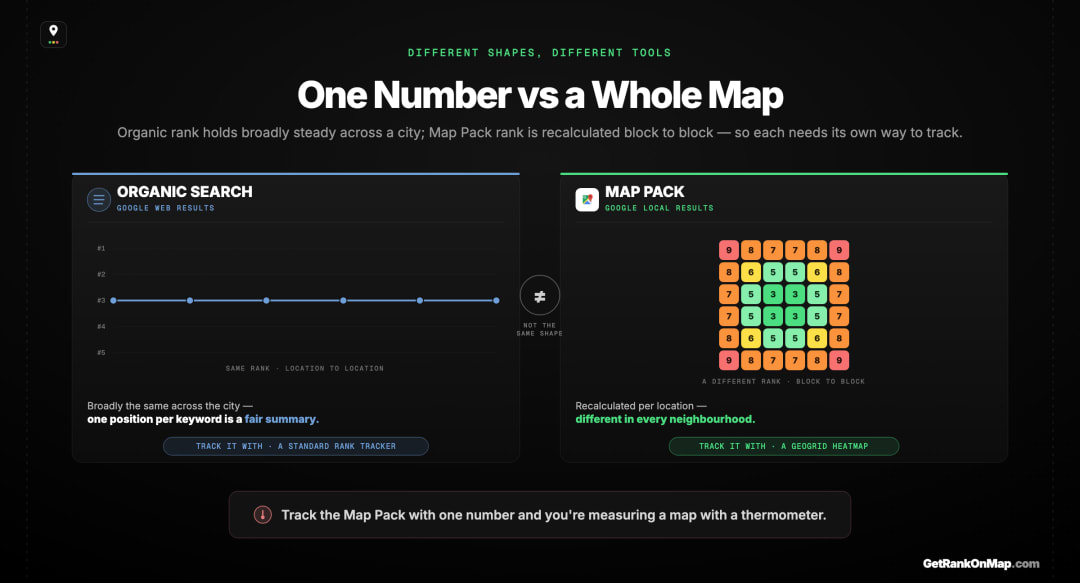
Because organic results are a contest between web pages, two people searching the same term in the same city generally see the same blue links — so a single tracked position is a reasonable summary of where you stand. But Map Pack ranking weighs distance from the searcher, so it's recalculated for every location and genuinely changes from neighbourhood to neighbourhood. (Here's exactly why Maps rankings vary by location.)
This is where treating the two surfaces the same goes badly wrong. A single position check — fine for organic — captures one point of a Map Pack ranking that has a different value everywhere else. You'd be measuring a map with a thermometer. The two rankings don't just have different factors; they have different shapes, and a method built for one misreads the other.
What This Means for Tracking Each One
Two different rankings with two different shapes need two different tracking approaches. Organic can be followed as a position over time. Map Pack visibility has to be followed as coverage across locations. Using the right tool for each is the difference between knowing where you stand and fooling yourself.
So how should you actually track each surface?
-
Organic Search: a standard rank tracker that follows your position for target keywords over time is appropriate, because the result is broadly consistent across the area. One position per keyword is a fair summary.
-
Google Maps / Map Pack: you need a location-aware method, because one position can't represent a ranking that varies across your service area. The right tool is a GeoGrid: a grid of points across your area, your rank checked at each, drawn as a colour-coded heatmap of where you're in the pack and where you're not. (Here's how a GeoGrid scan works.)
For most local businesses, the Map Pack is the surface that drives the phone calls and the directions taps — it's where local buying decisions happen — so it's the one most worth measuring properly. And measuring it properly means a map.
That's exactly what RankMap is built for: tracking your Map Pack visibility as real coverage across every neighbourhood, the way local ranking actually behaves. RankMap isn't live yet — we're pre-launch. Join the waitlist for early access and be first in line the day the map is ready.
Why a Local Search Rank Tracker Has to Do Two Different Jobs
Most rank trackers were built for organic search, where a keyword has one position and that position is broadly the same for everyone. Point that instrument at the map pack and it still returns one number — which is the wrong shape of answer, not a slightly inaccurate one.
The two rankings on this page need two different measuring methods, and a tool that only implements the first will report on the second anyway.
Tracking the organic ranking is a single-value problem. You ask where a page sits for a query, allow for personalisation and the searcher's broad region, and one number is a fair summary. Traditional rank tracking handles this well and has done for years.
Tracking the map ranking is an area problem. The same query returns a different top three depending on where it's asked from, so a single number is only true at the one coordinate it was sampled from. Change the sampling point by half a mile and the answer changes with it. That's why one rank number misleads here in a way it doesn't for organic results.
What to check before trusting a "local" rank tracker. Ask where it samples from. If the answer is a city or a postcode, you're getting one point with a local label on it. If the answer is a grid of coordinates, you're getting an area. Both are sold as local rank tracking, and only one of them can show you the shape of your visibility.
Run both instruments. The organic number tells you how your pages are doing. The grid tells you how your location is doing. Treating either as a substitute for the other is how businesses end up with a healthy report and an empty diary — or the reverse, a strong pin and no site traffic at all.
Two Results Pages, Two Games
Maps rank is location-bound in a way search is not — here is why your Google Maps ranking varies by location.
"Where do I rank on Google?" is two questions wearing one coat. The organic results and the Map Pack are separate rankings, decided by separate factors — content and links for one, relevance, distance, and prominence for the other — so winning one doesn't win the other, and the levers that move each are genuinely different.
The deepest difference is shape. Organic ranking is broadly the same across a region and can be tracked as a position. Map Pack ranking changes by location and can only be understood as coverage across a map. Track them the same way and you'll misread the one that matters most for a local business.
That's the gap RankMap is built to close — measuring your Map Pack visibility as a real coverage map, not a borrowed organic-style number. We're not live yet, but when we are, you'll see your local ranking the way it actually works. Join the waitlist to be first in line.
Frequently asked questions
- 01What's the difference between Google Search ranking and Google Maps ranking?
- Google Search ranking orders the organic "blue link" web results and is driven mainly by content, links, and site authority. Google Maps ranking orders the local Map Pack of nearby businesses and is driven by Google's three local factors — relevance, distance, and prominence. They're separate systems with different rules, run from the same search box, which is why your position in one can be completely different from the other.
- 02Can I rank #1 on Google but not show up on Google Maps?
- Yes, and it's common. Organic ranking rewards your website's content and authority, while Map Pack ranking rewards your Google Business Profile, reviews, proximity, and citations. A strong website can win the blue links while a thin, under-reviewed Business Profile never makes the local three. They're earned with different assets, so strength in one doesn't carry over to the other.
- 03Which one matters more for a local business?
- Usually the Map Pack, because it sits at the top of local searches and drives the calls, direction requests, and visits that turn into customers. Organic ranking still matters — your website supports trust and answers research-stage questions — but for "near me" and service-plus-place searches, being in the local three is typically the higher-value position for a local business.
- 04Do the same SEO tactics work for both?
- Only partly. Quality content and a healthy website help your organic ranking and indirectly support local relevance, but the Map Pack is driven largely by your Business Profile, reviews, and consistent business data — levers that do little for organic. To do well on both surfaces you generally work them separately: content and links for organic, profile and reviews for the Map Pack.
- 05How should I track my Google Maps ranking versus my organic ranking?
- Track them differently because they behave differently. Organic results are broadly consistent across an area, so a standard rank tracker following one position per keyword is fine. Map Pack results change by location, so you need a location-aware method — a GeoGrid that checks your rank across a grid of points and shows the pattern as a heatmap. A single position can't represent a ranking that varies neighbourhood by neighbourhood.
Explore with AI
Share this
Map your real rank across the city.
Free for the first 50 scans. No credit card.
Join the waitlist