Why Your Google Maps Ranking Matters More Than You Think
Your Google Maps ranking decides who gets the call. Near-me searches are high-intent and the top three take most of them. Here's what your rank is worth.
What the Top Three Take
- The Map Pack is where local buying decisions get made — "near me" and service-plus-place searches come from people ready to call, visit, or book now, not people idly researching
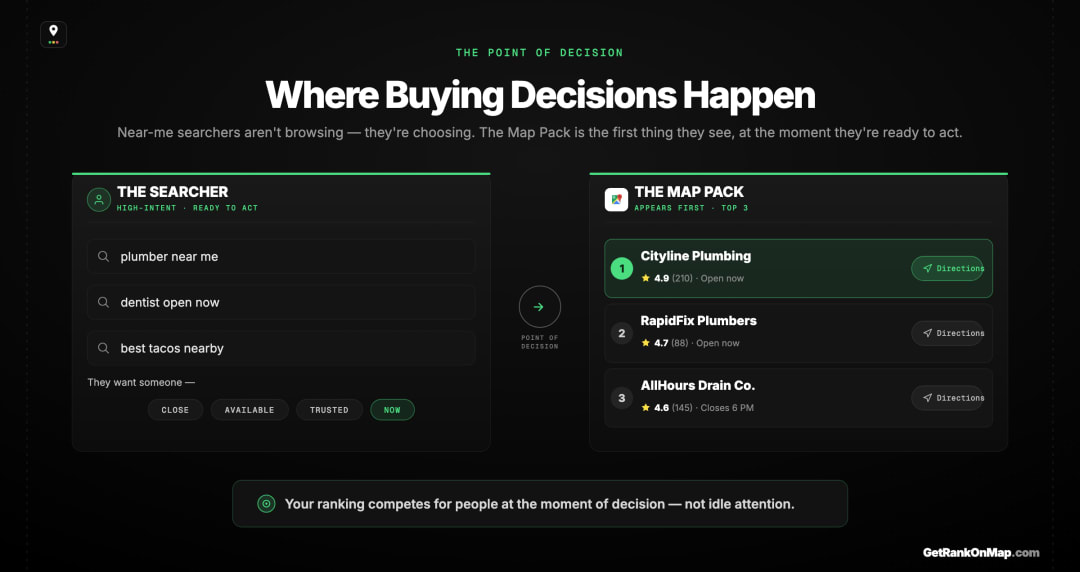
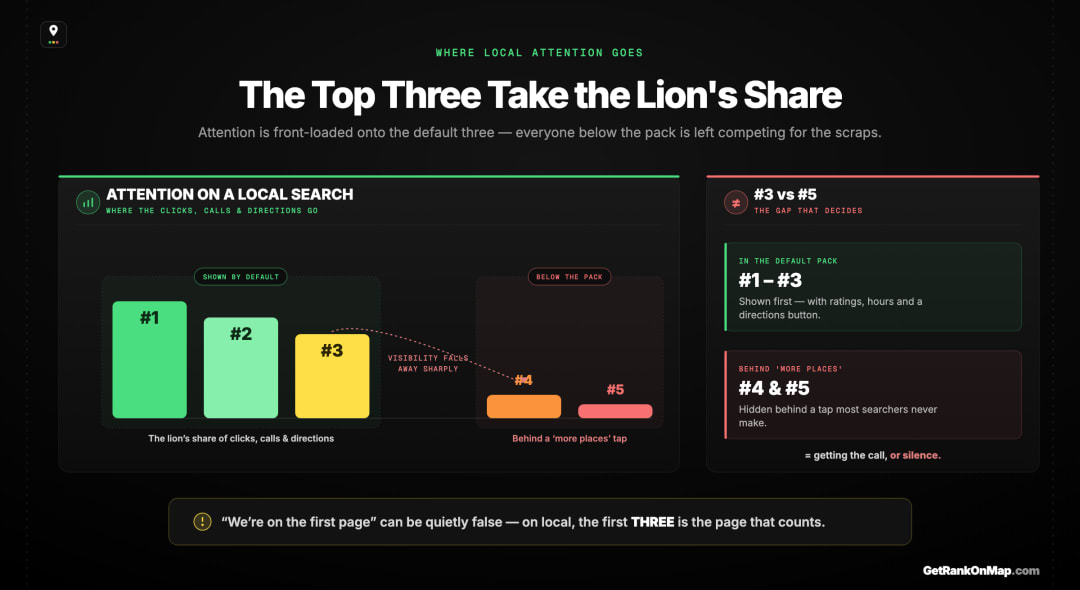
**The top three positions take the lion's share** of the clicks, calls, and direction requests — visibility drops off sharply below the pack, so the difference between #3 and #5 is the difference between getting the call and not * **Google decides the pack on [relevance, distance and prominence](https://support.google.com/business/answer/7091?hl=en), and distance is measured from the searcher** — so your ranking's value is geographic, not global — being top-three in one neighbourhood earns you those customers, while a red zone across town is real revenue going to a competitor, every day * **Invisible doesn't feel like anything** — you never see the calls you didn't get, so a weak ranking leaks business silently, which is why [most businesses don't even track it](https://getrankonmap.com/blog/map-pack-tracking-gap) * For a local business, [the Map Pack](https://getrankonmap.com/blog/how-to-rank-in-the-google-map-pack) typically matters more than organic rankings, because [it's a different surface that captures ready-to-act local intent](https://getrankonmap.com/blog/google-search-vs-google-maps-ranking) * You can't put a value on visibility you can't see — knowing what your ranking is worth means seeing your [coverage as a map](https://getrankonmap.com/blog/what-is-geogrid-rank-tracking), neighbourhood by neighbourhood It's easy to treat Google Maps ranking as a vanity metric — nice to be high, not worth losing sleep over. That's a mistake, and an expensive one. For a local business, your Map Pack ranking isn't a scoreboard; it's a tap on the flow of customers, and it's either open or it isn't in every neighbourhood you serve. This piece makes the case plainly: why where you rank on Google Maps directly decides who gets the call, why the value of that ranking is different in every part of your service area, and why being invisible costs you far more than it ever announces. ## The Map Pack Is Where Local Buying Decisions Happen

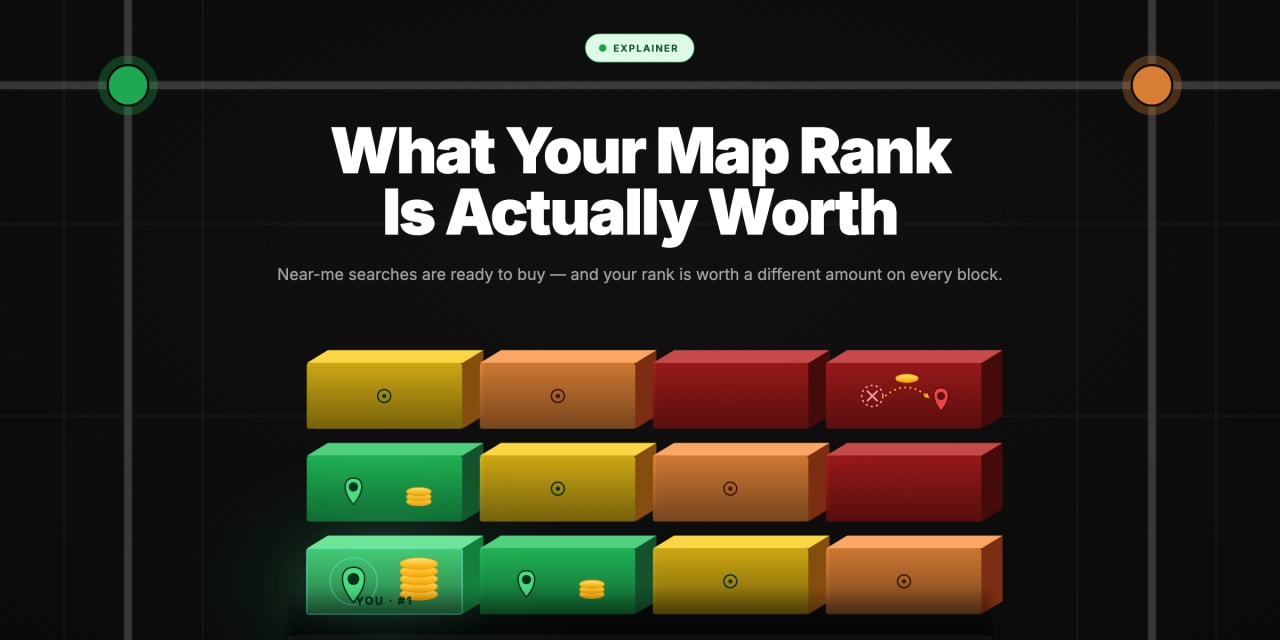
Think of it as a map of money, not a number. The neighbourhoods where you're green — top-three — are areas where ready-to-buy searchers see you first and call. The neighbourhoods where you're red are areas where those same high-intent searchers see a competitor first and call them instead. Every red cell on your coverage map is a steady, ongoing transfer of business to whoever ranks there. (This is exactly why no business ranks #1 everywhere, and why the goal is owning your core and winning the contested ring.)
This reframes ranking from a vanity score into a revenue map. The question isn't "are we ranking well?" It's "which neighbourhoods are we winning, which are we losing, and what is each one worth?" A business that's strong near its address but red across a high-value district isn't doing "fine" — it's leaking that whole district's worth of customers, invisibly, every single day.
What Being Invisible Actually Costs
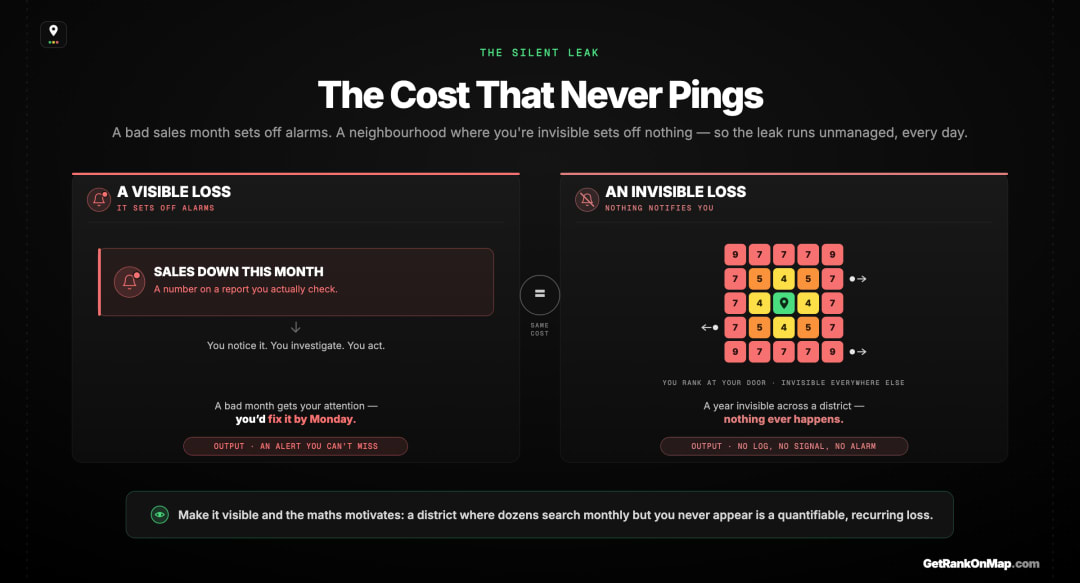
The cruellest thing about a weak ranking is that it's silent. You don't get a notification for the customer who chose a competitor because they never saw you. The cost is real but invisible, which is exactly why it goes unmanaged — and why it compounds.
The reason a poor Map Pack ranking is so dangerous is that it never announces itself. A bad month of sales gets your attention. A neighbourhood where you've been invisible for a year doesn't, because nothing happens — there's no missed-call log for the customer who found a competitor first and never knew you existed.
That silence is why the cost compounds unchecked. The customers in your red zones are searching, deciding, and buying — just not from you — and none of it shows up anywhere you'd naturally look. You can't react to a leak you can't see, so it keeps running. (It's the same blind spot that explains why most local businesses don't track their Map Pack visibility at all, and what that's costing them.)
Make the invisible visible and the maths gets motivating fast. If a single new customer is worth a meaningful amount to you, then a neighbourhood where you're absent — but where dozens of people search your service every month — is a quantifiable, recurring loss. Seen on a map, "we're red over there" stops being a shrug and becomes a number you'd want back.
You Can't Value What You Can't See
Everything above only becomes actionable once you can see your ranking as the map it actually is. The value, the losses, the priorities — they're all geographic, so they only appear when you measure across locations instead of checking one spot. Seeing the coverage is the first step to capturing the revenue.
Here's the throughline: your Google Maps ranking matters because it decides who gets the high-intent local customer — and it does that differently in every neighbourhood. Which means the value of your ranking is only visible as a map. A single rank number can't show you which districts you're winning, which you're leaking, or what to prioritise, because it collapses all of that geography into one figure from one spot.
To actually manage what your ranking is worth, you need to see your coverage: a grid of points across your service area, your rank at each, drawn as green where you win and red where you don't. (Here's how that GeoGrid view works.) That picture turns "ranking matters" from a platitude into a plan — defend the valuable green, target the winnable yellow, and quantify the red you're losing.
That's what RankMap is built to show you: not a vanity number, but a map of where your local visibility is earning you customers and where it's handing them away. RankMap isn't live yet — we're pre-launch. Join the waitlist for early access and be first in line the day the map is ready.
Silence Is What It Costs
Your Google Maps ranking isn't a vanity metric — it's the valve on your flow of local customers. The Map Pack captures people at the moment of decision, with intent to spend, and the top three take the lion's share of them. Where you rank decides who gets the call.
But the part that turns this from a platitude into a plan is that the value is geographic. You're winning some neighbourhoods and silently losing others, and each one is worth a different, real amount. The red zones don't feel like anything — there's no alert for the customer you never got — which is exactly why they go unmanaged and keep leaking.
You can only capture what you can see. That's what RankMap is built for: turning your ranking from an invisible, vanity number into a visible map of where you're earning customers and where you're handing them away. We're not live yet, but when we are, you'll finally see what your ranking is worth. Join the waitlist to be first in line.
Frequently asked questions
- 01Why does Google Maps ranking matter so much for local businesses?
- Because the Map Pack sits at the top of local searches and captures people with high intent — "near me" and service-plus-place searches come from customers ready to call, visit, or book now. The top three positions take the lion's share of the resulting clicks and calls, so where you rank directly decides how many of those ready-to-buy customers actually reach you rather than a competitor.
- 02How much difference does being in the top three really make?
- A large one. Visibility on local search is heavily front-loaded onto the three businesses shown in the default Map Pack; below that, attention drops off sharply. So the gap between #3 and #5 is often the gap between appearing in the pack and being hidden behind a tap most searchers never make. Small movements near the top of local results translate into outsized differences in real customers.
- 03Is Google Maps ranking more important than ranking on Google Search?
- For most local businesses, yes — the Map Pack captures ready-to-act local intent and is shown prominently above the organic results. Organic ranking still matters for trust and research-stage searches, but they're separate systems on separate surfaces. For "near me" and local service searches, being in the local three is usually the higher-value position.
- 04How do I know what a weak ranking is costing me?
- Make it visible by mapping your coverage. The cost of a poor ranking is silent — you never see the customers who chose a competitor because they never saw you. But if you map where you're invisible and consider how many people search your service in those areas each month, and what a customer is worth to you, the loss becomes a concrete, recurring number rather than an invisible leak.
- 05Does my ranking matter equally across my whole service area?
- No — its value is geographic. You're top-three in some neighbourhoods and absent in others, and each area represents a different amount of won or lost business. A district where you're invisible but demand is high is worth far more to fix than one where you're already strong. That's why ranking is best understood as a revenue map, not a single score — and why you need to see it as a map to act on it.
Explore with AI
Share this
Map your real rank across the city.
Free for the first 50 scans. No credit card.
Join the waitlist