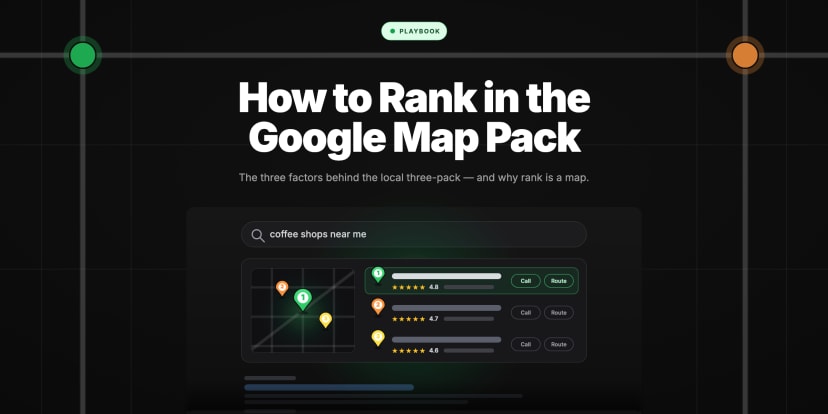
How to Rank on Google Maps With No Budget
You don't need to pay to rank in the Google Map Pack. The free, highest-leverage levers a small business can pull — profile, reviews, consistency.
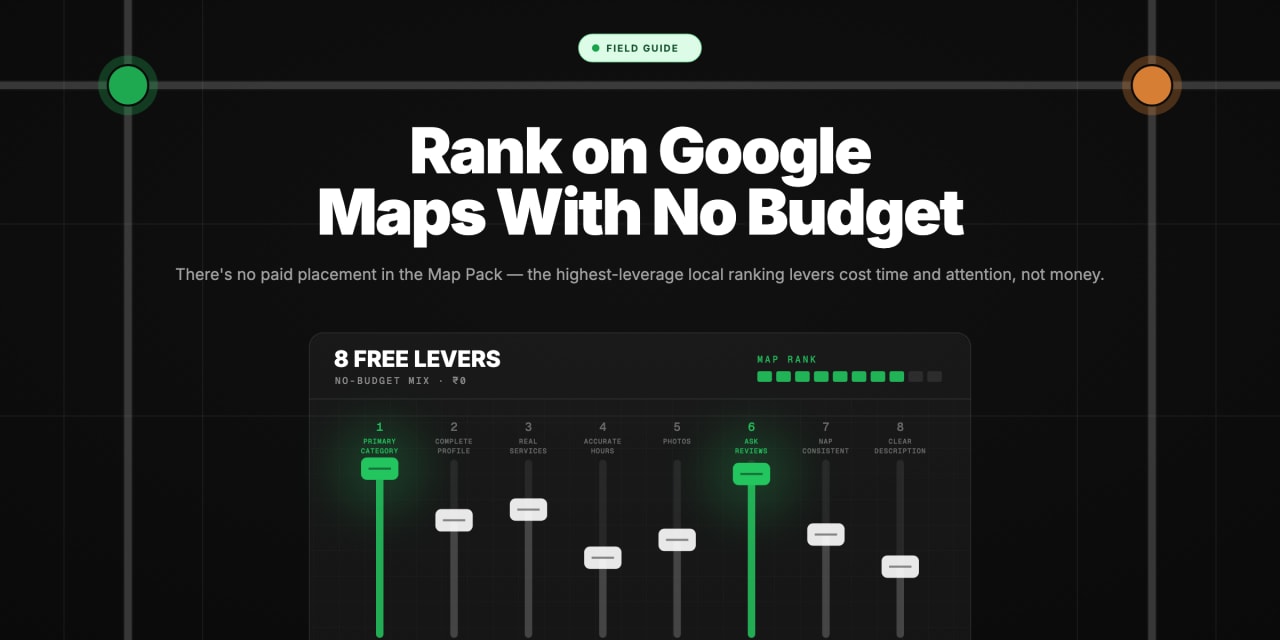
What Costs Nothing but Time
-
Map Pack ranking is earned, not bought — there's no paid placement in the local three-pack itself, so a small business with no ad budget can genuinely compete on the same terms as a bigger one
-
Google ranks local results on relevance, distance, and prominence — and the strongest levers for the first and third cost nothing but time and attention
-
Your free, highest-leverage asset is a complete Google Business Profile — correct primary category, real services, accurate hours, photos, and a clear description do more than most paid tactics
-
Reviews cost nothing but the asking — genuine reviews feed prominence, and steadily requesting them from happy customers is the single best free thing most small businesses don't do consistently
-
Consistency is free and most skip it — keeping your business name, address, and phone identical everywhere quietly supports ranking and costs only care
-
Google Ads buys visibility, not ranking — a paid ad can put you above the pack, but it doesn't improve your organic local position, and it stops the moment you stop paying
If you run a small local business, the SEO world can feel like a paywall — agencies, tools, ad spend, all asking for money you'd rather put into the actual business. Here's the good news the industry doesn't lead with: the Google Map Pack, the single most valuable surface in local search, doesn't have an entry fee. You can't buy your way into it, which means you can't be priced out of it either. The levers that move it most are free — they cost time and attention, not money. This piece is about which free levers actually matter, which paid ones are a distraction, and how to tell whether your effort is working.
The Map Pack Doesn't Charge Admission
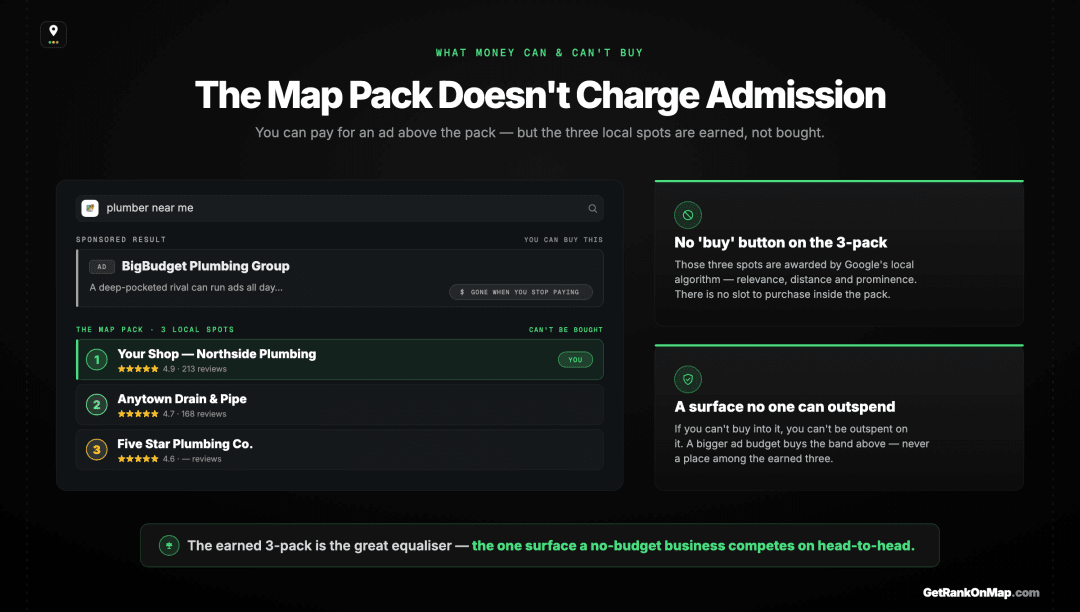
There is no paid placement inside the local three-pack. Google Ads can put a sponsored result above it, but the pack itself is earned through relevance, distance, and prominence — not bought. That's the great equaliser for a small business: you compete for those three spots on the same terms as anyone, no matter your budget.
It's worth being clear about what you can and can't pay for, because the confusion costs small businesses both money and confidence. You can pay for a Google Ad — including a Local Services Ad in some categories — that appears above the Map Pack with a "sponsored" label. What you cannot do is pay to rank inside the organic local three-pack. Those positions are awarded by Google's local algorithm, full stop.
That's genuinely good news if you're working without a budget. A surface you can't buy into is a surface you can't be outspent on. A big competitor with deep pockets can run ads all day and still sit below you in the actual pack if your profile, reviews, and relevance are stronger. The three local spots are earned, and effort buys them, not money.
So the question stops being "how much do I need to spend?" and becomes "which free things actually move this?" The rest of this piece answers exactly that.
Your Free, Highest-Leverage Asset: the Business Profile
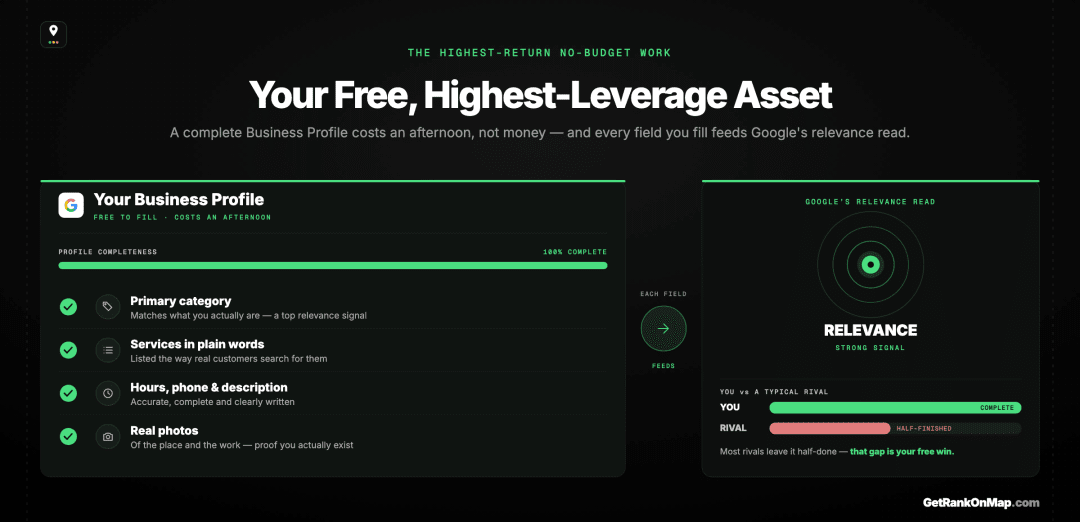
A complete, accurate Google Business Profile is the foundation of local ranking, and it's free. The right primary category, real listed services, correct hours, photos, and a clear description all feed relevance — Google's read of how well you match the search. Most small businesses leave easy relevance on the table simply by having a thin or half-finished profile.
If you do one free thing, make it this: fill out your Google Business Profile properly and keep it that way. It's the asset Google leans on most to decide whether you're a fit for a local search, and completeness is almost entirely within your control.
The pieces that matter most are unglamorous. Your primary category should match what you actually are — this is one of the strongest relevance signals, and getting it wrong quietly holds you back. Your services should be listed in plain terms customers search for. Your hours, phone, and description should be accurate and current. Photos of the real place or work help both Google and the customer. None of this costs anything but an afternoon and the discipline to keep it updated.
This is where the no-budget business has the most room to gain, because so many profiles are half-finished. A thin profile competing against a complete one is giving away relevance for free. Closing that gap is pure effort, and it's the highest-return free work in local SEO. The full set of factors a complete profile feeds is here.
Reviews Cost Nothing but the Asking
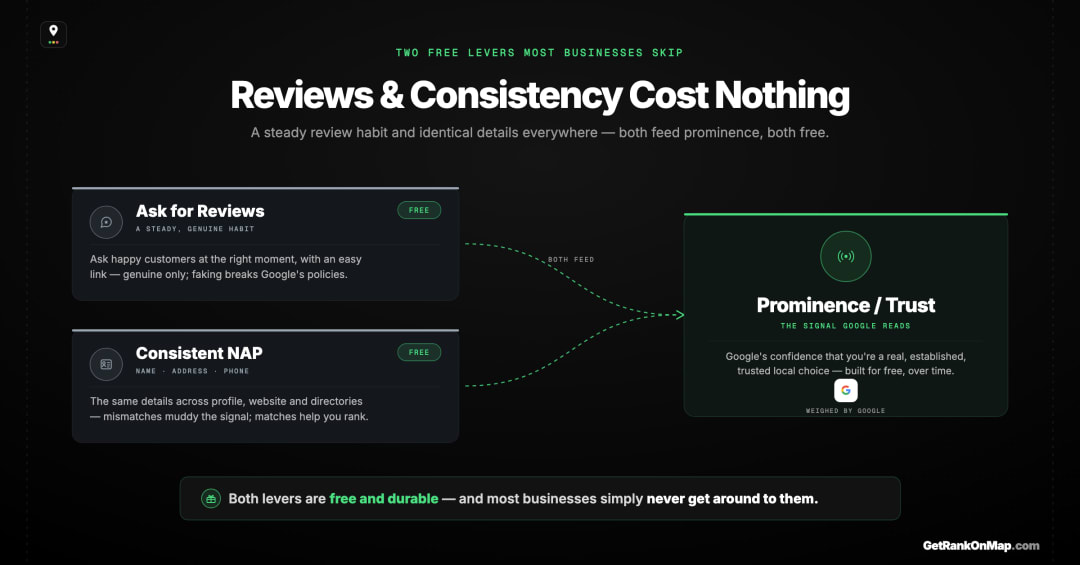
Reviews feed prominence, one of Google's three local factors, and earning them is free — it costs the small effort of asking happy customers and making it easy. It's the single highest-leverage free lever most small businesses pull inconsistently or not at all, usually because no one has made asking a habit.
After the profile, reviews are the next free lever, and arguably the most underused. Prominence — how established and trusted you look — is built substantially on your review profile, and growing one costs nothing but the habit of asking.
The reason this is such an opportunity is that most small businesses ask for reviews sporadically, if at all. There's no system: a great job gets done, the customer leaves happy, and no one mentions a review. Build a simple, consistent habit of asking — at the right moment, with an easy link — and you steadily accumulate the genuine reviews that feed prominence and reassure the next customer at the same time.
Two honest caveats. First, it has to be real: buying or faking reviews breaks Google's policies and the trust you're building, so the only sustainable path is genuine ones, earned over time. Second, reviews are a slow lever — they compound rather than spike. But they're free, they're durable, and they're the thing most no-budget businesses could improve tomorrow at zero cost.
Consistency Is Free, and Most Skip It
Keeping your business name, address, and phone number identical wherever they appear — your profile, your website, directories — quietly supports your local ranking and costs nothing but attention. Inconsistent details send mixed signals; consistent ones make you easier to trust and verify. It's unglamorous, free, and routinely neglected.
The least exciting free lever is consistency, and it's neglected precisely because it's boring. Your business name, address, and phone number — often shortened to NAP — should read identically everywhere they appear: your Google Business Profile, your website, and any directory or listing that mentions you.
When those details drift — a different phone number on an old listing, an abbreviated street name here, a former name there — it muddies the signal Google uses to recognise and trust your business. When they're consistent, you're easier to verify and easier to rank. There's no spend involved; there's only the care to audit where your business is listed and make the details match.
It won't single-handedly vault you up the pack, but it removes friction that's holding you back for free. For a no-budget business, "fix the things that quietly cost you nothing to fix" is exactly the right mindset.
How to Know If the Free Work Is Working
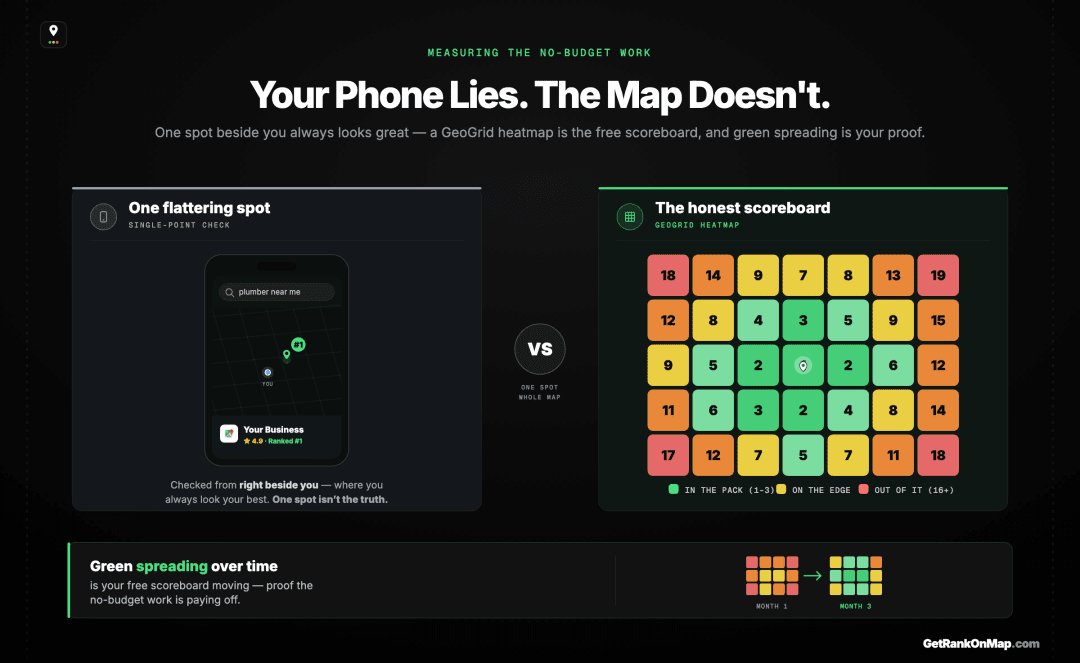
So you've completed the profile, you're earning reviews, your details are consistent — how do you know it's moving the needle without paying for an expensive tool? You need to see your Map Pack visibility, and because it changes from neighbourhood to neighbourhood, checking a single search from your own phone won't tell you — your phone shows you one spot, usually right next to your business, where you look better than you do everywhere else. The honest measure is a GeoGrid: your rank checked across a grid of points in your area, drawn as a heatmap of where you're in the pack and where you're not. Here's how a GeoGrid scan works. That picture turns free effort into something you can actually verify — green spreading across the map as your profile and reviews strengthen is the proof your no-budget work is paying off. It's the surface where local customers decide, so it's the one worth watching.
That's exactly what RankMap is built for: showing a small business its true Map Pack coverage, so the free work has a scoreboard. RankMap isn't live yet — we're pre-launch. Join the waitlist for early access and be first in line the day the map is ready.
Free Work Still Ranks
The most valuable surface in local search doesn't charge admission. You can't buy your way into the Map Pack, which means a small business with no budget can't be priced out of it either — the three local spots are earned through relevance, distance, and prominence, and the strongest levers cost time, not money. A complete profile, genuine reviews, and consistent details are free, durable, and exactly what most businesses do inconsistently.
What the free work still needs is a scoreboard — a way to see whether the effort is spreading your visibility across your area. That's the gap RankMap is built to close, showing your Map Pack coverage as an honest heatmap rather than a flattering single search. We're not live yet, but when we are, your free work will finally have proof. Join the waitlist to be first in line.
Frequently asked questions
- 01Can I rank on Google Maps without spending any money?
- Yes. The Map Pack — the local three-pack — can't be bought into; its positions are earned through Google's relevance, distance, and prominence factors. The strongest levers for two of those, relevance and prominence, are free: a complete and accurate Business Profile, the right categories and services, consistent business details, and genuine reviews. A small business with no budget can compete on the same terms as a larger one.
- 02Does paying for Google Ads improve my Map Pack ranking?
- No. Google Ads can place a sponsored result above the Map Pack, but it doesn't improve your organic position inside the local three-pack, and the visibility disappears the moment you stop paying. Ads buy temporary placement, not ranking. For lasting local visibility you work the organic factors — profile, reviews, relevance, consistency — which are largely free.
- 03What's the single most effective free thing I can do?
- Complete your Google Business Profile properly and keep it accurate — especially the primary category, services, hours, and description — and then build a consistent habit of asking happy customers for genuine reviews. The profile feeds relevance and the reviews feed prominence, two of Google's three local factors. Both cost only time and attention, and most small businesses do them only half-heartedly, which is exactly where the opportunity is.
- 04Do reviews really matter if I can't pay for tools?
- Yes, and they're free to earn. Reviews feed prominence, so a steadily growing, genuine review profile supports your ranking and reassures customers at the same time. You don't need a paid tool — you need a simple habit of asking at the right moment with an easy link. Just keep it genuine: buying or faking reviews breaks Google's policies and undermines the trust you're trying to build.
- 05How do I check my ranking for free without an expensive tool?
- Don't rely on searching from your own phone — it shows you one spot, usually right beside your business, where you look stronger than you do across your wider area. Because Map Pack ranking changes by location, the honest check is a GeoGrid that samples your rank across a grid of points and shows it as a heatmap. That reveals where your free work is genuinely lifting you in the pack and where you're still invisible.
Explore with AI
Share this
Map your real rank across the city.
Free for the first 50 scans. No credit card.
Join the waitlist