Do Reviews Improve Your Google Maps Ranking?
Reviews are a clear lever on your Google Maps ranking — they feed prominence, one of Google's three local factors. How they move your rank, and how to see it.

What Reviews Do and Don't Do
-
Yes — reviews are one of the strongest levers on your Google Maps ranking, because they feed prominence, one of the three factors Google uses to rank local results
-
It's not just your star rating — review volume, how recently and regularly reviews arrive, and whether they mention your actual services all contribute to how prominent Google judges you to be
-
Owner responses and steady velocity matter — a living, actively managed review profile signals a real, in-demand business far more than a pile of old five-stars
-
Review work often feels like it isn't paying off — because people measure it with a single rank number that can't show where the gains are actually landing
-
On a coverage map, review growth has a recognisable shape: your green core widens and your contested yellow ring flips green, as stronger prominence carries you past nearby competitors in more neighbourhoods
-
The only honest way to prove reviews moved your ranking is a before-and-after coverage heatmap — not a single position that hides the geography
"Do reviews actually help my ranking, or do they just look nice?" is one of the most common questions in local SEO, and the honest answer is: yes, genuinely, and more than most owners realise — but probably not in the way you're measuring. Reviews are a real ranking lever, but their effect shows up across your map, not as a tidy jump in one number. This piece explains how reviews move your Google Maps ranking, what counts beyond the star rating, and — the part nobody tells you — what review-driven growth actually looks like when you can see your whole coverage.
Reviews Feed Prominence — One of Google's Three Factors
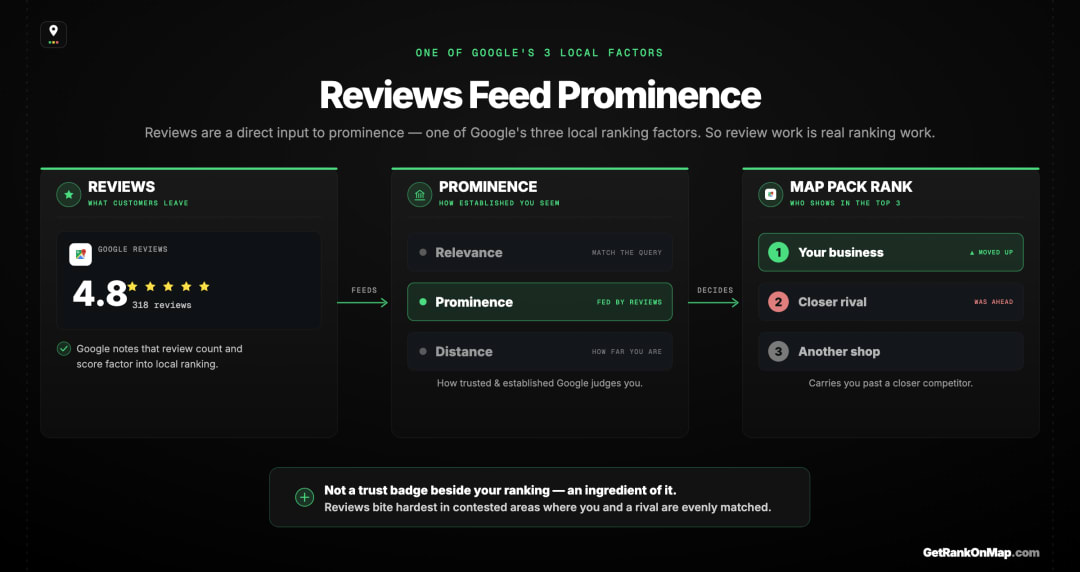
The reason reviews work isn't folklore — it traces straight to how Google says it ranks local results. One of the three factors is prominence, a measure of how established and trusted your business is, and reviews are among the clearest inputs to it. Understanding that link is what turns "get more reviews" from a vague chore into a deliberate ranking lever.
Start with the mechanism. Google has stated how it ranks local results: three factors — relevance, distance, and prominence. Prominence is Google's read on how well-known and established your business is, and reviews are one of its most direct inputs. Google itself notes that review count and score factor into local ranking.
So reviews aren't a "trust badge" that sits beside your ranking — they're an ingredient of it. A business with a deep, active, positive review profile reads to Google as more prominent, and prominence is one of the three levers that decides where you land in the Map Pack. That's why review work is real ranking work, not just reputation management.
It also explains where reviews help. Prominence is the factor that can carry you past a closer competitor — so reviews are most powerful in the contested areas where you and a rival are otherwise evenly matched, and the stronger profile tips it. Hold that thought; it's the key to seeing review impact on a map. It is also why a competitor with worse reviews can still sit above you — if they are closer to the searcher, prominence never gets the chance to decide it.
It's Not Just the Star Rating
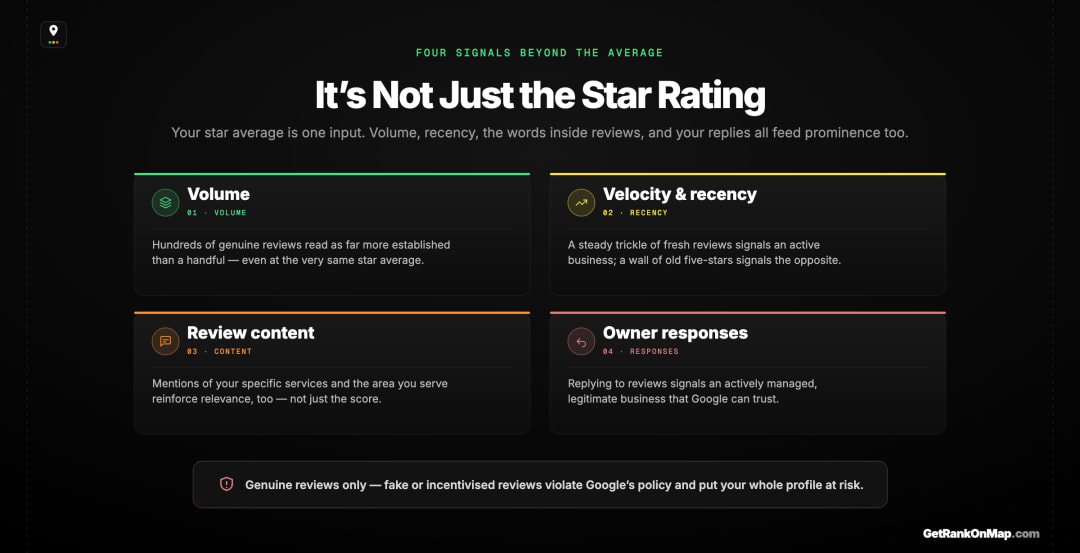
Most people reduce "reviews" to a single number — their average star rating — and assume the job is to keep it high. The rating matters, but it's one of several signals. Volume, freshness, regularity, the words inside the reviews, and how you respond all feed prominence, and treating reviews as just a star average leaves most of the lever unused.
If you're only watching your average rating, you're seeing a fraction of what reviews do. The signals that feed prominence are richer than one number:
-
Volume — how many reviews you have. A business with hundreds of genuine reviews reads as more established than one with a handful, even at the same star average.
-
Velocity and recency — how regularly fresh reviews arrive. A steady trickle of recent reviews signals an active, in-demand business; a wall of five-stars that all stopped two years ago signals the opposite.
-
Review content — what reviews actually say. Reviews that mention your specific services and location ("great emergency boiler repair in [area]") reinforce relevance as well as prominence, helping Google connect you to those searches.
-
Owner responses — replying to reviews, good and bad, signals an actively managed, legitimate business and keeps the profile alive.
The practical upshot: a healthy review strategy isn't "get the rating up." It's keep genuine reviews coming, steadily, with real detail, and stay engaged with them. (Reviews sit inside the wider prominence pillar alongside citations and links — here's the full ranking-factors picture.) And to be clear: this means genuine reviews — fake or incentivised reviews violate Google's policies and risk your profile, so the only durable play is the real one.
Measured side by side, the gap is large. Among 10,890 pairs of businesses appearing in the same grid cell within 100 metres of each other in our study, the one with more reviews ranked higher 66.9% of the time. The one with the better star rating ranked higher 52.7% of the time. Same data, same method, same pairs — count carries the signal, and the average barely moves anything.
Why Review Work Often Feels Like It Isn't Paying Off

Here's the frustrating experience almost every business has: they put real effort into gathering reviews, their rating and count climb — and their rank number doesn't budge. They conclude reviews don't work. The conclusion is wrong; the measurement is. The gains are real, they're just landing somewhere a single number can't see.
This is the trap that makes people give up on reviews. You run a review push, your count climbs, your rating holds strong — and the one rank you check, from your own office, doesn't move. So you decide reviews are overrated and stop.
But think about where review-driven prominence helps: in the contested areas, where you were close behind a competitor and stronger prominence now tips you ahead. The rank you check from your office is probably in your green core — a place you were already winning, where you can't move up because you're already top of the pack. The gains from your reviews are landing out in the neighbourhoods you weren't checking, flipping cells you never look at. (This is the exact failure mode of judging local visibility by a single rank number.)
So "reviews didn't help" almost always means "reviews helped somewhere I wasn't measuring." The work paid off; the single-number measurement just couldn't show it. Which is why the only fair test of review impact is one that looks at your whole map.
We found the mechanism, and it isn't what it looks like. In our own 300-cell study, the raw correlation between review count and rank across the whole corpus was ρ = −0.095. Read at face value, that says reviews do essentially nothing.
Hold distance fixed and the same correlation goes to −0.377. It quadrupled, not because we found a better dataset, but because we conditioned on the thing that was interfering.
The reason is unglamorous: businesses with the most reviews sit systematically further from the average point on a grid — they're the established ones in central, competitive locations. So distance was pushing their measured rank down at exactly the moment reviews were pushing it up, and the two roughly cancelled. That's called suppression, and it means the review effect was never weak or hidden. It was being masked by geography.
Which is precisely why review work feels unrewarded when you check your rank from one place. The instrument is combining two effects that are pulling in opposite directions and reporting the remainder.
What Review Growth Looks Like on the Map
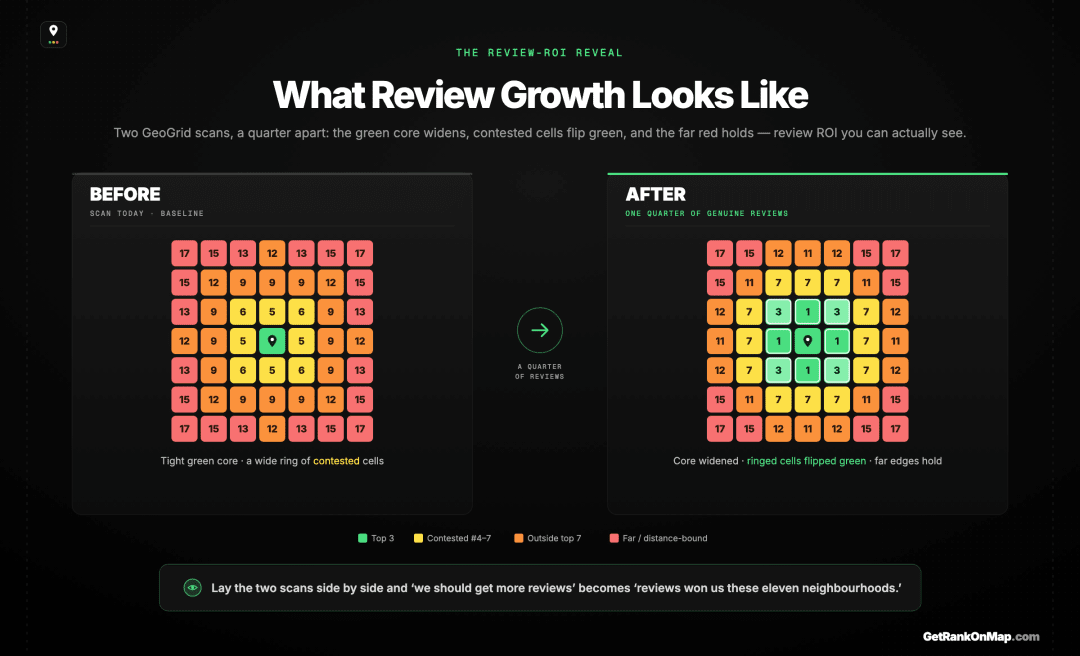
Once you can see your coverage, review-driven growth has a signature shape — and it's genuinely satisfying to watch. Because reviews lift prominence, and prominence wins the close contests, the change shows up at your boundaries: the contested ring turning green and the green core spreading outward. This is review ROI you can actually see.
When you measure your ranking as a coverage map instead of a number, review growth becomes visible and recognisable. It has a shape:
-
Your green core widens. As prominence rises, the area where you're solidly top-three pushes outward from your address into the next ring of neighbourhoods.
-
Contested yellow cells flip green. The boundary cells where you were #4–#7, evenly matched with a nearby competitor, are exactly where stronger prominence tips the contest — and they're the first to turn green. (This is the "win the contested ring" move in action.)
-
The far red mostly stays red. Out at the edges, distance is doing too much work against you for reviews alone to overcome — and that's expected. Reviews expand your reachable territory; they don't defeat geometry.
That signature — core widening, ring flipping, edges holding — is what real review ROI looks like. It's invisible on a single number and obvious on a map. Watching a quarter of review work turn a band of yellow cells green is the difference between believing reviews matter and seeing it.
How to Actually Measure Reviews → Ranking
If review impact is geographic, then proving it requires a geographic measurement: a snapshot of your coverage before a review push, and another after. That before-and-after pair is the honest test — and the thing that finally connects the reputation work to the ranking result.
So how do you actually prove reviews moved your ranking? With a before-and-after map, not a before-and-after number.
Run a GeoGrid scan to capture your coverage today — a grid of points across your service area, your rank at each, drawn in green, yellow, and red. (Here's how a GeoGrid scan works.) Then run your review strategy for a quarter, and scan again. Lay the two maps side by side and the effect is unmistakable: the cells that flipped, the core that grew, the ring you won. That comparison is the honest measure of review ROI — and the thing that turns "we should get more reviews" into "reviews won us these eleven neighbourhoods."
That's exactly what RankMap is built to show you: your coverage as a map you can re-run, so the work you put into reviews stops being an act of faith and becomes a change you can watch land, neighbourhood by neighbourhood. RankMap isn't live yet — we're pre-launch. Join the waitlist for early access and be first in line the day the map is ready.
How to Get Reviews on Your Google Business Profile
If reviews feed prominence, the practical question is how to get them without breaking the rules that govern them. Google's prohibited and restricted content policy is strict, and the two most popular tactics in local SEO are both on the wrong side of it.
Start with the mechanics, because most businesses make this harder than it is.
Use the short review link. Your profile generates a direct review link — findable in the profile's "Ask for reviews" control. It opens the review box directly instead of asking someone to search for you, find the listing and scroll. Every step you remove raises completion.
Ask at the moment of relief. The best time is immediately after the thing you were hired to do has visibly worked — the repair holds, the treatment ends, the meal finishes well. Satisfaction decays quickly, and a request sent three weeks later is asking someone to reconstruct a feeling.
Ask in person, follow up in writing. A verbal ask from the person who did the work, followed by the link over SMS or email, converts far better than the link alone. The ask creates the intention; the link removes the friction.
Two things not to do. Do not offer anything in exchange for a review — discounts, entries, freebies — that's incentivised review content and it's prohibited outright. And do not filter: surveying customers first and only sending the link to the happy ones is review gating, and it's prohibited too. Both are widely advised and both put the listing at risk.
Make it a routine, not a campaign. A burst of twenty reviews in a week reads differently from a steady two a week sustained for a year. Recency is part of what reviews signal, so the pattern matters as much as the total.
Then measure whether it moved anything — on the map, across your area, not on the star average.
Reviews Move Prominence, Not Miracles
If review management is why you're tool-shopping, read the honest BrightLocal alternative we're building.
Do reviews improve your Google Maps ranking? Genuinely, yes — they're one of the clearest inputs to prominence, one of the three factors Google ranks local results on. But their effect isn't a tidy bump in one number, and that mismatch is why so many businesses wrongly conclude reviews don't work. The gains land out in your contested neighbourhoods, exactly where a single rank check never looks.
See your ranking as a map and review ROI becomes obvious and motivating: a green core that widens, a yellow ring that flips, edges that hold. That's what real reputation work looks like when you can finally watch it move your visibility.
That's the whole point of RankMap — turning review work from an act of faith into a change you can see, neighbourhood by neighbourhood, on a coverage map you can re-run. We're not live yet, but when we are, you'll be able to prove exactly which neighbourhoods your reviews won back. Join the waitlist to be first in line.
Frequently asked questions
- 01Do Google reviews actually improve your Maps ranking?
- Yes. Reviews feed prominence, one of the three factors Google uses to rank local results, and Google itself notes that review count and score factor into local ranking. A deeper, more active, genuinely positive review profile reads as a more established business, which is one of the levers that decides your Map Pack position — so review work is real ranking work, not just reputation management.
- 02Is it just the star rating that matters, or something more?
- More than the rating. Review volume, how recently and regularly new reviews arrive, whether reviews mention your specific services and area, and whether you respond to them all contribute to prominence. A steady stream of recent, detailed, genuine reviews on an actively managed profile signals far more than a high average that stopped growing years ago. Treating reviews as just a star number leaves most of the lever unused.
- 03I got more reviews but my rank didn't change — why?
- Almost certainly because you're measuring from one spot — likely inside your green core, where you were already top of the pack and can't move up. Review-driven prominence helps most in the contested neighbourhoods you weren't checking, flipping cells there from mid-pack to top-three. The gain was real; a single rank number just can't show it. A coverage map reveals where the improvement actually landed.
- 04Where do reviews help my ranking the most?
- In your contested areas — the boundary neighbourhoods where you and a nearby competitor are otherwise evenly matched. Prominence is the factor that can tip a close contest in your favour, so stronger reviews turn those yellow, #4–#7 cells green first. They do little for the far edges, where distance dominates, and nothing for your core, where you're already winning. Reviews expand your reachable territory.
- 05How do I prove that reviews improved my ranking?
- With a before-and-after coverage map. Run a GeoGrid scan to capture your rankings across your service area today, run your review strategy for a quarter, then scan again and compare. The cells that flipped from yellow to green and the widening of your green core are the visible, honest measure of review ROI — something a single rank number, checked from one location, structurally cannot show you.
Explore with AI
Share this
Map your real rank across the city.
Free for the first 50 scans. No credit card.
Join the waitlist