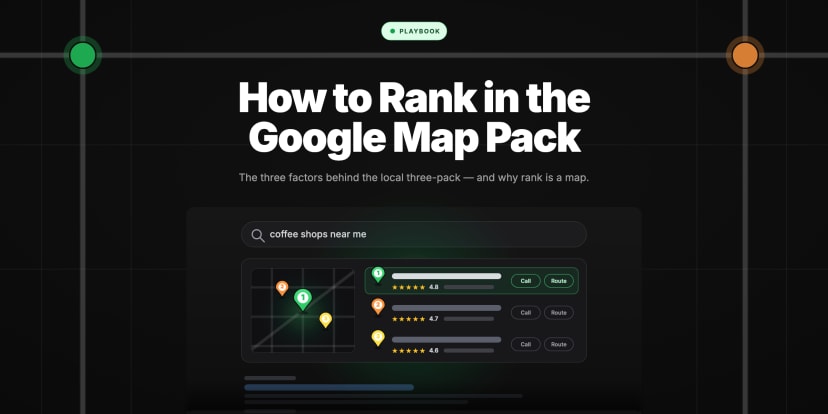
Google Maps Ranking Factors 2026: What Moves Your Rank
Google Maps ranking factors, explained through Google's three pillars: relevance, distance, and prominence. What actually moves your rank, and what's just noise.
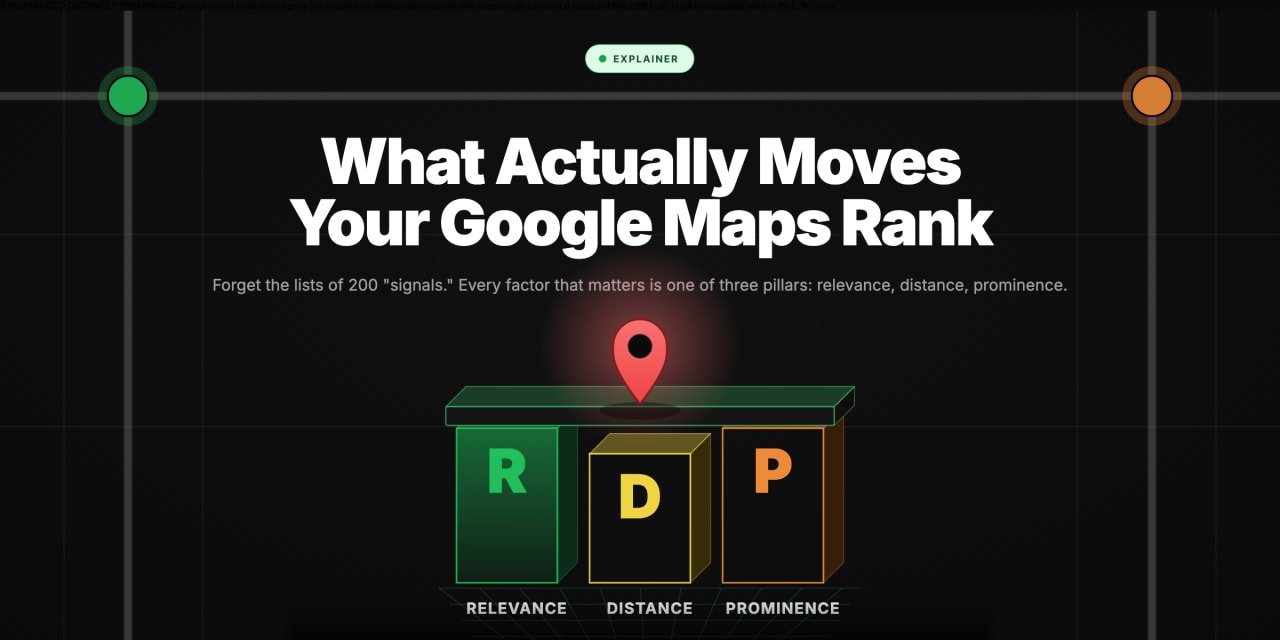
What Actually Moves Rank
- Every real Google Maps ranking factor rolls up into the three pillars Google states openly: relevance, distance, and prominence. Any "factor" worth your time is just one of these three, made specific
**Relevance** is how well your profile matches the search — driven by your primary category, the services and attributes you list, your business description, and a complete, accurate [Google Business Profile](/blog/google-business-profile-optimization-checklist) * **Distance** is the one factor you can't optimise, only understand — it's measured from the searcher, which is why your rank varies by location and why coverage, not a single rank, is the thing to track * **Prominence** is how established Google thinks you are — powered by review volume, velocity and quality, citation/NAP consistency, links and mentions, and real engagement signals like calls and direction requests * The factors people obsess over (keywords stuffed in your business name, fake reviews, spam citations) are either risky or low-yield in 2026 — **the durable wins are a complete profile, steady genuine reviews, and consistent business data*
You can't tell which factor is actually helping from a single rank number — you find out by watching which parts of your [coverage heatmap](https://getrankonmap.com/blog/what-is-geogrid-rank-tracking) turn green when you change something Search "Google Maps ranking factors" and you'll drown in lists of 50, 100, even 200 "signals," most of them invented, repackaged, or wishful. It's exhausting and it's mostly noise. The truth is far simpler and more useful: **Google has told us how it ranks local results, and everything real fits into three buckets.** This guide organises the factors that actually matter in 2026 under those three buckets — what each one is, how much it's worth bothering with, and, because this is the part everyone skips, how you'd actually *see* it working. ## The Google Maps Ranking Factors That Actually Matter: Google's Three Pillars

- Relevance — how well your business matches what the person searched for.
- Distance — how far your business is from the searcher's location.
- Prominence — how well-known and established your business is.
That's the whole framework. Every credible "ranking factor" you'll ever read about is one of these three, made specific — a complete profile is relevance, more reviews are prominence, and so on. The value of anchoring to the pillars is that it instantly tells you what's worth your time: if a tactic doesn't plausibly improve relevance, distance, or prominence, it isn't a ranking factor, it's a distraction. Let's take each pillar and turn it into the concrete things you can actually act on.
Relevance Factors: Help Google Match You to the Search

Relevance is the most directly controllable pillar — it's about telling Google clearly and completely what you do, so it can match you to the right searches. Most local businesses leave easy relevance on the table simply by having a thin or half-filled profile. This is the cheapest ranking work available.
Relevance is where the easiest wins live, because it's almost entirely under your control. The concrete factors:
-
Primary category — the single highest-leverage relevance setting you have. Pick the most accurate, specific primary category for your business; it heavily shapes which searches you're even considered for. Add relevant secondary categories, but don't dilute with ones that don't fit.
-
Profile completeness and accuracy — fill out every applicable field: services, products, attributes, hours, service areas, business description. A complete profile gives Google more to match against; a sparse one gives it less reason to surface you.
-
Services, products, and attributes — explicitly list what you offer using the terms customers actually search. If you do "emergency boiler repair," say so; don't make Google infer it.
-
Website content that matches local intent — your linked website's content reinforces relevance. Pages that clearly state what you do and where you do it help Google connect you to the right local searches.
How you'd see it work: improving relevance tends to expand the area where you're considered at all — cells that were blank red can start showing yellow as Google decides you're a legitimate match. On a coverage heatmap, relevance gains often show up as your pattern reaching into neighbourhoods it didn't touch before.
Distance Factors: The One You Can Only Understand

Distance is the odd pillar out — there's almost nothing to optimise, because it's measured from the searcher, not from you. But understanding it is essential, because it's the reason your rank varies by location and the reason a single rank number can't capture your real visibility. You don't tune distance; you plan around it.
Distance is the pillar you can't game. It's calculated from the searcher's location to yours, so it changes with every search and you can't be close to everyone at once. The few things that touch it:
-
Your actual location — proximity to dense customer areas genuinely helps, but short of relocating, this is fixed.
-
Service-area settings — for service-area businesses, defining your service areas accurately matters for eligibility, though it doesn't override raw proximity in the way many hope.
The real takeaway isn't a tactic — it's a measurement lesson. Because distance makes your rank different at every point, your Google Maps ranking varies by location by design. You can't optimise distance away; you can only see its effect and aim your relevance and prominence work at the neighbourhoods where you have a realistic shot. That's why distance is the factor that forces you to track coverage rather than a single position.
Prominence Factors: Earn Google's Confidence
Prominence is how established and trusted Google judges your business to be, and it's where most of the ongoing, compounding ranking work lives. Unlike relevance (largely a one-time setup) prominence is built steadily over time — and it's the lever that most reliably widens the area where you rank well.
Prominence is the long game, and the pillar that most reliably grows your strong zone outward. The factors that feed it:
-
Reviews — volume, velocity, recency, and quality. A steady flow of genuine, recent reviews is one of the strongest prominence signals there is. It's not just your star rating — it's how many, how regularly, how recent, and whether reviews mention what you actually do. (Reviews deserve their own treatment — here's how reviews move your ranking and how to see it on the map.)
-
Citation and NAP consistency — your Name, Address, and Phone number listed identically across directories and the web. Inconsistent data (old addresses, mismatched phone numbers) erodes Google's confidence; clean, consistent citations build it.
-
Links and mentions — being linked to and talked about across the web, especially by locally relevant sources, contributes to prominence the same way it does in organic search.
-
Engagement signals — real interactions with your profile: calls, direction requests, website clicks, photo views. These suggest a genuinely active, in-demand business, and they're an increasingly meaningful part of the picture.
How you'd see it work: prominence gains tend to widen your green core and push your yellow ring outward. As your reviews and authority grow, neighbourhoods where you were mid-pack flip to top-three. On a heatmap, that's the most satisfying change to watch — the green spreading.
What prominence is worth, measured without a model. In our own study of the local pack we took every pair of businesses that appeared in the same grid cell within 100 metres of each other — same query, same searcher, effectively identical distance — and simply asked which one ranked higher. That yielded 10,890 matched pairs across 12 markets, and it requires no statistical model to read.
| Feature | The business with more of it ranks higher |
|---|---|
| Review count | 66.9% of pairs |
| Profile completeness | 61.9% of pairs |
| Star rating | 52.7% of pairs |
Review count and completeness are real levers. Star rating, at 52.7%, is distinguishable from a coin flip only because the sample is large — it is not something to build a strategy on.
What's Overrated (and What's Risky) in 2026

Half of getting ranking right is not wasting effort on things that don't work or actively backfire. A few perennial "tactics" are either low-yield or against Google's guidelines, and chasing them costs you time you could spend on the durable wins.
Not everything labelled a "ranking factor" deserves your attention:
-
Keyword-stuffing your business name — adding keywords you're not actually named (e.g. "Joe's Plumbing | Best Emergency Plumber Near Me") violates Google's guidelines and risks suspension. Not worth it.
-
Fake or incentivised reviews — bought reviews and review-gating are against the rules, increasingly detected, and a fast route to losing your profile. Genuine reviews are the only durable play.
-
Spam citations at volume — blasting your business into hundreds of low-quality directories does little; a smaller set of accurate, reputable citations does more.
The durable formula in 2026 is unglamorous and effective: a complete, accurate profile (relevance), a steady stream of genuine reviews and clean business data (prominence), and realistic targeting around the distance you can't change.
Star rating belongs on this list. Holding distance constant across 10,890 matched pairs in our own corpus, the higher-rated business ranked above the lower-rated one 52.7% of the time. Chasing 4.7 to 4.9 is one of the most commonly recommended pieces of local SEO work and one of the least productive. Review count, in the same comparison, wins 66.9% of the time — so the effort is better spent getting more reviews than better ones.
How to Know Which Factor Is Actually Working

Here's the gap in every ranking-factors article: they tell you what to change, but not how to tell whether it worked. A single rank number can't separate signal from noise — but a coverage map can, because different factors move different parts of the map in recognisable ways.
This is where most ranking advice quietly fails you. You do the work — fix the profile, gather reviews, clean up citations — and then you check one rank number to see if it moved. But one number can't tell you which change helped, or whether your gains in one neighbourhood are masking losses in another. (That's the core problem with tracking a single rank number, and most businesses aren't even doing that much.)
A coverage heatmap turns ranking work into something you can actually read. Relevance gains reach into new areas; prominence gains widen your green core. Make one change, scan again, and see which part of the map responded. That's the difference between guessing and managing.
That's exactly what RankMap is built to give you: a before-and-after picture of your real coverage, so the ranking factors stop being a checklist you hope is working and become changes you can watch land. RankMap isn't live yet — we're pre-launch. Join the waitlist for early access and be first in line the day the map is ready.
Which Factor Actually Moved
Proximity is the reason your Google Maps ranking varies by location even when everything else is fixed.
Putting these factors to work in one industry? See how to rank a restaurant on Google Maps.
None of these factors require a big budget to move — here is how to rank on Google Maps with no budget.
The Google Maps ranking factors that matter in 2026 aren't a list of 200 mysterious signals — they're three pillars Google tells you about plainly: relevance, distance, and prominence. Make relevance concrete with a complete, well-categorised profile. Accept that distance can't be optimised, only understood and planned around. Build prominence patiently with genuine reviews, consistent data, and real engagement. Skip the risky shortcuts; they don't last.
But the factor everyone forgets is feedback — knowing whether any of it worked. A single rank number can't tell you which change moved the needle or where. A coverage map can, because different factors light up different parts of it.
That's what RankMap is built for: turning the ranking-factors guessing game into something you can watch happen on a map. We're not live yet, but when we are, you'll see exactly which neighbourhoods your work wins back. Join the waitlist to be first in line.
Frequently asked questions
- 01What are the main Google Maps ranking factors in 2026?
- They all roll up into the three Google states openly: relevance (how well your profile matches the search), distance (how close you are to the searcher), and prominence (how established and reviewed you are). In practice that means a complete, accurate Google Business Profile with the right primary category, a steady flow of genuine recent reviews, consistent business data across the web, and real engagement — calls, direction requests, clicks.
- 02What's the single most important ranking factor?
- There isn't one universal answer, because the three pillars work together and distance is weighted heavily for local intent. But of the factors you can actually control, your primary category (relevance) and your reviews (prominence) are usually the two highest-leverage levers. Distance matters enormously but isn't something you can optimise — you can only target your effort around it.
- 03Can I improve my ranking if I can't move my business?
- Yes. You can't change distance, but relevance and prominence are both within reach — a complete profile, the right categories, steady genuine reviews, and consistent citations all grow the area where you rank well. You won't rank everywhere (distance prevents that), but you can meaningfully widen your strong zone into neighbourhoods where you're currently mid-pack.
- 04Do reviews really affect Google Maps ranking?
- Yes — reviews are one of the strongest prominence signals, and prominence is one of Google's three official ranking factors. It's not just your star rating; volume, how recently and regularly reviews arrive, and whether they mention your actual services all contribute. There's a dedicated explainer on how reviews move your rank, and how to see that change on your coverage map, linked in this guide.
- 05How do I know if my ranking work is actually paying off?
- Track your coverage as a heatmap, not a single rank number. Make one change — fix your category, gather reviews, clean up citations — then scan again and see which part of the map responded: relevance gains tend to reach into new areas, prominence gains widen your green core. A single number can't separate which factor helped or reveal gains and losses in different neighbourhoods; a map can.
Explore with AI
Share this
Map your real rank across the city.
Free for the first 50 scans. No credit card.
Join the waitlist