59% of Local Businesses Don't Track Their Map Pack
Neil Patel's data: 59% of local businesses don't track their Map Pack, and most who do watch a single rank number that lies. Here's the real picture.

What the Survey Found
- In a May 2026 survey of 180 local businesses, Neil Patel (NP Digital) found that 59% don't track their Map Pack visibility at all — the single largest group by a wide margin
Only **13% track with any meaningful regularity.** The other 87% are optimizing their Google Business Profile, chasing reviews, and building citations with no way to see if any of it moved their position * Neil Patel's own advice points straight at the answer: track *"at the zip code or city level, not just the broad regional level."* He is describing hyperlocal tracking without naming the tool that does it * Here is the part even the 13% get wrong: most of them track a **[single rank number](/blog/one-rank-number-lies)** — and a single number lies, because you do not have one ranking, you have a different ranking on every block * Your business can sit at #1 outside your front door and #20 across town for the exact same search. One number averages that away; a **[GeoGrid](/blog/what-is-geogrid-rank-tracking) heatmap** shows it cell by cell * "Tracking your Map Pack" does not mean checking a position once a month. It means seeing your real coverage across the whole area you serve — the map, not the number The most quoted authority in our field just published a number that should stop every local business owner cold. In [a survey of 180 local businesses](https://neilpatel.com/marketing-stats/map-pack-visibility-tracking/), **59% are not tracking their Map Pack visibility at all.** Not occasionally. Not badly. At all. These are not careless operators. They are investing in exactly the things the industry tells them to invest in — Google Business Profile optimization, review generation, local citations — and then dropping all of it into a black box, with no mechanism to check whether a single hour of that work changed where they actually show up. As Neil Patel puts it, that is *"not a tracking problem but a decision-making problem."
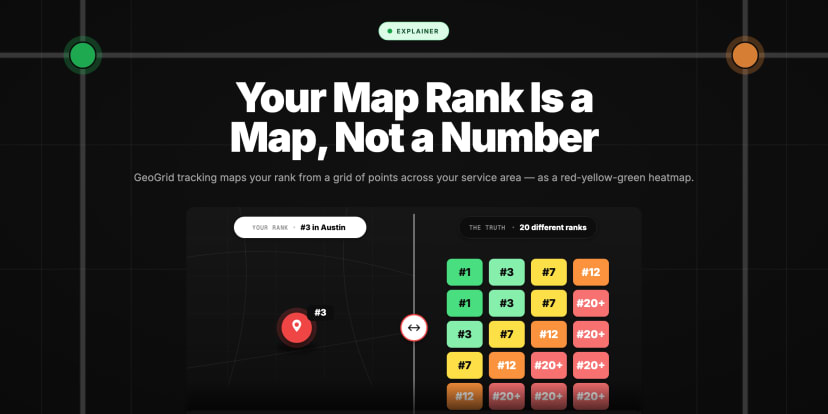
But there is a second, quieter problem hiding underneath his number, and it is the one this article is really about. The 13% who do track are mostly tracking the wrong thing — a single rank number — and a single number is the most convincing lie in local SEO. By the end of this you will understand why "I rank #3 for plumber near me" is a sentence that can be true and useless at the same time, and what tracking your Map Pack visibility actually looks like when you do it right.
What Neil Patel's Survey Actually Found
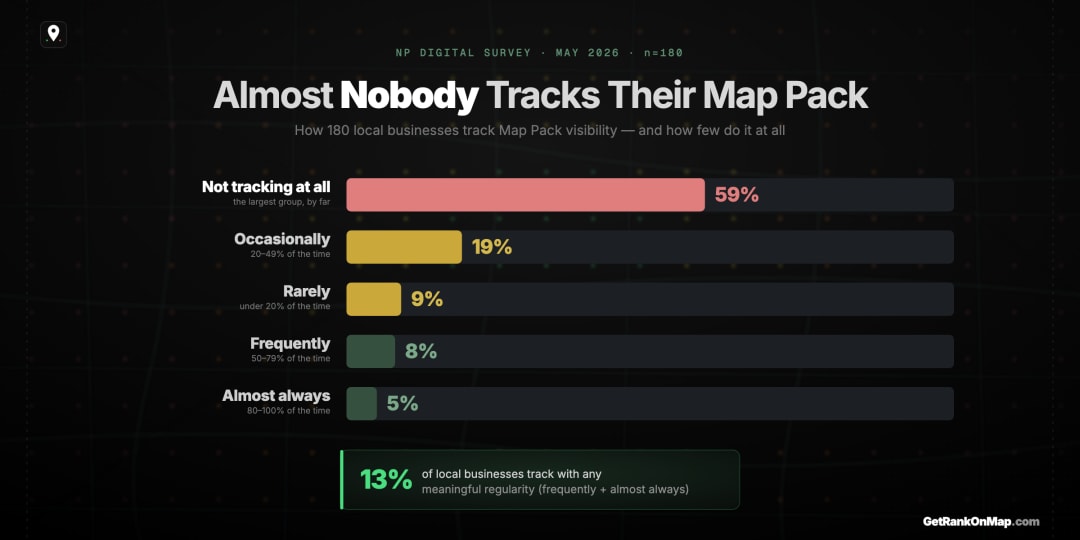
The headline is the 59% who don't track at all, but the full breakdown matters: tracking is not a yes/no switch, it is a spectrum, and almost everyone sits at the bottom of it. Only 13% of local businesses track their Map Pack with any real regularity. The rest are flying blind to some degree — and the gap between the 13% and the 87% is a structural competitive advantage hiding in plain sight.
The data comes from an NP Digital survey of 180 local businesses, published in May 2026. Here is the whole picture, not just the headline:
| How often they track Map Pack visibility | Share of local businesses |
|---|---|
| Not tracking at all | 59% |
| Occasionally (20–49% of the time) | 19% |
| Rarely (under 20%) | 9% |
| Frequently (50–79%) | 8% |
| Almost always (80–100%) | 5% |
Combine the top two rows and you get the number that actually matters: only 13% of local businesses track their Map Pack with any meaningful regularity. Eighty-seven percent do not.
Neil Patel's own framing is blunt, and worth quoting in full:
"If you are not tracking your Map Pack position, you have no way to know whether your local SEO work is actually doing anything. That is not a tracking problem but a decision-making problem. You cannot optimize a channel you are not measuring." — Neil Patel
He is right. And then, in his actionable advice, he says something most readers skim past but which is the entire hinge of this article. He tells businesses to track "at the zip code or city level, not just the broad regional level," using "hyperlocal rank tracking that shows your position within a specific radius." Hold onto that sentence. He has just described the GeoGrid — he simply has not called it that.
Why a Single Rank Number Lies
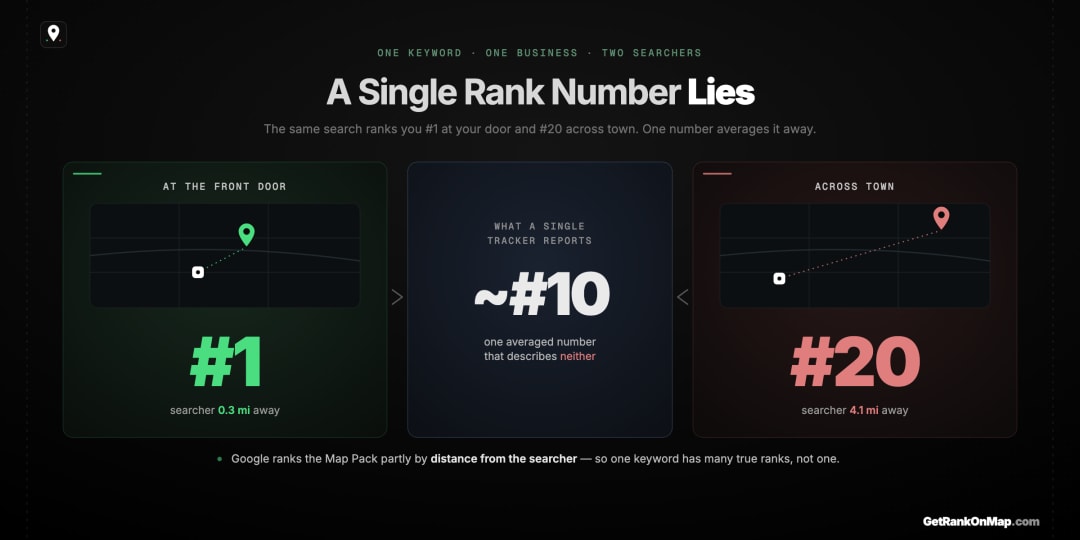
The 13% who track usually track one position per keyword — "I'm #3 for dentist near me." That number feels like the truth and behaves like a lie, because there is no single place where that search happens. Google ranks local results partly by how close each business is to the searcher, so your position changes street by street. One number is an average of dozens of different realities, and an average hides exactly the thing you need to see.
Ask most business owners where they rank and you will get a single number: "We're third for our main keyword." It sounds like a fact. It behaves like a lie, and the reason is built into how Google ranks local results.
Google has openly told us how it ranks the Map Pack. By its own account there are three factors: relevance, distance, and prominence. Relevance is how well you match the search. Prominence is how well-known and well-reviewed you are. But the middle one — distance — is the one that breaks the single-number habit completely. Distance means Google weighs how far each business is from the person searching. Move the searcher, and the distances change, and the ranking changes with them.
So there is no such thing as "your rank for plumber near me." There is your rank for plumber near me from the searcher standing outside your shop, and a different rank from the searcher two miles north, and a different one again from the neighbourhood on the far side of town. Same keyword, same business, same moment — different result in every location, because the searcher's position is part of the query whether they typed it or not.
When you record one number for that, you are not measuring your ranking. You are measuring your ranking in one spot — usually the spot you happened to search from, which is often your own office, the single location where you are most likely to look strong. The number that feels most reassuring is the one taken from exactly where your rank is best. That is not a measurement. That is a flattering selfie.
You Rank #1 on Your Block and #20 Across Town
Geographic ranking variance is not an edge case — it is the normal state of every local business. A plumber, dentist, or law firm will typically dominate the Map Pack in the few blocks around their address and fade quickly the further out you go. The places where you "rank well" and the places where you are invisible can be a five-minute drive apart, and a single rank number tells you about neither.
Picture a dentist on the east side of a mid-sized city. Search "dentist near me" from the street outside the practice and they are #1 — glowing, top of the pack, three glowing reviews on display. The owner checks from the front desk, sees #1, and concludes local SEO is handled.
Now drive ten minutes west, into a dense residential neighbourhood full of exactly the families that dentist wants, and run the identical search. The practice is nowhere in the pack. Not #4, not #7 — off the map entirely, beaten by three competitors who are simply closer to that neighbourhood. Same dentist, same keyword, same day. #1 in one place, invisible in another, and the gap between them is a short drive and a few thousand potential patients.
Which number is "the ranking"? Neither. Both are true. A single position can only ever describe one pin on the map, and your customers are not all standing on that pin. They are spread across the whole area you serve, and your real visibility is the pattern across that area — strong here, weak there, contested in the middle. The owner who sees only the #1 from the front desk is not informed. They are misinformed, confidently, by their own tracking.
What Tracking Map Pack Visibility Actually Looks Like
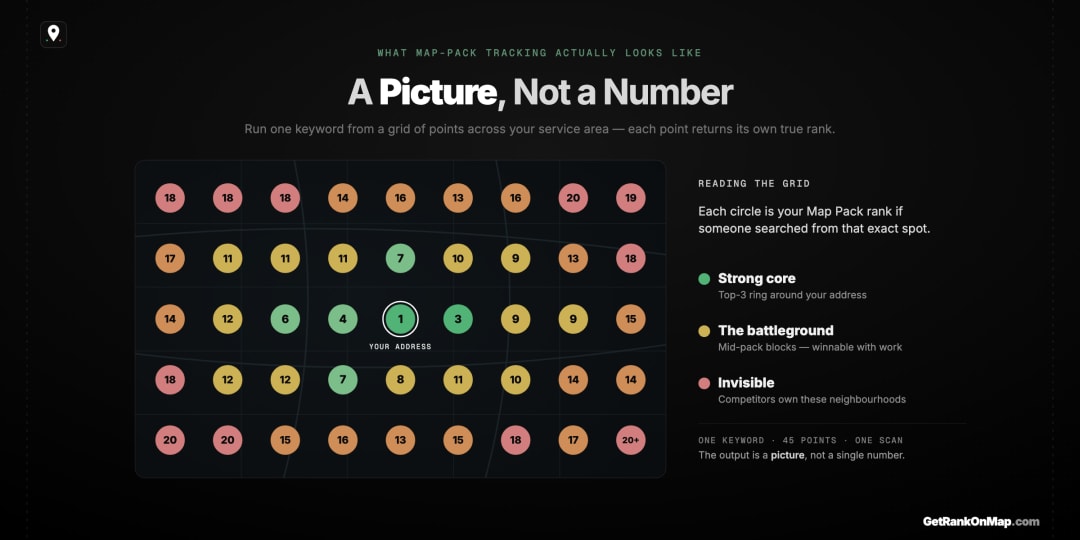
This is the payoff of Neil Patel's own advice to track "within a specific radius." Instead of one search from one spot, a GeoGrid runs your keyword from a grid of points spread across your service area and records your rank at each one. Plotted on a map and coloured by position — green where you rank top-three, yellow in the middle, red where you are invisible — it turns an abstract number into a picture of exactly where you win and where you lose.
Here is what "tracking your Map Pack visibility" means once you take it seriously. Instead of one search from one location, you lay a grid of points over the area you actually serve — a spread of pins across the city, the suburbs, the neighbourhoods you want patients or customers from. Then you run your keyword from every one of those points and record where you rank at each.
The result is not a number. It is a heatmap. Each point on the grid gets a colour based on your position there: green where you rank in the top three and show up in the pack, yellow where you are mid-pack and slipping, red where you are nowhere to be found. In one glance you see the truth a single number can never give you — the shape of your visibility across real geography. The green core around your address. The red edges where competitors own the neighbourhoods. The yellow battleground in between, where small improvements turn into real customers.
This is what the 13% should be looking at, and most are not. It is also, almost word for word, what Neil Patel told everyone to do — track within a specific radius, not just the broad regional level. The GeoGrid is simply the honest, visual form of that instruction. Once you have seen your business as a heatmap, the single-number habit feels like what it always was: checking your reflection from your best angle and calling it a physical.
What the Black Box Is Really Costing You
Not tracking is not a neutral gap — it has a running cost measured in missed calls, lost direction requests, and customers handed to whoever is more visible in the neighbourhoods you cannot see. The Map Pack is the highest-converting real estate in local search, and ranking changes there happen week to week. Businesses flying blind do not notice a slide until the lead volume has already dried up.
The Map Pack is not a vanity placement. It is the highest-converting real estate in local search — the three results that get the calls, the direction taps, and the "open now" clicks before anyone scrolls to the blue links below. Every red cell on a heatmap is a neighbourhood where someone searched, found three competitors, and called one of them. That is not a hypothetical loss. It is a phone that rang at a business that was not yours.
And local rankings move. Competitors collect reviews, Google ships updates, proximity signals shift as new businesses open. A practice that is solidly green this quarter can develop a creeping red edge next quarter without a single thing changing on their own profile — they simply got out-optimized in part of their map. The businesses tracking weekly catch that drift while it is still a few yellow cells. The 59% tracking nothing find out months later, the way you find out about a slow leak: by the damage. By then the competitor who took those neighbourhoods has banked the reviews and the engagement that make the position hard to win back.
This is the real cost of the black box. Not that you lack a dashboard — that you are making decisions about money, time, and marketing spend with no idea whether any of it is working, in most of the places your customers actually live.
How to Actually Start Tracking This Week
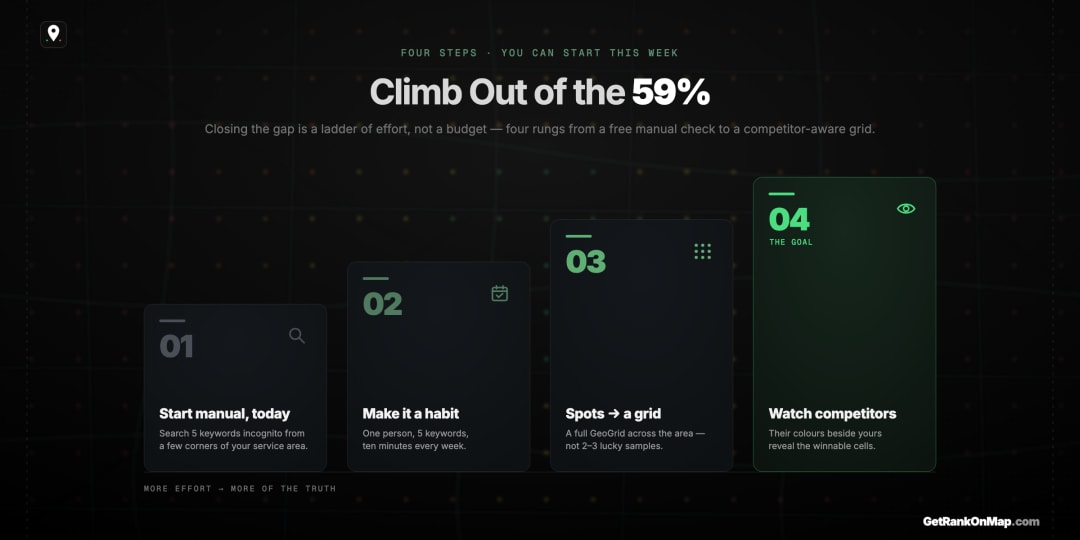
Closing the gap does not require a big budget or technical skill — Neil Patel's own data notes the real barrier is habit, not complexity. The fix is to start measuring across your service area, not from one spot, and to do it on a regular cadence so you catch movement early. Here is the practical version, from a free manual check to the heatmap view that makes the pattern obvious.
You do not need to be in the 59%. Here is how to climb out, in order of effort:
-
Start manual, today. Pick your five most important keywords. Open an incognito browser and search each one — then do it again from a different part of your service area (your phone, off Wi-Fi, from across town works). You will see your rank change between locations with your own eyes. That alone puts you ahead of most of your competitors.
-
Make it a habit, not a one-off. A single check tells you where you are today; a weekly check tells you which direction you are moving and how your position responds to the work you do. Assign it to one person, five keywords, ten minutes a week. The barrier, as Neil Patel's data shows, is the habit far more than the tool.
-
Move from spots to a grid. Manual checks from two or three locations hint at the pattern; they cannot show you the whole shape. To see your real coverage you need a grid of points across your service area and your rank at each — the heatmap, not the handful of samples.
-
Watch competitors, not just yourself. Your own position tells you where you stand. A competitor's position in the same cells tells you whether you are gaining ground or losing it. The neighbourhoods where they are green and you are red are your clearest, most winnable targets.
That last step — the full grid, your colours and your competitors' side by side, refreshed on a schedule — is exactly what RankMap is built to do. It turns Neil Patel's "track within a specific radius" advice into a single heatmap you can read in seconds, across your whole service area, without running dozens of incognito searches by hand.
RankMap is not live yet — we are pre-launch. If you want to see your business as a heatmap instead of a single misleading number the day we open, join the waitlist for early access. No pretending we are something we are not; just first in line when the map is ready.
The 59% and the 13%
The blind spot most owners share is assuming one position — but no business ranks #1 everywhere on the map.
Once you start tracking, the next question is cadence — daily vs periodic map rank tracking.
For the full picture, start with how to rank in the Google Map Pack.
Neil Patel's number is a wake-up call wearing a statistic's clothes: 59% of local businesses are not tracking their Map Pack visibility at all, and only 13% track it with any regularity. If you are in the 87%, the first move is simply to start looking — even a manual check from a couple of locations this week puts you ahead of most of your market.
But do not stop at the 13%'s mistake. Even most businesses that do track are watching a single rank number, and a single number is the one measurement guaranteed to mislead you, because you do not have one ranking — you have a different one on every block. The honest version of "track your Map Pack," the version Neil Patel pointed at when he said to measure within a specific radius, is the heatmap: your real coverage across the whole area you serve, green where you win and red where you do not.
That is the entire reason RankMap exists — to turn your local visibility from a flattering number into a map you can actually act on. We are not live yet, but when we are, you will be able to see your business the way your customers' searches really see it. Join the waitlist to be first in line.
Frequently asked questions
- 01What is the Google Map Pack?
- The Map Pack — also called the local pack or three-pack — is the block of three local business results, with a map, that Google shows at the top of the page for searches with local intent ("dentist near me," "plumber in [city]"). It sits above the regular blue-link results and captures the majority of clicks, calls, and direction requests for local searches, which is why ranking in it matters far more than ranking tenth in the organic results below.
- 02What is GeoGrid rank tracking?
- GeoGrid rank tracking measures your Map Pack position from a grid of geographic points spread across your service area, rather than from a single location. Each point records your rank for a given keyword, and the results are plotted on a map and colour-coded — typically green for top-three, yellow for mid-pack, red for not ranking. The output is a heatmap of your real local visibility, showing exactly where you win and where you are invisible, instead of one number that averages it all away.
- 03Why does my Google ranking change depending on location?
- Because distance is one of the three factors Google uses to rank local results, alongside relevance and prominence. Google weighs how close each business is to the person searching, so the same keyword returns different results from different locations. Move the searcher and the distances change, which changes the ranking. This is why a single rank number is misleading — it only describes your position at the one spot you searched from.
- 04How often should I check my Map Pack rankings?
- Weekly is the practical sweet spot for most local businesses. Daily mostly captures normal day-to-day noise, while monthly or quarterly checks miss the gradual position erosion that usually precedes dropping out of the pack entirely. A weekly cadence across your top keywords catches real movement early — while a slipping position is still a few yellow cells and not a lost neighbourhood.
- 05Is tracking a single rank number enough?
- No. A single number describes your ranking at exactly one location — usually wherever you happened to search from, which is often your own office, the spot where you tend to look strongest. It tells you nothing about how you rank across the rest of your service area, where most of your customers actually are. Real Map Pack tracking measures position across a grid of locations and shows the pattern, not a flattering single data point.
- 06Can I track my Map Pack manually, or do I need a tool?
- You can start manually: search your keywords in an incognito browser from different parts of your service area and note how your rank changes. It is free and genuinely useful as a first step. But manual checking cannot scale to a full grid of locations refreshed every week without consuming hours, and it is easy to fool yourself by always checking from the same convenient spot. A GeoGrid tool automates the grid, removes the bias, and turns the result into a heatmap you can read at a glance.
Explore with AI
Share this
Map your real rank across the city.
Free for the first 50 scans. No credit card.
Join the waitlist