When Clients Say the Leads Are Fake: Sort the Call Log Together
A more visible Google Business Profile draws spam and sales calls along with customers. Sort two weeks of the call log and report new enquiries.
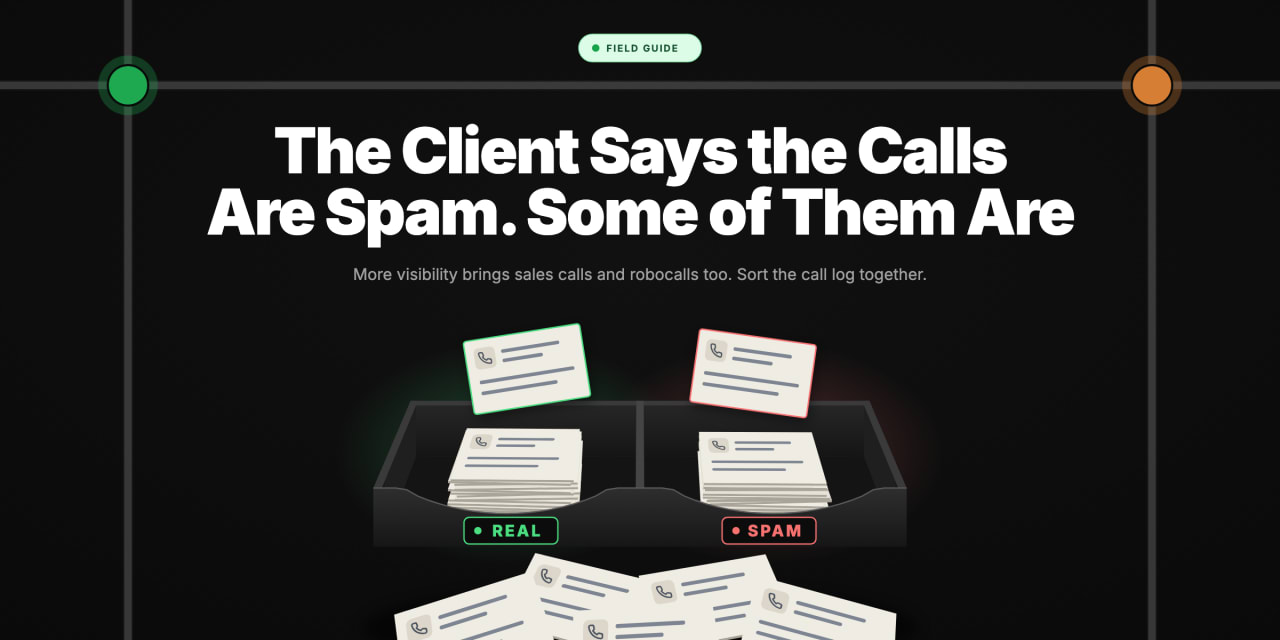
When a local SEO client says the new leads are fake or spam, they are usually partly right. A Google Business Profile that gets more visible draws sales calls, robocalls and wrong numbers along with real customers. Google's own definition of the profile's Calls metric is the number of times someone tapped the call button, so every one of those callers is in the count. The way out is not to defend the dashboard. Agency and business owner sort two weeks of the real call log together, then report new enquiries as a share of all calls. This holds as of November 2026.
Quick answer
- The client is probably partly right. More visibility brings more junk calls, and the profile counts them all.
- The profile's call count can't tell callers apart. Google defines it as taps on the call button, nothing more.
- Junk calls hit visible businesses often. In the owner posts we collected, sellers and robocalls were a repeat complaint.
- The question is how many, not whether. A campaign can work and still bring in a lot of noise.
- Sort the call log together. Two weeks, one line per call, six groups, on a shared screen.
- Report new enquiries, not total calls. Show them as a share of all calls, next to a period before the work.
- Google itself doesn't charge for junk. Its paid local ads filter spam leads and credit some low-quality ones.
- Check where the visibility landed. Our study shows map pack callers come from close by, so far-away callers point elsewhere.
- Sometimes the client is right for a fixable reason. Missed calls and wrong-service calls look like "no leads" from their side.
Why the profile's call count includes the junk
The profile's call number counts taps, not customers. Google's help page on Business Profile performance defines Calls as "The number of times a customer clicked on the call button on your Business Profile." It doesn't say anything about who was calling or why.
So a report built on that number alone invites the dispute. A cold caller selling listings, a robocall and a real customer each add one to the same total. Neither Search Console nor a rank tracker fixes this. They show that more people found the business, not who picked up the phone.
The case that started this page shows it plainly. On 14 August 2026 a practitioner posted on r/localseo about three months of work for a junk removal client. They fixed the profile's services and service area, retargeted the landing page, built citations, published two guest posts and blog posts. They had three kinds of proof: Search Console comparisons, profile call data and ranking data. All three went up. Then the client said the calls were "fake or spam".
| record | what it shows | what it can't show |
|---|---|---|
| Search Console | More searches showed the site, more clicks | Who called, or why |
| Profile calls | Taps on the call button, by period | Whether the caller was a customer |
| Rank tracker | Where the business appears for a keyword | Anything about the phone |
| The client's call log | Every call, with number and time | Where the caller found the business |
Read down the right-hand column. Each record leaves a gap the others don't fill. The agency's charts can't see who called, and the client's phone can't see where the caller came from. The call log is the one record both sides can check line by line. That is the same gap covered in why the profile is where leads land, not why: a profile label records the door a lead used, not what brought it there.
A visible profile attracts sales calls and robocalls too
Business owners describe the other side of this dispute in their own forums. We searched the posts we collected from r/smallbusiness and r/GoogleMyBusiness between August 2025 and August 2026, 1,880 in all. At least six described unwanted calls swamping the business line:
- "Voice search" robocalls, December 2025. An owner described calls from a company called "voice search now": an automated voice first, then a real person.
- Unknown numbers daily, April 2026. An owner reported "at least eight calls" in one day, with a new number each time.
- Telemarketers, June 2026. An owner asking for help regaining a profile mentioned spam phone calls from telemarketers.
- Fifteen a day on two lines, July 2026. The callers said the business needed to register so people using voice search could find it.
- Website sellers, August 2026. A business three months old got calls "daily saying someone built a website for me".
- Fifteen a day from a business card, August 2026. An owner who handed out their number at events got a minimum of 15 spam calls a day.
I get about 15 of these calls on two lines everyday.
The last one has nothing to do with Google, and that is the point. Any number that gets published widely gets found by sellers. A profile that has just become visible is a newly published number.
Google warns about these callers itself. Its page on fraudulent calls says scammers "might say they work "with Google" or "for Google."" It says Google will "never ask you for payment information over the phone or guarantee you a special spot in our products." Its advice is plain: "If someone calls you pretending to be from Google, hang up."
So when a client sees the phone ringing more while jobs stay flat, "the calls are fake" is a reasonable first guess. The work is finding out how much of it is true.
The question is how many calls are junk, not whether
Some of the new calls are almost certainly junk. The useful question is what share. Take two made-up months, not from any real client, each with the same number of profile calls. In one, a quarter of the calls are new customers. In the other, three quarters are. Both clients would say they're getting spam, and both would be right. Only one is describing a campaign that failed.
  SAME CALL COUNT, TWO DIFFERENT MONTHS
  (made-up example, not a client)

  month A  [new][junk][junk][junk]
  month B  [new][new][new][junk]

  the profile reports both as "4 calls"
  only the call log tells them apart
That is why arguing over the total goes nowhere. The agency points at a rising line. The client points at a phone full of sellers. Both are describing the same month from different ends.
The source post also listed "100 basic backlinks" among the work. That is worth a separate look, but it doesn't explain the calls. Links can change who finds the business. They don't change whether a stranger picks up the phone to sell it something.
Sort two weeks of the call log together
The fix is a shared count. Take two weeks of the client's phone log, put one line per call, and agree on a group for each call while both of you are looking at it.
  SORTING THE CALL LOG
  client's phone log, 2 weeks
     |
  one line per call: number, time, length
     |
  put each call in one of 6 groups
     |
  new enquiries / all calls = the real share
     |
  compare with 2 weeks before the work began
Use these six groups. Only one of them is new business.
| group | counts as new business? | what it tells you |
|---|---|---|
| New customer enquiry | Yes | The work reached a buyer |
| Existing customer or repeat | No | Good, but not new business |
| Vendor or sales pitch | No | The number is now easy to find |
| Robocall or "voice search" pitch | No | Same, and easy to spot |
| Wrong number or wrong service | No | The profile may attract the wrong searches |
| Missed, no voicemail | Unknown | A gap on the client's side |
The table matters most in its last two rows. Wrong-service calls and missed calls are the ones that turn into a real problem, and both have a fix. The other junk rows only need to be counted and set aside.
A few rules keep the count honest:
- Do it together, on a call. A sort done by the agency alone looks like grading its own homework.
- Write down the rule for each group first. Decide what counts as an enquiry before you read the first line.
- Count repeat callers once. The same number calling three times is one person.
- Keep the before period. Two weeks before the work started, sorted the same way, is the comparison that settles it.
If the client's phone system records caller number and time, compare the total with the profile's call count for the same days. A tracking number on the website can add call recordings for web calls. We haven't tested specific call tracking tools, so check what the client's phone provider already records first.
How to tell a junk call from a real enquiry
Most junk is easy to spot once you look at the log line by line. The table below lists the signs we'd check first. These are rules of thumb from the posts above, not tested by us across a call set.
| sign in the log | likely group | how to check |
|---|---|---|
| A new number every time, recorded message | Robocall | Same message across days |
| Pitch for listings, "voice search" or a website | Vendor | The caller asks the business to buy |
| Asks for a service the client doesn't offer | Wrong service | Compare with the profile's services |
| Very short, no conversation | Unclear | Ask the client what they heard |
| Asks price, area or availability | New enquiry | The caller wants to buy |
Distance is a useful clue. In our local pack GeoGrid study, a business appeared in the map pack in 96.4% of searches made within 500 metres of it and in none beyond 5 km. Map pack callers mostly come from close by. Our study measured where businesses appear, not who calls, so treat this as a hint: a wave of calls from area codes far outside the service area more likely came from a list a seller bought than from a searcher.
What Google itself refuses to charge for
Google already separates junk from real leads in its own paid local product, and its rules are a good model for a client report. Local Services Ads charge per lead, so Google has to say what counts.
Its help page on how leads work says "You're charged for each valid lead you receive through your Local Services ad." It also says "Google's automated systems proactively filter out invalid activity (such as spam or duplicate contacts)". Charged leads "get reassessed by our models over time, and may be issued credits automatically". The lead credits page adds that Google "no longer supports credits for "job type not serviced" and "geo not serviced" leads."
| Google product | what counts | junk handling |
|---|---|---|
| Business Profile Calls metric | Every tap on the call button | None stated |
| Local Services Ads | Valid leads only | Filters spam and duplicates, credits some low-quality leads |
| Google Ads call conversions | Calls over a minimum length | The advertiser sets the length |
The pattern is clear. When money changes hands per call, even Google stops counting every tap. On Google Ads, its call measurement page describes counting "calls that last longer than a minimum duration you set." A client report should do the same: define a real call in writing, then count only those.
Two limits are worth knowing:
- Wrong-service and wrong-area leads aren't credited any more. Google dropped those credit reasons, so it treats them as the advertiser's problem to fix.
- Lead credits aren't everywhere. Google says they aren't available for health care, tax specialists or advertisers in EMEA.
Show the client where the new visibility landed
A grid scan shows which streets the work reached, and that helps match the calls to the work. It runs the same keyword from a fixed grid of points across the area and records where the business shows in the top three.
Our study shows why that matters for a call dispute. Visibility falls off fast with distance. The same study found appearance at 96.4% within 500 metres, 40.5% at 0.5 to 1 km and 11.1% at 1 to 2 km. When rankings improve, the gain usually shows up in a ring around the business, not across the whole city.
  MATCH THE CALLS TO THE MAP

  grid scan, before and after
     |
  which points newly show the
  business in the top three?
     |
  do the new enquiries come
  from those areas?
     |
  yes  -> the work reached buyers
  no   -> look at the callers again
To place a caller, use the address they give for the job, their area code or a question the client's team asks on the phone. If the new enquiries cluster where the grid improved, that is evidence both sides can see. It's stronger than any rank number from the shop door.
Change what the monthly report counts
After the sort, change the report so the same fight doesn't start again next month. Report new enquiries, not total calls, and say how they were counted.
- Lead with new enquiries. Show them as a share of all calls, with the before period next to it.
- Keep total calls lower down. They still show reach, but labelled as taps, including junk.
- Add booked jobs when the client will share them. Booked jobs times profit per job is the number that settles ROI. The full method is in local SEO ROI is booked jobs, not rankings or traffic.
- Write down what counts as a call. A real enquiry, about a service the client offers, from one person once.
Where a report sits in the month, and what else belongs in it, is covered in what agencies send in a white-label local SEO report. If your fee depends on leads, agree on the definition before the first call comes in. That deal shape is covered in which result to pay on in pay-for-results local SEO.
When the client is right for a fixable reason
Sometimes the client's complaint points at a real problem, just not the one they named. Two of the six groups usually show it.
Missed calls look like "no leads". If real enquiries ring out with no voicemail, the client never hears them. From their side, the phone only rings with sellers. The sort makes this visible as a count of missed calls. The wider pattern, where rankings rise and jobs don't, is in ranked #1 and the phone still isn't ringing.
Wrong-service calls point at the profile. If many callers want something the client doesn't do, the profile may be showing for the wrong searches. Check the primary category, any secondary categories and the services list. Which of those helps, and which pulls in the wrong searches, is covered in whether secondary categories help.
What to do with each finding:
- Many missed calls. Fix call answering or voicemail with the client before judging the campaign.
- Many wrong-service calls. Tighten the profile's categories and services, then sort again in a month.
- Mostly vendors and robocalls. Agree the campaign raised visibility, and report new enquiries only from now on.
- Few new enquiries and few junk calls. The work hasn't reached buyers yet. Say so, and check the grid.
Bottom line
When a client says the leads are fake, they are usually partly right. A more visible Google Business Profile draws sellers and robocalls along with customers, and Google's Calls metric counts every tap on the call button. Don't defend the total. Sort two weeks of the call log together into six groups, report new enquiries as a share of all calls, and compare with a period before the work. Google's own paid local ads already filter spam and duplicates. A client report should hold itself to at least that.
RankMap is built to show where a profile's visibility changed, as a map you can re-run before and after the work. We're pre-launch. Join the waitlist for early access.
Frequently asked questions
- 01Why does my client say the leads from local SEO are fake?
- Usually because some of them are. A Google Business Profile that becomes more visible draws sales calls, robocalls and wrong numbers as well as customers. Google's Calls metric counts every tap on the call button, so all of those callers are in the total. Sort two weeks of the client's call log together to find out what share of the calls were real new enquiries.
- 02How do I prove local SEO leads are real?
- Sort two weeks of the client's call log into six groups: new enquiries, repeat customers, sales pitches, robocalls, wrong numbers or services, and missed calls. Do it together, with the rules for each group written down first. Report new enquiries as a share of all calls, and compare with two weeks before the work began, sorted the same way.
- 03Does the Google Business Profile call count include spam calls?
- Google defines the Calls metric as the number of times a customer clicked the call button on the profile. The help page says nothing about screening callers, so a seller or robocall that taps the button counts the same as a customer. Treat the number as a count of taps and reach, not as a count of leads.
- 04Should I report total calls or qualified calls to a local SEO client?
- Report qualified calls, meaning new customer enquiries, as the main number. Keep total calls lower in the report, labelled as taps that include junk. Write down what counts as a qualified call before the month starts. Google's own call conversions in Google Ads already count only calls over a minimum length the advertiser sets.
- 05Are the "voice search" calls from Google?
- Owners on r/GoogleMyBusiness describe these as sales pitches, often from a new number each time. Google's help page on fraudulent calls says scammers may claim to work "with Google" or "for Google", and that Google will never ask for payment information over the phone. Its advice is to hang up. Report the calls through Google's webform and, in the US, to the FTC.
- 06Can I get credited for spam leads from Google?
- On Local Services Ads, Google says its systems filter out invalid activity such as spam or duplicate contacts, and charged leads may get credits automatically if later judged low quality. Credits for wrong job type or wrong area are no longer supported. The free Business Profile has no credits because nothing is charged per call.
Sources
Primary data, collected by us
- Local pack GeoGrid study
- collected July 2026. 300 grid cells (5×5, 1 km spacing) across 12 markets. Appearance by distance: 96.4% under 0.5 km, 40.5% at 0.5–1 km, 11.1% at 1–2 km, 0% beyond 5 km. Published on our research page, linked twice in the body above.
- Owner and practitioner discourse cache
- 1,880 posts from r/smallbusiness and r/GoogleMyBusiness and 1,464 from r/localseo and r/bigseo, August 2025 to August 2026. A keyword search of titles and stored post text on 9 November 2026 found at least six owner posts about unwanted calls to the business line, and one practitioner post about a client calling the leads fake. The posts below are from it.
- Search Console query pull
- no queries showed this page in Google in the 90 days to 9 November 2026. Pulled 9 November 2026.
Cited Accessed November 2026.
- Google Business Profile Help, performance and insights support.google.com. Supports the Calls metric as taps on the call button.
- Google Business Profile Help, fraudulent calls support.google.com. Supports callers claiming to work with or for Google; no payment info by phone; hang up; FTC and webform reporting.
- Local Services Help, how leads work support.google.com. Supports charged per valid lead; spam and duplicates filtered; automatic credits; no credits for health care, tax specialists or EMEA.
- Local Services Help, automated lead credits support.google.com. Supports job type and geo not serviced no longer credited.
- Google Ads Help, measure calls from ads support.google.com. Supports call conversions counted over a minimum duration the advertiser sets.
- r/localseo, 14 August 2026, the client says the calls are fake or spam reddit.com. Supports the case; junk removal; 3 months; GSC, profile call and ranking data; the work done incl. "100 basic backlinks".
- r/GoogleMyBusiness, 3 July 2026, google spam calls reddit.com. Supports about 15 "voice search" sales calls a day on two lines; new number each time; quoted line.
- r/GoogleMyBusiness, 16 December 2025, voice search spam calls reddit.com. Supports calls from "voice search now", automated voice then a person.
- r/GoogleMyBusiness, 8 April 2026, google voice search verification reddit.com. Supports at least eight calls in a day, number changing each time.
- r/GoogleMyBusiness, 1 June 2026, profile verification help reddit.com. Supports spam calls from telemarketers.
- r/smallbusiness, 13 August 2026, spam calls offering a website reddit.com. Supports daily website-seller calls to a 3-month-old business.
- r/smallbusiness, 14 August 2026, number became unusable reddit.com. Supports at least 15 spam calls a day after handing out a business card.
Explore with AI
Share this
Map your real rank across the city.
Free for the first 50 scans. No credit card.
Join the waitlist