Distance decides whether you appear. Reviews decide the order.
Across 300 grid cells in 12 local markets, distance from the searcher decided whether a business appeared at all — 96.4% of the time within 500 metres, and never once beyond five kilometres. Reputation decided almost nothing about appearance, and a great deal about order: among businesses standing within 100 metres of each other, the one with more reviews outranked the other 66.9% of the time, while the one with the better star rating won just 52.7%.
Everyone agrees proximity matters. Nobody agrees what else does.
Ask what moves a business up the Google local pack and you will be handed a ranked list of factors — proximity first, then reviews, then categories, then a long tail. Those lists come almost entirely from surveys of practitioners: people are asked to rate how important each factor is, and the averages are published as findings.
The trouble is that a survey measures belief. The practitioners answering it formed those beliefs from the same shared folklore the survey was meant to adjudicate, so the result is circular by construction — confident, widely cited, and untethered from any observation of the thing itself.
So we measured instead. This study runs the same search from many locations, records what Google actually returned, and asks which differences survive once the obvious explanation is held still.
Hold something fixed, and whatever still moves is not caused by the thing you held.
The reason ranking factors are hard to separate is not statistical, it is structural. In any cross-section of real businesses, the close ones and the well-reviewed ones are largely the same businesses: established firms occupy central locations, and central locations accumulate reviews. Two causes that never vary independently cannot be told apart after the fact, no matter how the numbers are modelled afterwards.
The design therefore separates them before any analysis happens, using two cuts that fail in opposite directions.
Cut 1 — within business
One business, observed from twenty-five locations across a 5×5 grid. Its rating, its review count, its categories and its profile completeness are identical at every one of those points, because they are properties of the business and the business did not move. Only the searcher’s distance changed.
So if it appears at eight points and not at the other seventeen, reputation cannot be the explanation — reputation never varied. The cost of that design is real and worth stating plainly: it is structurally blind to attributes, and can never tell us whether reviews matter.
Cut 2 — within cell
The mirror image. Condition on a single grid cell — one query, one coordinate, one moment — so the searcher’s location is fixed and only the businesses differ. Whatever separates them there is not proximity, because proximity is now a constant.
Neither cut is a survey of opinion, and neither compares businesses that rank against businesses that don’t — the comparison no statistics can rescue.
Four findings, each one checkable.
Each finding below states the claim, the evidence, and the file the number came out of. Two of them are what we expected. One of them is the opposite of what we registered.
Visibility does not fade with distance. It ends.
The same businesses were observed from every point of a 5×5 grid, so nothing about them changed between these bands — only where the search was made from. Within half a kilometre they appeared almost always. Past five kilometres they appeared never.
Zero is not a rounded number. It is 0 appearances across 3,258 opportunities.
Strip out every reputation signal and the model barely notices. Strip out distance and it collapses.
A model was fitted to predict whether a business would appear at a given point, then refitted from scratch with each group of features removed — so the remaining features had every chance to compensate. Evaluation is leave-one-market-out: each score is performance on a market the model never saw in training.
Bars start at AUC 0.50 — the score a coin flip would earn.
Dropping every reputation feature costs 0.006. Dropping distance alone costs 0.296.
Reviews look irrelevant until you hold distance still. Then the effect quadruples.
Measured across the whole corpus, review count correlates with rank at −0.095 — indistinguishable from noise, and the reason so much review work appears unrewarded. Residualise on distance and the same correlation moves to −0.377. Nothing about the data changed; we conditioned on the variable that was interfering. Businesses carrying the most reviews sit systematically further from the average grid point, so distance pushed their measured rank down exactly as reviews pushed it up, and the two roughly cancelled.
A stronger negative means a better rank, because rank 1 is the top position.
Star rating is not a lever. Review count is.
This finding assumes no model at all. Take every pair of businesses that appeared in the same grid cell within 100 metres of each other — same query, same searcher, effectively identical distance — and ask only which ranked higher. That yields 10,890 matched pairs across 12 markets. A coin flip would sit at 50%.
Bars begin at 48%. The dashed line is 50% — a coin flip. Star rating clears it by 2.7 points.
Star rating separates from a coin flip only because the sample is large. Moving 4.7 to 4.9 is among the most commonly recommended pieces of local SEO work, and among the least productive.
A grid can measure nothing at all and never tell you.
Sampling the map requires a zoom level alongside each coordinate, and getting it wrong produces no error — the request succeeds and returns a plausible list of businesses that simply is not local to the point requested. We measured how much the results overlapped between neighbouring points on a 3×3 grid before collecting anything. An overlap of 1.0 means every point returned the same businesses; 0 means they shared none.
| Configuration | Overlap | Reading |
|---|---|---|
| Zoom 13 | 0.698 | Roughly 70% identical everywhere — a flat, effectively fictitious geography |
| Zoom 16 | 0.405 | Lists genuinely turn over between points — geography exists |
| Rival provider, ~7.5× cost | 0.705 | Indistinguishable from not varying by location. Disqualified. |
The check cost $0.13 and prevented roughly $6 of confidently wrong data. Zoom 16 was adopted for the whole corpus.
The commercial rank trackers this study sits alongside commonly default to the coarser zoom, which means their heatmaps are systematically flatter than the map really is. That is not an accusation about intent — it is a property of the sampling, and it is invisible from the outside, because a flat heatmap looks like a finding about your business rather than an artefact of how it was measured.
What this study cannot tell you.
Every measurement buys its precision by narrowing what it observes. These are the questions this design is structurally unable to answer, listed so that nobody has to infer them from silence.
- Three cities, four verticals
- Bengaluru, Delhi and Mumbai; cafés, dentists, gyms and salons. Local search elsewhere may behave differently, and this study cannot tell you by how much.
- One window
- Collected in July 2026, in a single pass. It is a photograph, not a time series.
- Right-censored
- The provider returns at most 20 results per cell, so a business ranked 40th and one ranked 400th are recorded identically.
- The rank model is weak
- A second model predicting rank given appearance reaches only ρ = 0.32. Within-pack ordering depends on signals absent from the response, and we do not claim to have found them.
- The hypothesis was wrong
- We registered a crossing — geography decides eligibility, reputation decides order. There is no crossing. It is reported as disconfirmed rather than quietly reframed.
- We are not disinterested
- This is our own research, published by the company selling a grid rank tracker. Everything needed to check it is public, which is the only answer to that we can offer.
How to cite this study.
GeoGrid: a grid-based measurement of distance and reputation in the Google local pack. RankMap, July 2026. https://www.getrankonmap.com/research/local-pack-geogrid
The questions people ask about this.
Does distance matter more than reviews for Google Maps ranking?
They decide different things. Distance decides whether a business appears at all: removing it from our model dropped AUC from 0.9223 to 0.6259, while removing every reputation feature cost 0.006. Reviews decide order among businesses that are already close: within 100 metres, the business with more reviews ranked higher in 66.9% of 10,890 matched pairs.
Do star ratings affect Google Maps rankings?
Barely. Across 10,890 distance-matched pairs, the higher-rated business ranked above the lower-rated one 52.7% of the time — statistically separable from chance only because the sample is large. Review count, measured the same way, wins 66.9% of pairs.
How far does a Google Maps ranking reach?
In our corpus, businesses appeared in 96.4% of searches made within 500 metres, 11.1% at one to two kilometres, 0.9% at three to five, and 0.0% beyond five kilometres — zero appearances across 3,258 opportunities.
Why does review work often seem to make no difference to rankings?
Because a single-point rank check combines two effects pulling in opposite directions. Businesses with the most reviews tend to sit further from the average grid point, so distance pushes their measured rank down while reviews push it up. Raw correlation reads −0.095, close to noise; hold distance fixed and it moves to −0.377.
How was this study conducted?
Two complementary cuts through one corpus of 300 grid cells. The first observes a single business from 25 fixed points, so its attributes cannot vary and only the searcher moves. The second conditions on a single grid cell, so location is fixed and only the businesses differ. Each design is blind exactly where the other can see.
Where these findings show up.
Every ranking claim in the journal resolves to a measurement. These are the pieces that lean on this one.
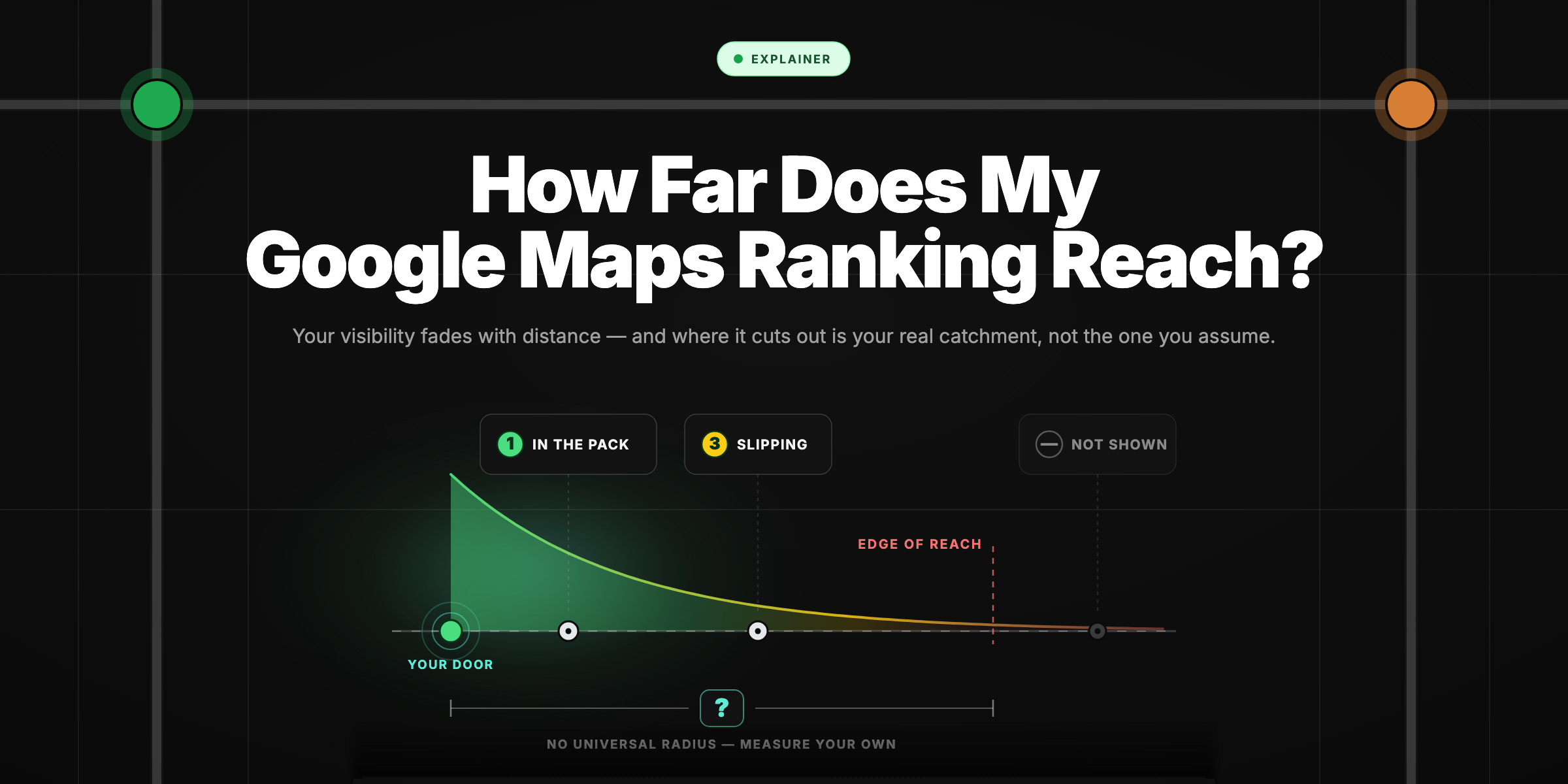
How Far Does My Google Maps Ranking Reach?
Your Google Maps ranking fades with distance. How far your visibility really reaches, what sets that range, and why your catchment isn't the one you assume.
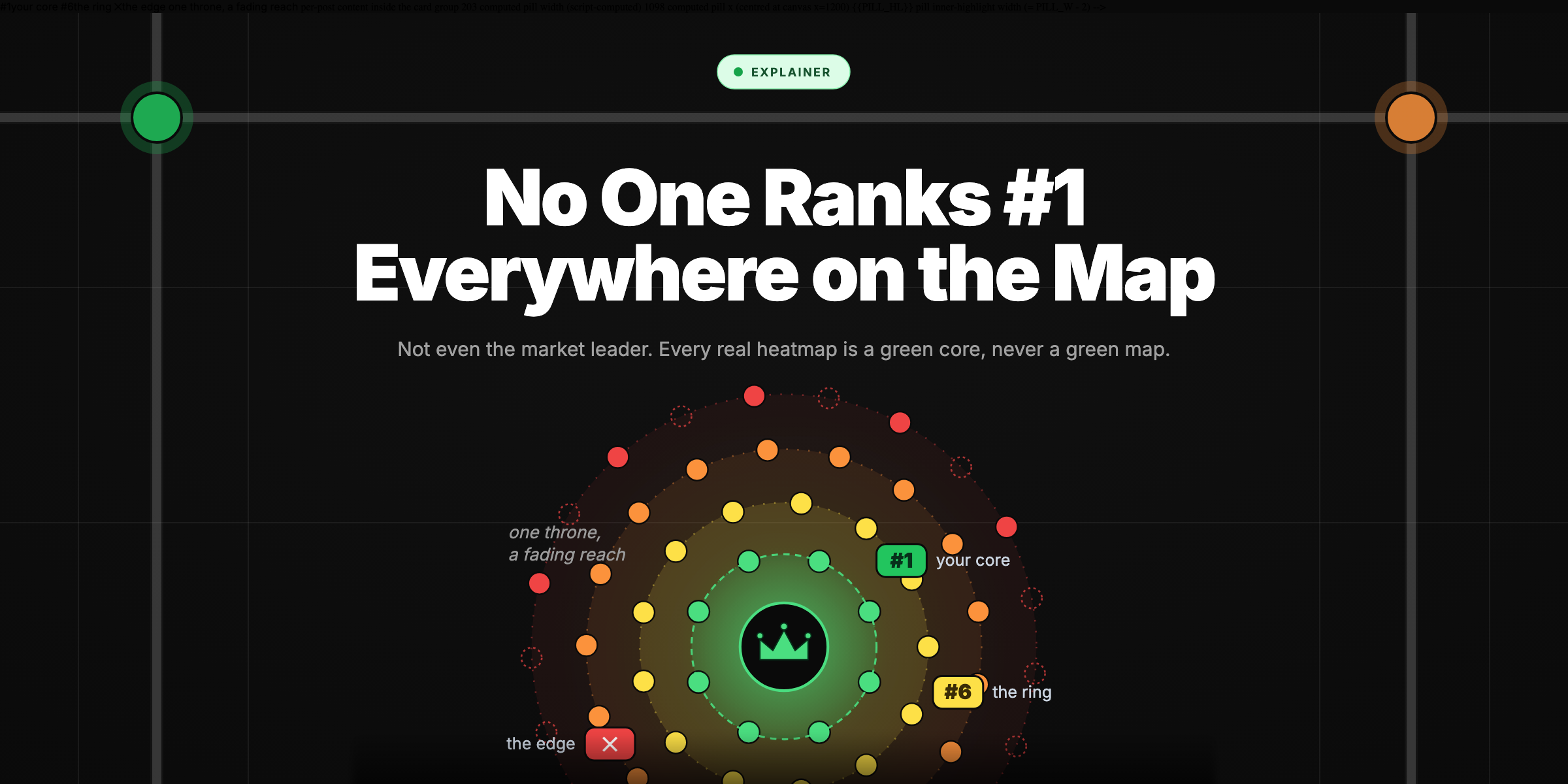
No Business Ranks #1 Everywhere on Google Maps
No local business ranks #1 across its whole service area — not even the market leader. Why total Map Pack domination is a myth, and the smarter goal.
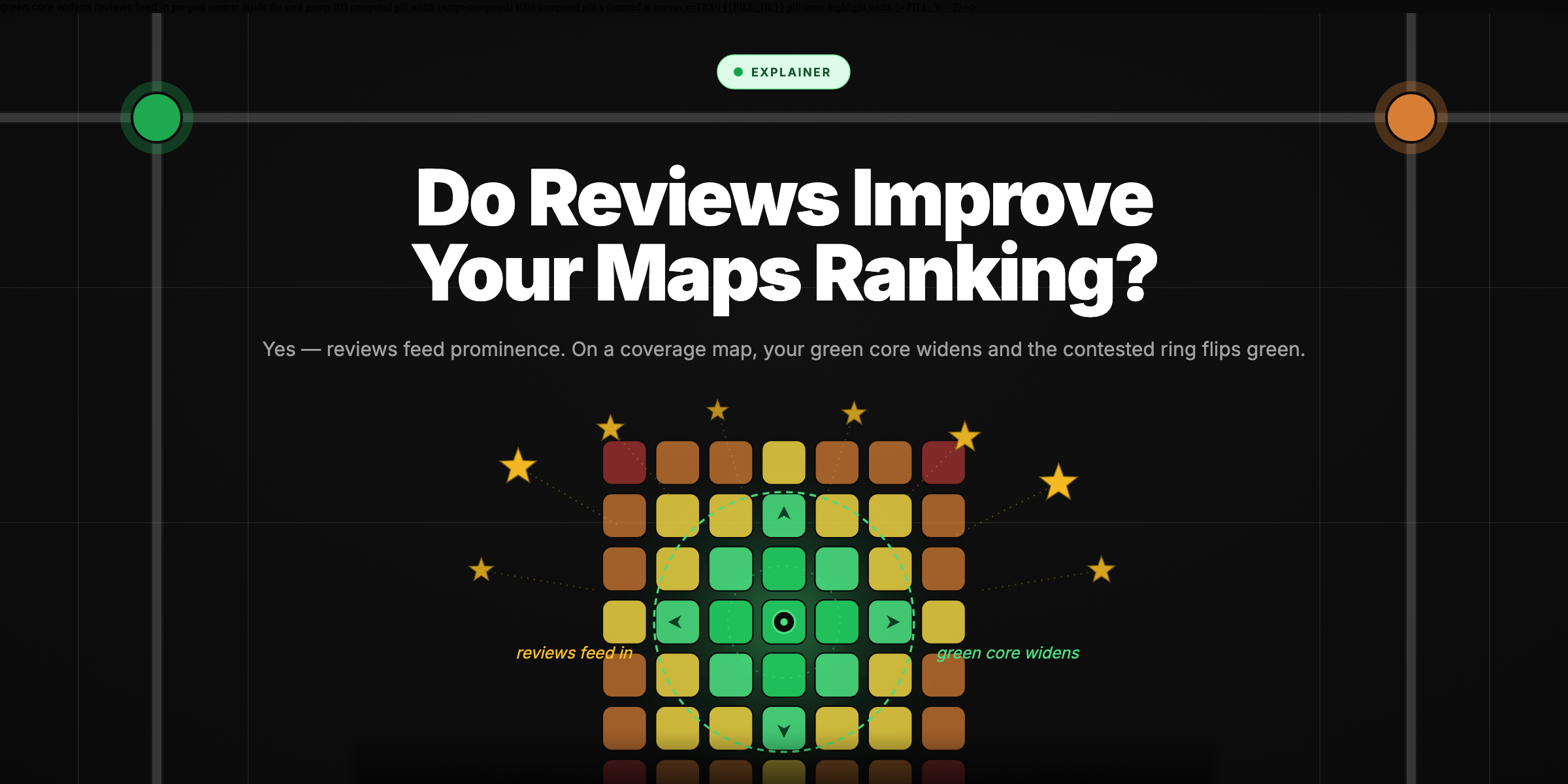
Do Reviews Improve Your Google Maps Ranking?
Reviews are a clear lever on your Google Maps ranking — they feed prominence, one of Google's three local factors. How they move your rank, and how to see it.
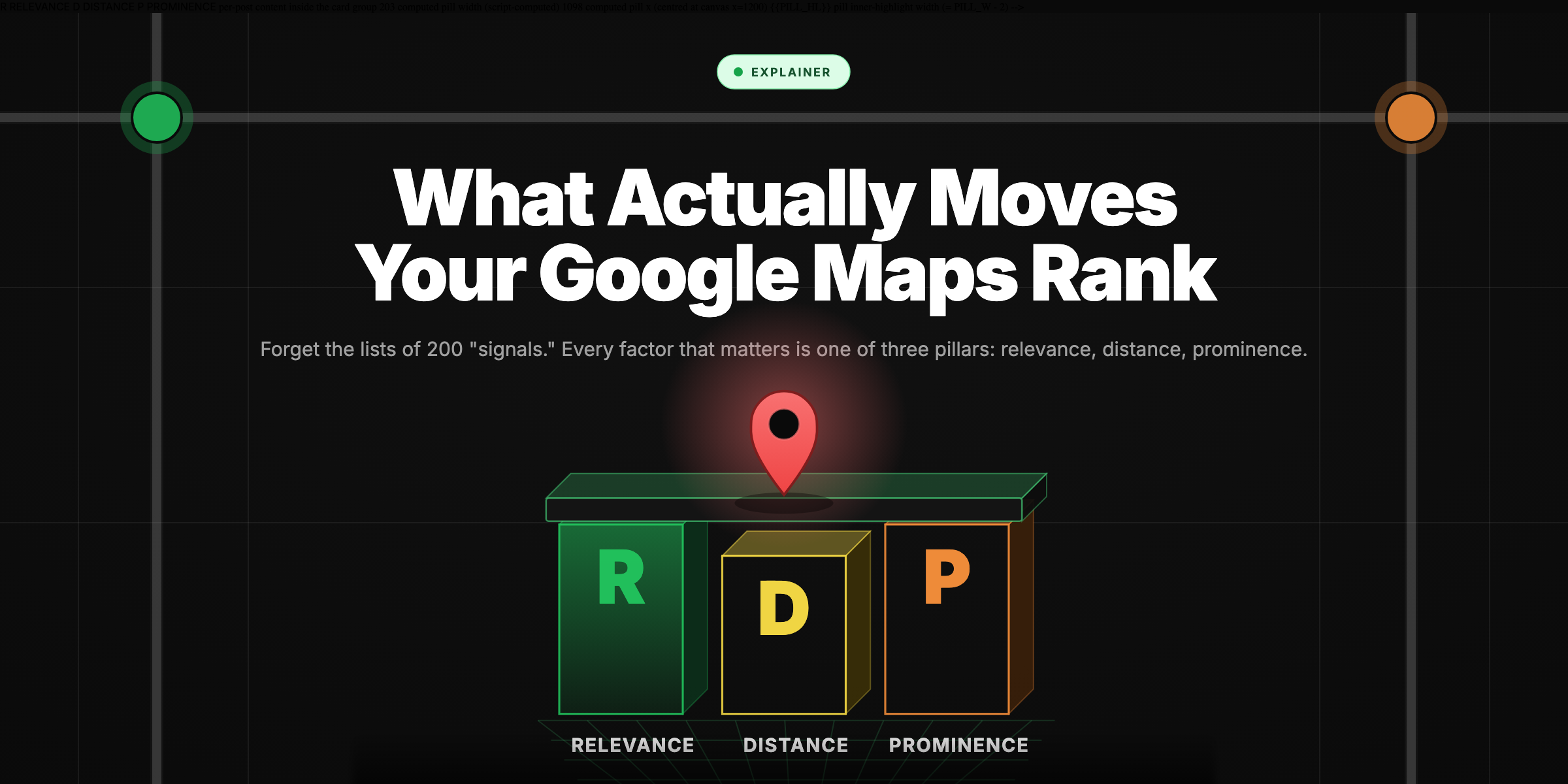
Google Maps Ranking Factors 2026: What Moves Your Rank
Google Maps ranking factors, explained through Google's three pillars: relevance, distance, and prominence. What actually moves your rank, and what's just noise.
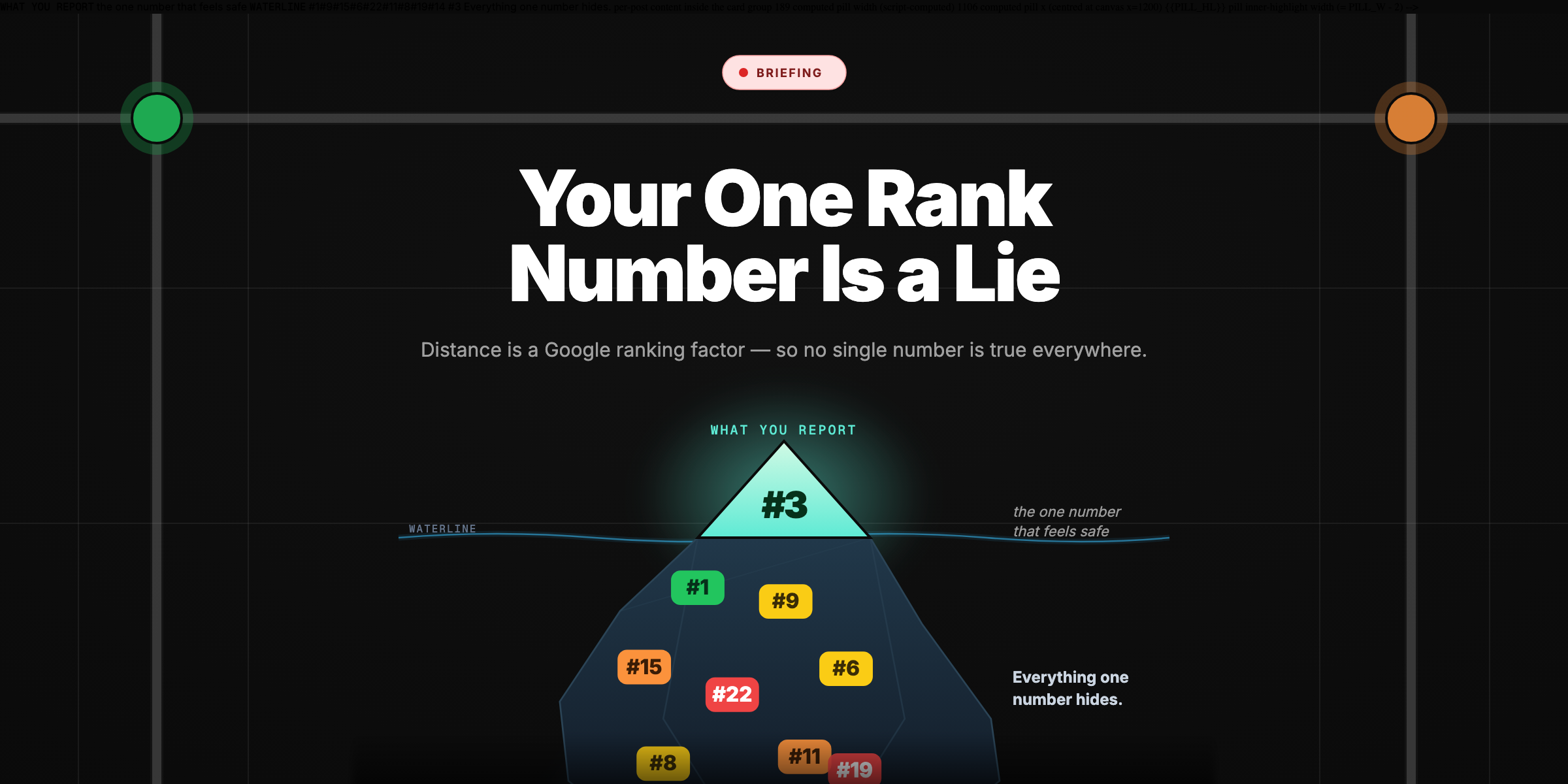
My Google Maps Ranking Dropped: What Actually Happened
You were #4, now you're #10, and nothing changed on your profile. A drop in one number usually means you lost some streets, not all of them. How to tell which.
Best Local Rank Trackers (2026): An Honest Comparison
Every 'best local rank tracker' list is written by a company selling one — and it always wins. We're pre-launch, so here's the honest, neutral version.