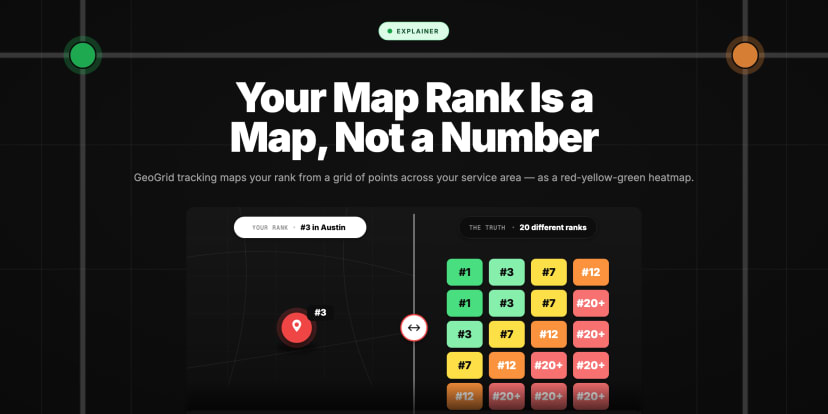
No Business Ranks #1 Everywhere on Google Maps
No local business ranks #1 across its whole service area — not even the market leader. Why total Map Pack domination is a myth, and the smarter goal.

Nobody Wins the Whole Map
- No local business ranks #1 across its entire service area — not the market leader, not the franchise, not the company outspending everyone. Every real Google Maps heatmap is a green core, never a green map
The reason is structural: **distance from the searcher is one of Google's three ranking factors**, so the farther a neighbourhood is from your address, the more a closer competitor outranks you — physics no budget overrides * "#1" isn't a single position you hold or lose — **it's a place.** You're #1 in some neighbourhoods, #7 in others, invisible at the edges, all for the same keyword at the same moment * Chasing #1 everywhere is **the wrong goal** — it's literally unachievable, and aiming at it wastes effort defending a green core that's already safe while ignoring the areas you could actually win * The smarter objective is **own your core, expand the contested ring** — protect the neighbourhoods you already win and push into the yellow cells next door, where small gains flip directly into Map Pack placements * You can't aim at any of this with a single rank number — you need to **see your coverage as a map** first, which is the whole reason [GeoGrid heatmaps exist](https://getrankonmap.com/blog/what-is-geogrid-rank-tracking) There's a fantasy that quietly runs underneath most local SEO: that if you do everything right — perfect profile, glowing reviews, strong site — you'll rank #1 for your keyword, and #1 will mean *#1, everywhere your customers are.* It's a comforting goal because it's simple and it sounds like winning. It's also impossible, and not in a "very hard" way — in a "the laws of how Google ranks local results forbid it" way. This piece is about the single most freeing fact in local search: **no business ranks #1 everywhere, including the one beating you.** Once you accept that, the goal changes from an impossible green map to a winnable one — and your effort stops leaking into places it can never help. ## The Fantasy of Total Domination > Every local business owner has, at some point, pictured the clean win: their name at the top of the Map Pack for the keyword that matters, full stop. It's the mental model behind most ranking goals — get to #1 and stay there. The problem isn't ambition. It's that the picture has no geography in it, and local search is nothing but geography. Ask someone what winning at local SEO looks like and you'll hear a version of the same thing: "be #1 for our main keyword." It's the scoreboard everyone imagines — a single throne, and the job is to climb onto it and defend it. That model is borrowed from regular Google search, where it almost makes sense: for a given query there's one results page, so being #1 means being #1 for everyone who searches. Local search looks like it should work the same way — same Google, same box of results — so the goal gets imported wholesale. Climb to the top, hold the top, win. But the Map Pack isn't one results page. It's a different page for every location a customer searches from. So "be #1" quietly smuggles in a word that was never true: **everywhere.** And the moment you say it out loud — "be #1 *everywhere*" — you can hear that it's not a stretch goal. It's a category mistake, the same one that makes [a single rank number a lie](https://getrankonmap.com/blog/one-rank-number-lies). There is no single throne. There's a whole map of them. ## What Every Real Heatmap Actually Looks Like
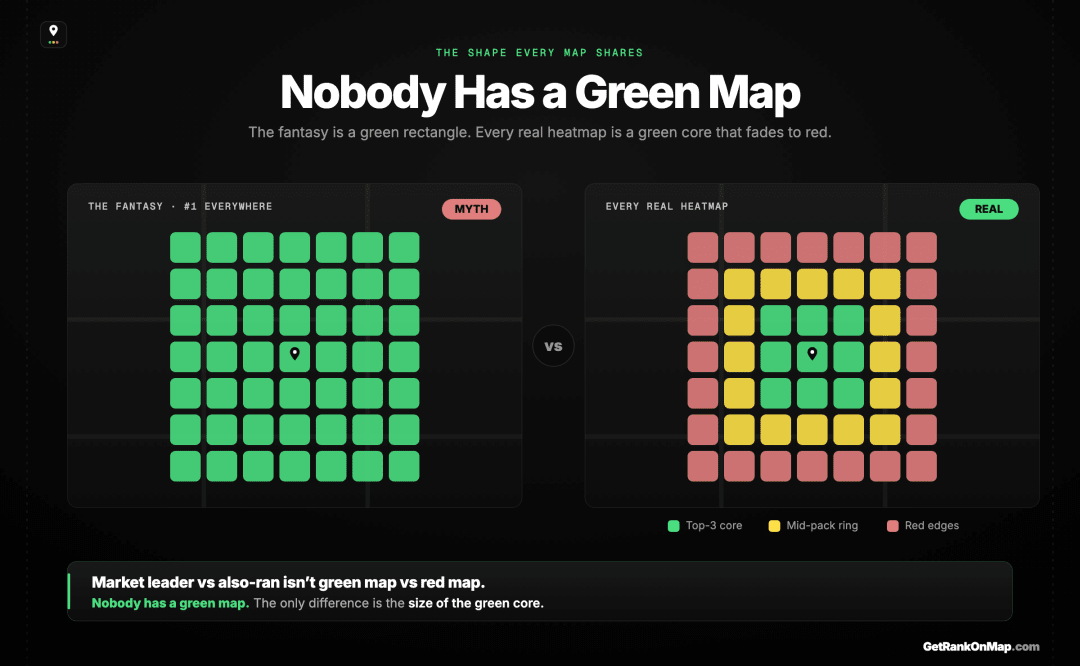
The strongest business in town has this shape. So does the weakest. The difference between a market leader and an also-ran isn't that one has a green map and the other a red one — nobody has a green map. The difference is the size of the green core and how far the yellow reaches before it surrenders to red. Domination, in reality, looks like a bigger green blob, not a green rectangle.
This is the visual that a text-only "rankings vary by location" explanation can never land. You don't argue someone out of the domination fantasy — you show them their own heatmap, point at the red third of it, and watch the goal rewrite itself.
Why Even the Market Leader Has Red Zones

The reason every map has the same shape isn't market-specific or fixable with effort. It's built into how Google decides local rankings. One of the three official factors is distance — and distance is the one thing about a searcher you can't change, can't optimise, and can't outspend. It guarantees that someone closer beats you somewhere.
Here's why the green core fades, every time, for everyone. Google has stated how it ranks local results: three factors — relevance, distance, and prominence. You can win relevance with a well-built profile. You can win prominence with reviews and authority. But distance is measured from the searcher's location to yours, and you cannot move your business to be close to everyone at once.
So picture the edge of your service area — a neighbourhood three suburbs over. A searcher there is far from you and close to a competitor who's based right there. Even if you have more reviews, a better profile, and a bigger budget, Google is weighing that competitor's proximity in their favour for that searcher. Often it's enough to beat you. Not because you did anything wrong — because they're there and you're not.
Multiply that across every edge of your map and the red rim is inevitable. The market leader isn't leading because they erased their red zones; they're leading because their green core is the biggest and their prominence stretches the yellow the furthest. Total domination would require being the closest business to every searcher simultaneously, which is not a marketing problem. It's geometry.
This is measurable, and we measured it. Across our own 300-cell study of the local pack — 12 markets, three Indian cities, 64,750 business-by-location observations — we fitted a model to predict whether a business would appear at a given point, and then refitted it from scratch with each group of features removed to see what the loss was.
Removing every reputation feature the industry optimises for — star rating, review count, all of it — cost the model almost nothing: 0.9223 down to 0.9162. Removing distance alone collapsed it from 0.9223 to 0.6259, which is barely better than guessing.
That is what a red zone is, stated numerically. The market leader's reviews and ratings travel with it to every point on the map; its distance does not. No amount of the first compensates for the second, which is why the strongest business in a city still goes dark a few kilometres out.
"#1" Is a Place, Not a Position
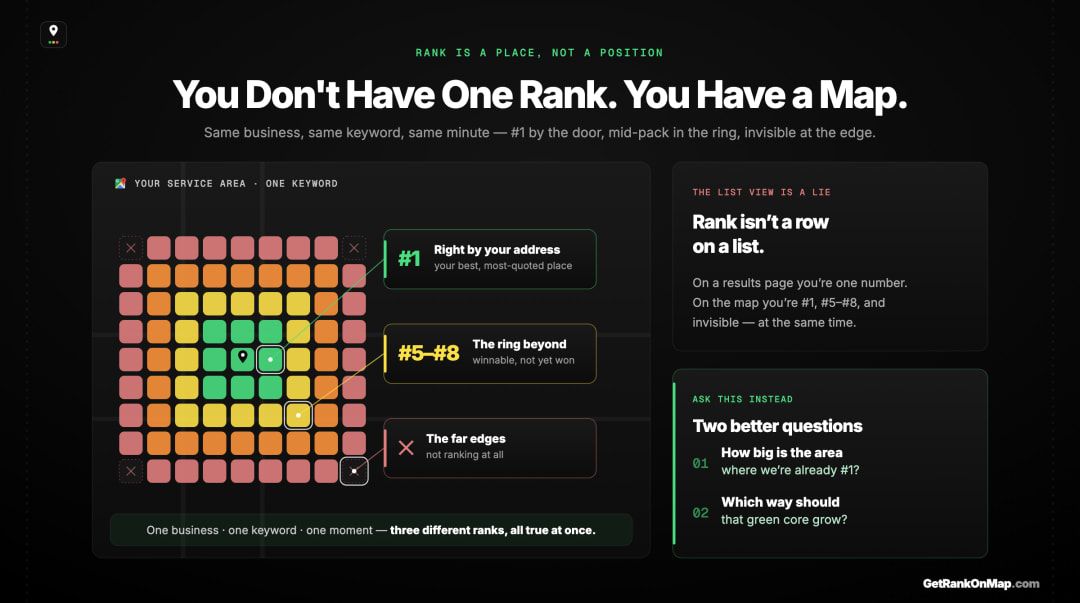
The single most useful mental shift in local SEO is to stop treating your rank as a number you hold and start treating it as a location you occupy. You don't have a rank. You have a rank here, a different rank there, and no rank at all over there — all at once, all for the same search. Once "#1" becomes a place, the whole game makes sense.
This is the reframe that makes everything click: your rank isn't a position on a list, it's a position on a map.
"We're #1" is an incomplete sentence. #1 where? You're #1 in the few neighbourhoods clustered around your location, probably #5 to #8 in the ring beyond that, and nowhere at all out at the edges — all true simultaneously, all for the same keyword in the same minute. "#1" describes one of those places, usually your best one. It was never a single status you'd earned across the board.
Once you internalise that rank is geographic, the questions get sharper and more honest. Not "are we #1?" but "how big is the area where we're #1, and which direction should it grow?" Not "did our rank drop?" but "which neighbourhoods did we lose, and to whom?" These are answerable, strategic questions. "Are we #1?" — with the silent "everywhere" attached — is neither.
The Smarter Goal: Own Your Core, Win the Ring

Giving up the domination fantasy isn't lowering your ambition — it's pointing it somewhere it can actually work. The winnable game has two moves: defend the green core you already hold, and convert the contested yellow ring next to it. The red far edges mostly aren't worth fighting, and knowing that is what lets you stop wasting effort on them.
If #1-everywhere is off the table, what should you actually aim at? A real, reachable goal in two parts:
-
Own your core. The green cells around your location are your base — the customers most likely to call and convert. The first job is never losing them. A competitor expanding toward you eats your core from the outside in, and on a single rank number you'd never see it coming until it reached your front door.
-
Win the contested ring. The yellow cells at the boundary of your green — where you're #4 to #7 — are the highest-leverage real estate you have. You're close enough that relevance and prominence gains can flip them green, and every cell that flips is a neighbourhood that starts seeing you in the Map Pack. This is where local SEO effort pays back fastest.
-
Be honest about the far red. The neighbourhoods way out at the edge, dominated by a competitor sitting in the middle of them, usually aren't worth the spend — the distance factor is working too hard against you. Knowing which red to ignore is as valuable as knowing which yellow to chase.
This is a strategy you can only run if you can see the core, the ring, and the edge. A single number shows you none of them — it shows you one cell and hides the board. (And most businesses aren't tracking even that much, so simply seeing the map puts you ahead of the field.)
How to See Where You Actually Stand
The strategy above needs a map, and the map needs the right tool. A GeoGrid scan lays a grid over your service area, checks your rank at every point, and draws the whole thing in colour — so the core, the ring, and the edges stop being abstractions and become something you can point at and plan around.
You can't aim at a core you can't see or defend a boundary you can't find. Seeing your real coverage takes a GeoGrid scan: a grid of points across your service area, your keyword run from each, the results drawn back over the map in green, yellow, and red. (Here's exactly how that works if you want the mechanics.) What comes out is the picture this whole article has been describing — your green core, the yellow ring you can win, and the red edges to leave alone.
That's what RankMap is built to give you: drop a grid over your service area, pick your keyword, and see your real Map Pack coverage — your colours against your competitors' — instead of one number pretending to be a throne you don't actually sit on.
RankMap isn't live yet — we're pre-launch. If you're ready to swap the impossible goal of ranking #1 everywhere for the winnable one of owning your core and taking the ring, join the waitlist for early access. You'll be first in line the day the map is ready.
Own the Core, Grow the Ring
The most freeing fact in local SEO is that the business beating you isn't ranking #1 everywhere either. Nobody is. Distance is one of the factors Google ranks on, and no amount of budget, reviews, or optimisation makes you the closest business to every searcher at once. So every real heatmap is the same shape — a green core, a yellow ring, red at the edges — and "domination" just means owning a bigger core than the next business.
That turns an impossible goal into a winnable one. Stop trying to be #1 everywhere; start owning the core you already hold and converting the contested ring next to it, neighbourhood by neighbourhood. The far red edges will stay red, and that's fine — knowing which battles to skip is half the strategy.
You just have to be able to see the board. That's what RankMap is built to show you — your real Map Pack coverage as a map, not a number that pretends to be a throne. We're not live yet, but when we are, you'll finally see where you actually win, where you can, and where to let go. Join the waitlist to be first in line.
Frequently asked questions
- 01Can any business rank #1 everywhere on Google Maps?
- No. Distance from the searcher is one of Google's three local ranking factors, so the farther a neighbourhood is from your location, the more a closer competitor is favoured there. Every business — including the market leader — shows a green core near its address that fades to red at the edges. Total domination would require being the nearest business to every searcher at once, which is geometrically impossible, not just difficult.
- 02Why does the market leader still beat me if they also have red zones?
- Because leading isn't about having no red zones — it's about having the biggest green core and the widest yellow ring. The strongest business in a market wins more neighbourhoods and holds them further out, thanks to relevance and prominence (profile quality, reviews, authority). But it still loses the far edges to whoever's physically closer there. The gap between you and the leader is the size of the green, not the presence of red.
- 03If I can't rank #1 everywhere, what should my goal be?
- Own your core and win the contested ring. Defend the green cells around your location, then push into the adjacent yellow cells where you're mid-pack — those flip to green with the least effort and each one is a new neighbourhood seeing you in the Map Pack. The far red edges, dominated by a competitor sitting in them, usually aren't worth chasing. It's a reachable goal, unlike #1 everywhere.
- 04Does this mean local SEO doesn't work?
- The opposite — it means local SEO works in a specific, measurable way. You can't make distance disappear, but better relevance and prominence genuinely grow your green core and stretch your yellow ring outward. The point isn't that effort is futile; it's that the *target* should be expanding your winnable coverage, not achieving an impossible clean sweep. Aimed at the right goal, the work pays off visibly on the map.
- 05How do I see which neighbourhoods I rank in and which I don't?
- Run a GeoGrid scan: it places a grid of points across your service area, checks your Map Pack rank at each, and draws the results as a colour-coded heatmap. That shows you exactly where you're green, yellow, and red — your core, your contested ring, and your edges — instead of the single number a traditional tracker reports from one spot. There's a full explainer linked throughout this piece.
- 06Isn't a single rank number good enough to track progress?
- No, because it can't show the geographic spread that defines local visibility. A single number might hold steady while you're quietly losing neighbourhoods on one side and gaining them on another — you'd never know. Tracking coverage as a heatmap shows whether your green core is actually growing, which is the only honest measure of progress in a game where your rank is different in every neighbourhood.
Explore with AI
Share this
Map your real rank across the city.
Free for the first 50 scans. No credit card.
Join the waitlist