Best Local Rank Trackers (2026): An Honest Comparison
Every 'best local rank tracker' list is written by a company selling one — and it always wins. We're pre-launch, so here's the honest, neutral version.

How We Ranked Them
- Almost every "best local rank tracker" roundup ranks the publisher's own tool at number one. We sell nothing yet, so this list ranks on merit, not on who owns the page
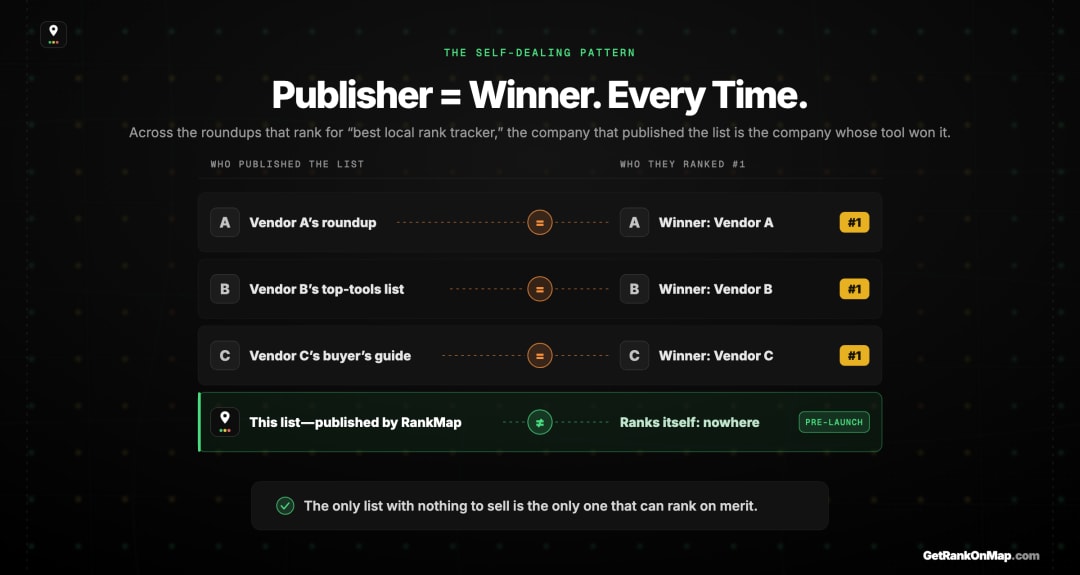
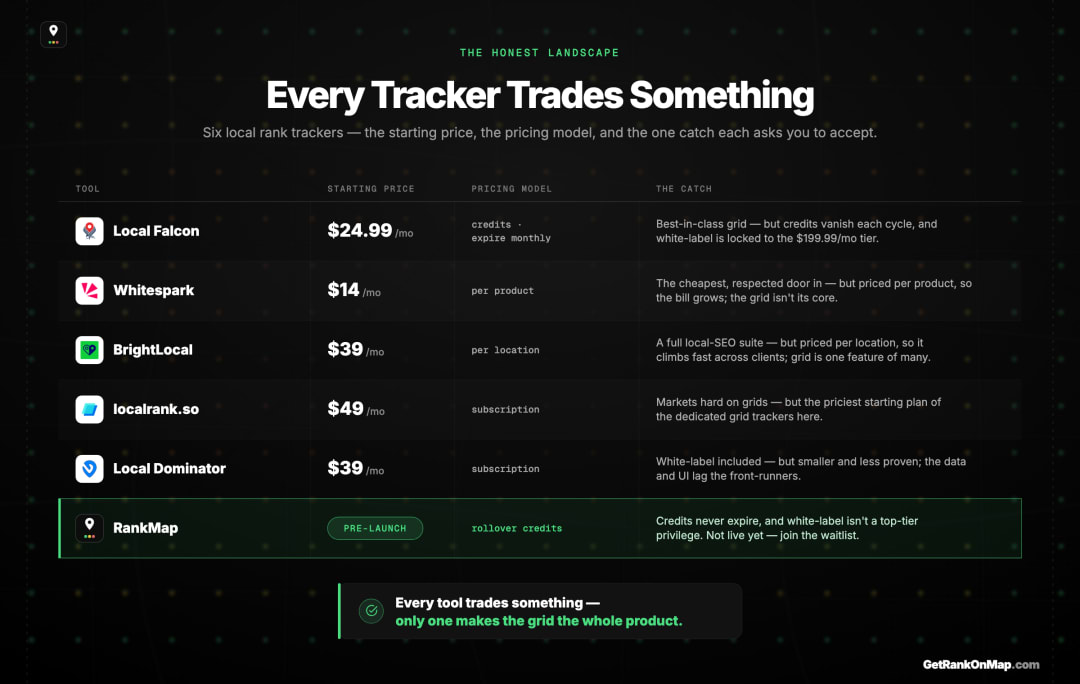
The single most important thing a local rank tracker does is not report a position — it is show you that you do not rank in one position. Your rank changes block by block, and a tool that hands you one number is hiding that * The honest local metric is average map rank across a grid of points, not a single "you're #3" snapshot taken from one spot * This is the only comparison in the category with a true side-by-side matrix: grid coverage, single-rank versus grid-average, the credit model, refresh cadence, [free tier](/blog/free-google-maps-rank-checker), and starting price in one place * The pricing model matters as much as the price. Expiring credits, per-location multipliers, and metered per-scan billing all decide what you actually pay to watch your own map — and they are rarely shown side by side * Best fit by use case: [Local Falcon](/blog/local-falcon-alternative) for scan-on-demand audits, [BrightLocal](/blog/brightlocal-alternative) for agencies already in its suite, [Whitespark](/blog/whitespark-alternative) for citation-led teams, Local Dominator for budget grid tracking Search for "best local rank tracker" and you will find a dozen confident roundups. Read four of them and the pattern is immediate: the company that publishes the list also sells the tool that wins the list. Local Falcon's guide leans toward Local Falcon. BrightLocal's comparison concludes you should use BrightLocal. Tool after tool, the author and the winner are the same company, and not one of them stops to explain why. That is not a comparison. It is an ad with a table in it. We can write the version that is not an ad, for one specific and slightly awkward reason: **RankMap is not live yet.** We are pre-launch. We have no subscription to defend and no reason to rig the order, so we are the one list in this SERP that gains nothing by lying to you. When our own tool appears later on this page, it appears clearly labelled as pre-launch with a waitlist link and no rank number — because pretending otherwise would make us exactly the thing this article exists to call out. Here is what the honest version adds that the vendor roundups do not: a real side-by-side feature matrix instead of scattered prose, a section that explains plainly what a local rank tracker actually measures, and a flat refusal to claim "we tested all of these" when no list in this category ever shows a benchmark to prove it. By the end you will know which local rank tracker fits your team, what these tools genuinely measure, and the one question that separates a useful tool from a vanity dashboard. ## Why Most "Best Local Rank Tracker" Lists Cannot Be Trusted
What a Local Rank Tracker Actually Measures (and Why One Number Lies)
Local search has no single "rank" the way a national keyword does, because Google personalises map results by the searcher's exact location. The same query returns a different winner two streets over. So a single position number is one reading from one spot, presented as if it described your whole market. The honest metric is your average rank measured across a grid of points spread over your service area — the heatmap, not the headline.
National rank tracking works on a simple assumption: one keyword, one results page, one position. Local search breaks that assumption at the design level. Google's map pack is ranked partly by how close the searcher is to your business, so your position is not a property of your listing — it is a property of where the person searching is standing. Run the same search from your front door and you might sit at number one. Run it from three miles away and you may not appear at all. There is no single true number, and any tool that reports one is choosing a spot for you and hoping you do not notice.
That is the entire reason grid-based, or GeoGrid, tracking exists. Instead of one query from one location, a grid tool runs the same search from dozens of points spread across your service area and plots the result as a heatmap — green where you rank well, red where you do not. The number that matters is the average map rank across that grid, and the picture that matters is where the red zones are, because each one is a pocket of customers who cannot find you. For the full breakdown of how grid tracking works and why it beats a single number, see our explainer on what GeoGrid rank tracking is.
Everything credible in this category is built on that idea. The tools below differ mostly in how wide they scan, how they bill you for it, and how clearly they show you the red.
One check we'd suggest running on any tool in this category. Sampling the map requires a zoom level as well as a coordinate, and getting it wrong produces no error — just a flatter heatmap than reality, with every grid point returning much the same businesses.
When we calibrated the instrument for our own measurement study, the mean pairwise overlap between neighbouring grid points was 0.698 at zoom 13 against 0.405 at zoom 16. The coarser setting was returning near-identical results across the whole grid. We also ran the same grid through a second data provider costing roughly 7.5× more, which scored 0.705 — statistically indistinguishable from not varying by location at all. It was disqualified. The check cost $0.13 and prevented about $6 of confidently wrong data.
We raise it because the failure is invisible from the outside: a flat heatmap looks like a finding about your business rather than a property of the sampling. If a tool publishes its grid geometry and zoom, that's a point in its favour. Most don't.
How We Evaluated These Tools (Our Honest Methodology)
The one section every other roundup skips. Here is exactly how this comparison was built, what we relied on, and what we did not independently verify — so you can weight it accordingly. An honest methodology that admits its limits is more useful than a confident "we tested everything" with no evidence behind it.
We judged each tool against the things that actually predict usefulness for a local business or agency: how wide a grid it scans, whether it reports a true grid average or leans on a single number, how its credit or per-location pricing behaves as you grow, refresh cadence, free-tier access, and price-fit by team size. Of these, the pricing model matters more than the headline price — expiring credits, per-location multipliers, and metered per-scan billing can quietly turn a cheap-looking plan into the expensive one.
Now the part the others leave out. The figures here are drawn from each vendor's own published pricing and documentation, checked live in June 2026, not from a controlled head-to-head benchmark we ran ourselves. We did not put all four tools on an identical business in an identical city and grade their accuracy against a ground truth, and we will not pretend we did. Where a vendor does not publish a spec, we marked it rather than inventing a plausible-looking number. And we have a structural interest to disclose: we are building a tool in this space, which is precisely why we listed ourselves with no rank and no claims we cannot yet support. The honest version of "we tested everything" is "here is what we verified, here is what we did not, and here is how to check the rest yourself."
The Tools, Reviewed
Local Falcon: Best for Scan-On-Demand Map Audits
Local Falcon is the most recognised name in grid-based local rank tracking, and for good reason — its scan grids, from 3×3 up to 15×15, produce the clean heatmap visual the whole category is now judged against. For one-off audits and client pitches, dropping a grid on a map and watching the green-to-red gradient appear is hard to beat.
- Configurable scan grids with a polished heatmap output
- Strong for agency reporting and new-client audits
- Reports a genuine grid average, not a single position
Pricing starts at $24.99/month. Watch-out: it runs on scan credits that expire monthly, so the cost is really per-scan, and white-label reporting sits on the Premium plan at $199.99/month. Good fit for teams that audit in bursts; not a fit for anyone who wants to watch the same locations continuously without burning credits they cannot roll over.
BrightLocal: Best for Agencies Already in Its Suite
BrightLocal is a full local-SEO platform — citations, reviews, audits, and a geo-grid rank tracker in one place. For an agency already living in BrightLocal, adding grid tracking without adopting a second tool is the operationally efficient path, and the suite breadth is real.
- Geo-grid tracking inside a broader local-SEO toolkit
- One dashboard for citations, reviews, and rank
- Trusted, long-established platform
Pricing starts at $39/month for the Track plan, rising to $49 (Manage) and $59 (Grow). Watch-out: billing is per location, so cost scales with your client count — twenty locations is twenty multipliers — and the geo-grid on the base plan is capped near five keywords. A roughly 5% price increase is signalled for 1 July 2026. Good fit for agencies already inside BrightLocal; not a fit if you want deep grid tracking without paying for the whole suite per client.
Whitespark: Best for Citation-Led Local SEO
Whitespark built its reputation on citation building and local-SEO services, and its Local Rank Tracker is a respected, affordable subscription. Its grid product — Local Ranking Grids — is genuinely good, with pay-per-pin pricing and credits that do not expire.
- Affordable subscription rank tracker
- Grid credits that do not expire — a real advantage over expiring-credit models
- 200 free grid credits to start
Watch-out: the grid is sold as a separate product from the subscription tracker, so the heatmap most people actually want is a metered add-on (around $0.005 per pin) layered on top of the base plan, not the core of the tool. Good fit for citation-first teams who want grids occasionally; not a fit for anyone who wants grid tracking to be the main event rather than a bolt-on.
Local Dominator: Best for Budget Grid Tracking
Local Dominator offers geo-grid map scanning at an accessible entry point, positioned as a straightforward way to plot your map rank without a full SEO suite around it. For a smaller business that wants the heatmap and not much else, it is a credible budget option.
- Geo-grid map scanning at a low entry price
- Focused on rank visualisation rather than a sprawling toolkit
Pricing starts around $39/month. Watch-out: it is the tool in this list we have the least independent visibility into, so confirm grid size, refresh cadence, and current pricing directly before committing. Good fit for budget-conscious single businesses; not a fit for agencies needing white-label depth or large multi-location reporting.
RankMap: Pre-Launch (Listed in the Open)
This is our own tool, and the honest thing to do is show it to you with the same scrutiny as the rest — minus the rank we have not earned. RankMap is not live yet. We are building it around the one principle this whole article keeps returning to: that a single local "rank" is a half-truth, and credible measurement means scanning a grid across your whole service area and showing you the average and the red zones, with pricing that does not punish you for looking.
- Planned: grid-first tracking where the heatmap is the core, not an add-on
- Planned: pricing that does not lean on expiring credits or per-location multipliers
- Not yet available — join the waitlist to be told when it is
We have deliberately given ourselves no rank number and made no spec claims we cannot yet support. If we listed ourselves first, like everyone else does, you would be right to close the tab. If the honest alternative to a specific tool is what you are after, we have also written up the Local Falcon alternative we are building, along with our take as a Whitespark alternative and a BrightLocal alternative.
How to Choose the Right Local Rank Tracker for Your Team
There is no single winner, and any list that names one is usually naming its own product. The right tool depends on who you are.
- Agency running audits and client pitches: Local Falcon, for the cleanest heatmap and scan-on-demand grids — just watch the expiring credits.
- Agency already inside a local-SEO suite: BrightLocal, to keep citations, reviews, and grid tracking in one place — budget for the per-location multiplier.
- Citation-led team that wants grids occasionally: Whitespark, for an affordable tracker and non-expiring grid credits as a bolt-on.
- Budget-conscious single business: Local Dominator, for grid tracking at a low entry price — confirm the specs first.
Whichever you pick, the decisive question to ask any vendor is the same: does this show me my average rank across a grid, or one number from one spot? If the answer is one number, you are buying a half-truth.
Rank the Tools by the Job
Whichever tool you pick, decide your cadence with daily vs periodic map rank tracking.
Almost every "best local rank tracker" list in this market is written by a company selling one of the tools, and the conclusion is fixed before the comparison begins. We could write the neutral version only because we have nothing to sell you yet — and when our own tool entered this list, it entered with no rank and no claims we cannot support. That is the whole point.
The tools that earn a place are genuinely useful within honest limits. Local Falcon leads for scan-on-demand audits. BrightLocal fits agencies already in its suite. Whitespark serves citation-led teams with non-expiring grid credits. Local Dominator is the budget grid entry. None of them gives you a single true rank, because in local search no honest tool can — what they give you is a map, and the value is in reading where the red is.
At RankMap, we are building the version where that map is the whole product, priced so that looking at it does not cost you more every month. When our tracker is ready, you will find it held to exactly the standard we have just held everyone else to. Join the waitlist to know when it lands.
Frequently asked questions
- 01What is the best free local rank tracker?
- There is no fully free grid-based local rank tracker worth relying on, because running a grid of searches costs the vendor real money per scan. The most accessible starting points are Whitespark's 200 free grid credits and the free trials offered by Local Falcon and BrightLocal. For ongoing tracking, a paid tool becomes worth it once you need to watch the same locations regularly rather than run the occasional one-off audit.
- 02What is a GeoGrid or grid-based rank tracker?
- A grid-based rank tracker runs the same local search from many points spread across your service area — arranged in a grid — and plots each result as a heatmap, usually green where you rank well and red where you do not. It exists because local map rankings change with the searcher's location, so a single position number cannot describe your real visibility. The grid average and the location of the red zones are the metrics that matter.
- 03Why does my Google Maps rank change depending on location?
- Because proximity is a ranking factor. Google's map pack weights how close the searcher is to your business, so someone searching from next door sees a very different result than someone three miles away. Your "rank" is therefore not a single property of your listing — it varies continuously across your service area, which is exactly why grid tracking replaced single-keyword tracking for local businesses. We cover this in depth in our piece on [why one rank number lies](https://getrankonmap.com/blog/one-rank-number-lies).
- 04How often should I run a local grid scan?
- For most local businesses, weekly to monthly is the right cadence. Daily scanning mostly captures minor fluctuation and burns credits without adding insight, while quarterly misses real movement after a content push, a review campaign, or a competitor's change. A steady weekly or fortnightly grid over the same points is what turns scans into a trend you can act on.
- 05Why do expiring credits and per-location pricing matter so much?
- Because they decide what you actually pay to watch your own map. Credits that expire monthly mean unused capacity is lost, so the real cost is per-scan rather than the headline subscription. Per-location billing means a twenty-client agency pays twenty multiples. Two tools with the same sticker price can cost very differently once their pricing model meets how you really work — which is why the matrix above lists the model, not just the price.
- 06Can a small business rank well in one area and badly in another?
- Yes, and most do. It is completely normal to dominate the map pack within a mile of your premises and be invisible at the edge of your service area, because proximity pulls your rank down as the searcher moves away. That gap is not a failure — it is information. The red zones on a grid scan are precisely the neighbourhoods where focused work, more reviews, or a service-area adjustment can win you customers you are currently losing.
Explore with AI
Share this
Map your real rank across the city.
Free for the first 50 scans. No credit card.
Join the waitlist

