Ranked #1 and the Phone Still Isn't Ringing
A #1 map pack spot with a quiet phone has two causes a ranking report can't tell apart: a #1 measured from one spot, or a click lost on trust.

A local business can hold the number one position in the Google Maps map pack and see no change in the number of calls it gets. This is the most common hard conversation in local SEO, and it has two entirely different causes that a ranking report cannot tell apart. Either the #1 is real only at the point it was measured from — usually the business's own address — or the #1 is real everywhere and the business is still losing the click to whoever sits below it. The first is a measurement problem. The second is a trust problem. On 15 July 2026 a practitioner laid the second one out in r/localseo in a way worth quoting in full, because the shape of it is exact.
The setup is almost always identical. They've been paying for SEO for a year. The monthly report is full of green arrows. Rankings are actually up, impressions up, traffic up. Then they ask the only question that matters: "So why aren't we getting more calls?"
And the report has no answer, because nobody was tracking calls in the first place.
r/localseo, July 2026
Two Causes, and the Report Sees Neither
  CAUSE 1 — the #1 is one sample
    measured from the shop counter, where you are closest to yourself.
    three streets out you are #6. most searches happen three streets out.
    -> a COVERAGE problem. the profile is fine.

  CAUSE 2 — the #1 is real and still loses
    you are top of the box in the whole area and the customer picks #3.
    -> a CONVERSION problem. the position is not the thing to fix.
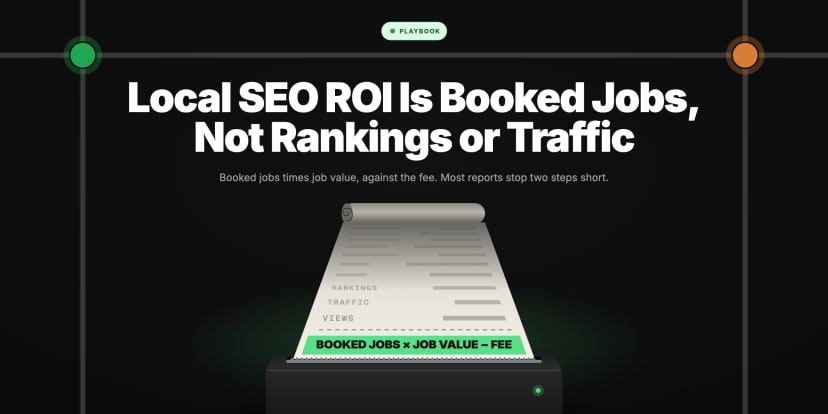
A ranking report with green arrows is compatible with both. That is the whole difficulty: it is not a wrong report, it is a report answering a question the client did not ask. And an agency that cannot separate these two on demand will spend the next quarter optimising the wrong one.
Cause One: You Are Not #1 Where the Searches Are
Position in the map pack moves with the distance between the business and the person searching. Check from your own premises and you are reading the single most favourable point on the map, because it is the point you are closest to. Customers are rarely standing at your counter when they search.
The test is to measure the same keyword from many points across the area rather than once, and look at the shape rather than the number — which is what geo-grid rank tracking is for. A business that is green at the centre and red at the edges is not ranking #1 in any meaningful sense; it is ranking #1 in the one place it did not need to.
  WHAT A SINGLE #1 CAN HIDE
    at the shop            #1     <- the number in the report
    1 km north             #3
    2 km east              #7
    3 km south             not in the pack at all
  same keyword, same day, four points
This is not a hypothetical failure mode. It is the default reading of why one rank number lies, and it is why a client checking from home gets a different answer to the one in the report and concludes that the report is wrong.
Cause Two: You Are #1 and the Customer Still Picks Someone Else
If the coverage is genuinely good, the position is not the problem, and the July 2026 thread describes the alternative precisely:
A plumber ranks #1 in the map pack. Great. But the profile sits at 3.9 stars from 40 reviews, the newest photo is three years old, two recent reviews mention that nobody answers the phone, and the owner has never replied to a single one.
Meanwhile the guy at #3 has 4.8 from 300 reviews, replied to his last bad review like an actual human, lists pricing ranges on his site, and picks up on the second ring.
r/localseo, July 2026
The conclusion in that post — "position loses to trust every time" — is stronger than the evidence supports as a universal rule, but the mechanism is real and it is the part agencies under-report. The map pack shows three businesses side by side with their rating, their review count and their photos. Being first in a row of three is a small advantage. Being first with 3.9 stars next to a 4.8 is not an advantage at all.
What Actually Converts, Once You Are Visible
The same post names four things, and they are all observable on a competitor's profile without any tooling:
| what the customer sees | why it decides the call |
|---|---|
| The newest five reviews | People read recent, not lifetime. A 4.9 with nothing new in eight months reads as a closed business |
| Owner replies, especially to bad ones | A reply is the only evidence in the listing that a human is on the other end |
| Photos with a date on them | A three-year-old newest photo suggests the business may not still exist |
| Whether the phone is answered | Two reviews saying nobody picks up will outweigh the position above them |
None of that is ranking work, and none of it appears in a ranking report. That is the gap the client is pointing at when they ask why the phone is quiet.
Review pattern matters more than review total here, which is the same finding as what reviews actually do for Maps ranking: a steady trickle reads as a live business, a large dormant number does not.
Why the Green-Arrow Report Keeps Happening
Because every metric in it is cheap to produce and none of it is falsifiable by the client. Impressions go up on their own as a profile ages. Traffic goes up when anything is published. A position checked from one favourable point goes up more often than it goes down.
The fix is not a prettier report. It is reporting something the client can reproduce:
- The same points, every time. A named set of locations across the area they sell into, not a position from wherever the tool happened to check.
- The same keyword, stated in the report. Not "rankings improved" — the phrase, written out.
- The same cadence. Weekly or monthly, chosen once. Comparing a weekly reading to a monthly one produces movement that is not movement.
- One conversion number next to it. Calls, form fills, bookings — whatever the business already counts. It does not have to be attributed perfectly. It has to be present, so the two lines can be looked at together.
The fourth is the one that ends this conversation permanently, and it is the one most often missing. A report with rankings and no conversion line is a report that cannot answer the only question the client will ever ask of it.
Set the Expectation Before You Take the Work
The conversation is much easier when it happens at the start. Position is a visibility measurement; it is not a demand measurement and it is not a promise about the phone. In a category with genuinely low search volume, a business can be dominant across the whole map and still get very few calls, because the map is not where the shortage is.
Saying that in the first meeting costs one uncomfortable minute. Not saying it costs you the fourth month, which is when a client who has seen four green reports and no change in the phone decides the work is not working — and by then the argument is about the invoice, not the measurement.
The Client Checked It Themselves and Got a Different Number
This lands in the same conversation almost every time. The report says #1, the owner searched on their phone at home, and they were fourth. Both readings can be correct, and the client is not being difficult.
  WHY A SELF-CHECK DISAGREES WITH THE REPORT
    different LOCATION      they searched from home, not the shop
    personalised RESULTS    their account, their history, their previous taps
    a different MOMENT      map results move day to day on their own
    a different PHRASE      they typed what they would type, not the tracked term
Every one of those makes the self-check the least reliable measurement available, and the client will still trust it more than the report — because they did it themselves and they can repeat it.
That is the lesson to take, rather than the argument to win. A measurement the client can reproduce beats a measurement they have to accept. Naming the points you measure from, in the report, and inviting them to check one, converts the most damaging conversation in the relationship into the most reassuring one.
When the Map Is Not the Shortage
There is a third possibility, and it is worth ruling in before promising anything. The business may be visible across the whole area, converting fine, and still quiet — because not enough people are searching for the thing at all.
Visibility work cannot manufacture demand that is not there. A category with a few dozen local searches a month will not produce a busy phone no matter who holds the pack, and an agency that has not checked this is selling against a ceiling it cannot see. The honest sequence is coverage first, conversion second, demand third — and if demand is the answer, say so, because the alternative is being paid for another six months to move a number that was never the constraint.
What to Do When the Client Asks Today
- Measure across the area before answering. If the coverage is patchy, you have your answer and it is cause one. Do not skip this because you believe the coverage is fine — believing is what produced the green arrows.
- If coverage is good, open the competitor's profile next to your client's. Rating, review count, newest review date, newest photo date, owner replies. Read it as a customer would, in that order.
- Check whether the phone is actually answered. It is the least technical item on this page and it has ended more of these conversations than anything else.
- Add one conversion line to the report, this month, even if the attribution is imperfect. The imperfect version is infinitely better than the absent one.
- Re-measure the same points next cycle. A change is only a change against an earlier reading of the same grid.
Frequently asked questions
- 01Why am I ranked #1 on Google Maps but getting no calls?
- Either the #1 is only true where it was measured, usually at your own address, or it is true everywhere and customers still pick a competitor with stronger reviews and photos. Measure across your area first to see which.
- 02Why does my client see a different ranking than my report?
- Their check comes from a different location, a personalised account, a different moment and often a different phrase. Name the points your report measures from and invite them to check one of those.
- 03What makes customers choose #3 over #1 in the map pack?
- What they can see: the newest reviews, owner replies, dated photos and whether the phone gets answered. Being first next to a much better-rated listing is a small advantage.
- 04What should a local SEO report show besides rankings?
- The same points, the same keyword and the same cadence every time, plus one conversion line such as calls, form fills or bookings. Imperfect attribution is fine. A missing conversion line is not.
- 05Can a business rank #1 everywhere and still be quiet?
- Yes, when too few people search for the service at all. Visibility cannot create demand. Check search demand before promising a busier phone, and say so if demand is the limit.
Sources
Cited Accessed September 2026.
- r/localseo, 15 July 2026, ranked #1 and the phone still isn't ringing reddit.com. Supports the green-arrow report with no call tracking; the 3.9/40 vs 4.8/300 plumber comparison; review recency, owner replies, photo age and answering the phone as the four conversion factors.
- Google, improve your local ranking support.google.com. Supports distance as one of the three named factors, which is what makes a single measured position a sample rather than a ranking.
Explore with AI
Share this
Map your real rank across the city.
Free for the first 50 scans. No credit card.
Join the waitlist