BrightLocal vs Local Viking (2026): Billing, Not Features
Local Viking's pricing now renders as Local Optics, billed in credits — not locations. That changes the BrightLocal comparison more than any feature does.

Billing Decides This One
- Local Viking's pricing page now renders under the name Local Optics. The marketing site still says LocalViking; the pricing app doesn't. We checked on 2 August 2026. Any comparison that doesn't mention this is working from stale information.
- The two products meter you in incompatible units. BrightLocal bills per location. Local Viking/Local Optics bills in credits — and splits them into two separate pools, one for keyword tracking and one for GeoGrid scans.
- That means the headline prices don't compare. Which tool is cheaper depends entirely on your ratio of locations to scan frequency, and the answer flips depending on which way that ratio runs.
- BrightLocal is a suite with grid tracking added on. Local Viking is a GBP-management and grid tool. Neither is "better"; they're built around different centres of gravity.
- The failure mode with credit pricing is running out of one pool while the other sits unused. It's the most common complaint about this billing model and it's structural, not a bug.
Start With the Name Change
Before anything else, a correction that most articles on this comparison haven't made yet.
As of 2 August 2026, loading localviking.com/pricing/ in a real browser renders a pricing page branded Local Optics, not Local Viking. The marketing pages still carry the LocalViking name; the product's own pricing surface does not.
We're flagging it rather than resolving it, because we can't tell you from the outside whether this is a completed rebrand, a partial one, or two products sharing a domain. What we can tell you is that if you're evaluating this tool, you should expect to see a name you didn't search for, and that any article confidently reprinting "Local Viking's pricing" from an older source may be describing a product that has since been repackaged.
Throughout this article we'll use "Local Viking" because that's the name in circulation and the name you searched for, with the understanding that the current product presents as Local Optics.
What Each Tool Is Built Around
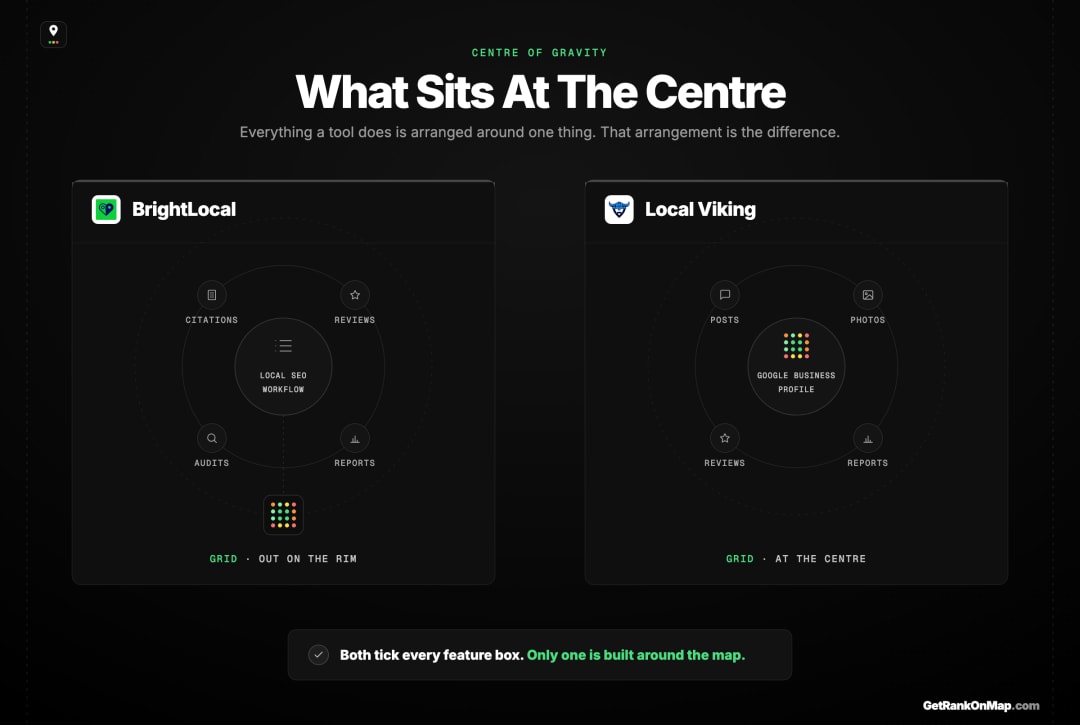
The most useful comparison in this category isn't feature-by-feature. It's asking what each product's centre of gravity is — what it was designed to do first, with everything else arranged around it.
BrightLocal is a suite. Its centre is the local SEO workflow as a whole: citations and listings management, review monitoring, local audits, and — the part agencies actually pay for — white-label client reporting. Rank tracking lives inside that, and grid tracking exists as Local Search Grid, an add-on layer with grid sizes listed from 5×5 up to 21×21. You're buying a platform that can also draw a heatmap.
Local Viking is a GBP and grid tool. Its centre is Google Business Profile management — posting, scheduling, managing the profile itself — with geo-grid tracking as a first-class part of the product rather than an add-on. It doesn't try to be the whole stack, and it doesn't price like it does.
If you've read the "39 alternatives" listicles that rank for this term, you'll notice this distinction gets flattened into a feature table where every row is a checkmark. The checkmarks are mostly accurate and mostly useless, because the question isn't whether a product technically has a feature — it's whether that feature is what the product is organised around.
The Real Difference: How Each One Charges You
The meter is what people actually feel. A freelancer in May 2026, running six small businesses:
the local grid tool is useful but not $50-60/month useful for six small businesses.
r/localseo, May 2026
That is not a judgement on the grid. It is arithmetic about who the bill is spread across.
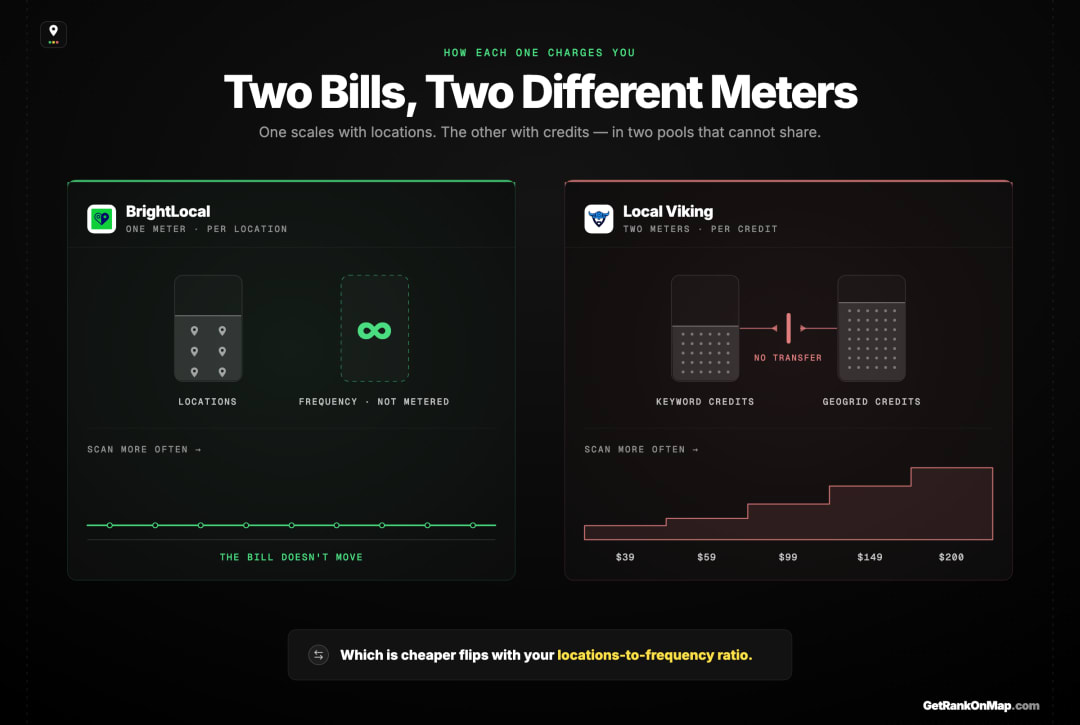
Here's the part that actually decides the purchase, and the part almost no comparison article covers properly.
BrightLocal bills per location
Read from BrightLocal's own pricing page on 2 August 2026, the metering unit is the business location. Your bill scales with how many locations you track.
The consequences are worth thinking through. At one location it's inexpensive and completely predictable — you know your bill in January and it's the same in December. At forty locations, the same price sheet produces a very different number. And crucially, scanning more often costs you nothing extra. Once a location is on the plan, running a report weekly instead of monthly doesn't change the bill.
Local Viking bills in credits — two separate pools
Local Viking's published plans, read from its own pricing page on 2 August 2026, run from $39 to $200 per month. But the number that matters isn't the price, it's what each plan buys:
| Plan | Price | Listings | Keyword credits | GeoGrid credits |
|---|---|---|---|---|
| Single | $39/mo | 1 | 1,600 | 7,500 |
| Starter | $59/mo | 10 | 3,200 | 8,100 |
| Pro | $99/mo | 20 | 5,600 | 16,200 |
| — | $149/mo | — | 17,700 | 24,300 |
| — | $200/mo | — | 26,600 | 32,400 |
Two things jump out. First, your cost scales with how much you look, not how many locations you own — and grid size is the multiplier that matters, because a 15×15 grid is 225 separate searches against 25 for a 5×5. Second, and more consequentially, keyword credits and GeoGrid credits are metered separately.
That separation is the structural weak point of this model. You can exhaust your GeoGrid allowance halfway through the month while thousands of keyword credits sit unused, and there's no way to move value from one pool to the other. Whether that bites depends entirely on whether your usage pattern happens to match the ratio the plan was designed around.
Which is cheaper depends on a ratio, not a price
So the honest answer to "which costs less" is that it inverts depending on where you sit:
- Many locations, occasional scans — a multi-location business checking quarterly — tends to favour the credit model, because you're not paying a per-location fee twelve times a year for a tool you open four times.
- Few locations, frequent scans — a single business owner or a small agency watching a handful of clients closely — tends to favour per-location pricing, because unlimited-frequency scanning at a fixed price is exactly what that model gives you.
- Large grids are the thing that breaks credit budgets fastest. If you want 13×13 or larger regularly, model the credit consumption before you subscribe, not after.
Work out your own numbers first: locations, keywords, scans per month, grid size. Then price it. Comparing "$39 versus BrightLocal's entry tier" without doing that is comparing figures that don't share a denominator, and it's how people end up on the wrong plan at both vendors. We've written more on the three billing models running through this whole category if you want the wider picture.
Where They Genuinely Differ on Capability
Setting billing aside, a few differences are real and stable enough to be worth stating.
GBP posting and scheduling. Local Viking does this as a core function. If publishing to Google Business Profile on a schedule is part of your week, that's a meaningful reason to pick it, and it isn't what BrightLocal is for.
Client reporting. BrightLocal's white-label reporting is the mature offering here, and it's the single most common reason agencies stay on the platform. If you present to clients monthly, this is likely the deciding feature and everything else is secondary.
Citations and listings. BrightLocal's territory. Local Viking isn't trying to compete on it.
Grid tracking. Both draw grids. BrightLocal's goes to 21×21 as an add-on; Local Viking's is core to the product and metered by credit. Which serves you better depends on the frequency question above rather than on the grid itself.
Who Should Pick Which
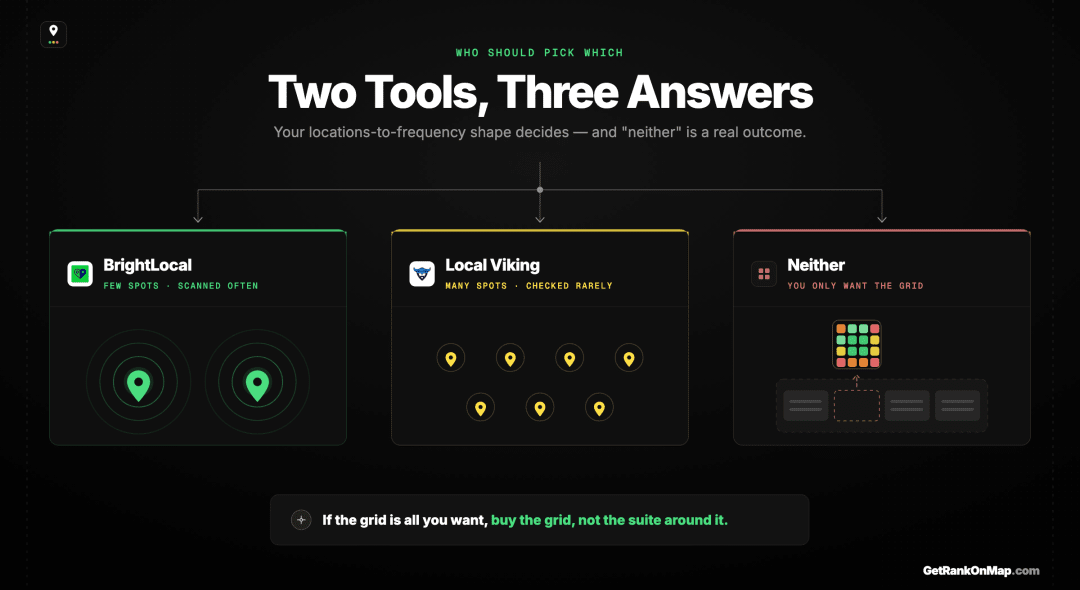
Pick BrightLocal if you're an agency that needs client reporting, if you need listings and citation management in the same subscription, or if you have few locations and want to scan them often without watching a credit balance.
Pick Local Viking if GBP posting and management is a real part of your workflow, if you have many locations but check them occasionally, or if you want grid tracking as the main event rather than as a module inside a bigger platform.
Pick neither if the grid is genuinely all you want. Both of these tools bundle it with something else — a suite in one case, GBP management in the other — and you'll be paying for that something else. Measurement-first tools price differently again, and our comparison of local rank trackers covers that layer. If you've already ruled one of these two out, we've also written specifically on alternatives to BrightLocal and alternatives to Local Viking.
Before You Commit to Either
Whichever way you go, a grid is only worth paying for if you know what you're reading. Google Maps results vary with the searcher's physical location, which is the entire reason grid tracking exists — a single position number can be flattering and wrong at the same time. If the concept is new, start with what GeoGrid rank tracking is before you pick a vendor to buy it from.
And verify the current pricing yourself. Every figure in this article was read first-hand from each vendor's own page on 2 August 2026, which is the most reliable form these numbers come in and still no guarantee they're the numbers you'll see. Plan structures change. The billing models are stable; the price lists aren't.
Per Location or Per Credit
This comparison gets written as a feature contest, and it shouldn't be. Both products draw grids, both track local rankings, and a checkmark table will show them looking more alike than they are.
The difference that will actually show up in your bank account is the metering unit. Per location means predictable and frequency-blind. Per credit means flexible and usage-sensitive, with a second wrinkle that the credits come in two pools that don't share. Neither is better in the abstract — but one of them will fit your pattern of use noticeably better than the other, and you can work out which in about ten minutes with your own numbers.
Do that first. Then read the feature list, which by then will mostly confirm what the pricing already told you.
We should be straight about our position: RankMap is building in this space and we're pre-launch, so we're not a neutral referee and we're not asking you to wait for us. But the reason we keep returning to metering rather than features is that it's where we've seen the most money wasted in this category — join the early-access waitlist if you want to see what we're building when it's ready.
Frequently asked questions
- 01Is Local Viking the same as Local Optics?
- The pricing page at localviking.com renders under the Local Optics brand as of 2 August 2026, while the marketing site still uses LocalViking. We can't confirm from the outside whether that's a full rebrand in progress or something else. Expect to encounter both names.
- 02Does BrightLocal track daily rankings?
- Its tracking runs on a schedule you configure rather than on demand, and reporting frequency is one of the things that varies by plan tier. Check the current plan details, since this is exactly the kind of detail that shifts between pricing revisions.
- 03Do I have to pay extra for white-label reports?
- White-label reporting is one of the features gated by plan tier at BrightLocal rather than included universally. If it's the reason you're buying, confirm it's on the tier you're pricing before you subscribe.
- 04Is there a free alternative to either?
- Not one that gives you tracked history over time. For a one-off look at where you stand, our guide to [free Google Maps rank checking](https://getrankonmap.com/blog/free-google-maps-rank-checker) covers what's genuinely available at no cost. Grid scanning at scale costs real money to run, which is why nobody gives it away.
- 05Which is better for a single-location business?
- Usually BrightLocal, on the frequency logic — one location on a fixed price with no credit meter running is simpler to reason about than a credit budget you have to manage. Unless GBP posting is central to your week, in which case Local Viking earns its place.
- 06What happens when I run out of credits mid-month?
- You buy more or you stop scanning until the reset. This is the practical downside of credit pricing, and it's sharper here than elsewhere because the two pools don't share — running dry on GeoGrid credits while keyword credits remain doesn't help you.
Explore with AI
Share this
Map your real rank across the city.
Free for the first 50 scans. No credit card.
Join the waitlist

