Geomapy vs BrightLocal (2026): One of These Tools Is Offline
We checked both. Geomapy's site has served nothing since its certificate expired in March 2026. Here's the evidence, and what actually replaces it.

One of Them Is Offline
- Geomapy's website has not served a working page since at least 16 March 2026. Its TLS certificate expired that day, which makes every modern browser refuse the connection outright.
- Bypassing the certificate warning doesn't help. The server answers with a redirect to
/index.phpand returns a zero-byte response — a loop, not a website. We checked on 2 August 2026. - That makes this comparison unusual: there is no live product on one side of it. If you're evaluating Geomapy, the useful question isn't how it compares to BrightLocal — it's what to move to.
- BrightLocal is a full local SEO suite billed per location, with grid-based map tracking sold as an add-on rather than as the core product. That distinction decides whether it's the right replacement for you.
- If what you wanted from Geomapy was the map heatmap specifically, a suite is a heavier and more expensive answer than a measurement-first tool.
The Short Version

People still search for this comparison, so it's worth answering directly rather than burying it: we could not reach Geomapy at all.
We're not inferring this from a slow page or a broken image. Here's exactly what we checked on 2 August 2026, so you can verify it yourself in about thirty seconds:
- The certificate for
geomapy.comwas issued 16 March 2025 and expired 16 March 2026. That's not a maintenance window; it's four and a half months lapsed at the time of writing. - An expired certificate causes Chrome, Safari, Firefox and Edge to block the page with a full-screen interstitial. No ordinary visitor gets past that screen, and no prospective customer bothers to try.
- Bypassing certificate validation deliberately, the server responds with a
302redirect to/index.phpand a body of zero bytes. Requesting it over plain HTTP just redirects back to the HTTPS address that fails. There is no page behind the warning.
A company that is actively selling software renews its certificate, because an expired one costs it every single new signup from the day it lapses. Four months of that is not an oversight anyone survives by accident.
We'll put the appropriate caveat on this: a dead website is not a death certificate. It's possible the product continues under a different domain, or inside an app that never touches the marketing site. What we can say with confidence is narrower and more useful — as of 2 August 2026 there is no way for a new customer to reach, evaluate or buy Geomapy through its own website. For anyone reading a comparison article, that's the operative fact.
Why This Comparison Existed in the First Place
Geomapy and BrightLocal got compared because they appeared to overlap: both were associated with seeing local search performance across a geographic area rather than as a single number.
That overlap was always thinner than the pairing suggested, and it's worth being honest about the limits of what we can now confirm. With the site offline we cannot verify Geomapy's current feature set, pricing or grid sizes from a first-party source, and we won't reprint claims from third-party listicles as though we had. Anything you read about Geomapy's specifications in 2026 — including in articles that rank well for this term — is being copied from cached or second-hand material, not read from the vendor.
So this article does the thing the search deserves instead: it treats you as someone who needs a working tool.
What BrightLocal Actually Is
BrightLocal is a local SEO suite, and understanding that word is most of the decision.
It bundles citation and listings management, review monitoring, local audits, client reporting and rank tracking into one subscription. Its pricing, read from its own page on 2 August 2026, is metered per location — your cost scales with how many business locations you're tracking, which is predictable and cheap at one location and a very different calculation at forty.
Map grid tracking exists in the product as Local Search Grid, with grid sizes listed from 5×5 up to 21×21. The important structural detail is that it's positioned as an add-on layer on top of the platform, not as the thing the platform is built around. You're buying a suite that can also draw a heatmap.
That's the right shape for some readers and the wrong shape for others, and which one you are depends entirely on what you wanted from Geomapy.
Choosing a Replacement: Two Different Questions
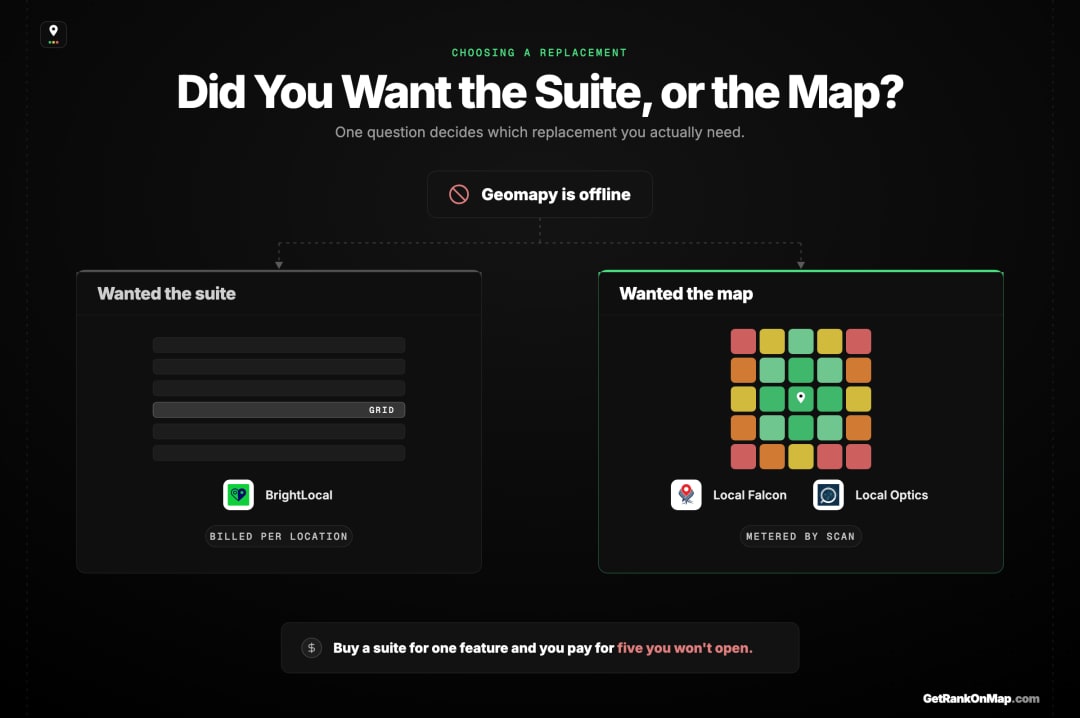
If you wanted the suite
If Geomapy was one part of a broader local SEO workflow — you also needed listings consistency, review monitoring and something to send a client at month end — then BrightLocal is a reasonable and well-established landing spot. It's the most complete platform in the category, it's been around long enough that it isn't going to vanish behind an expired certificate, and the reporting is genuinely good.
The trade-off is that you'll pay for six jobs whether or not you have six jobs. We've mapped out what a local SEO stack actually has to cover if you want to work out which of those you'd really use.
If you wanted the map
If the heatmap was the point — if what you actually wanted was to see where you rank across your service area rather than at one pin — then a suite is an expensive way to buy one feature.
This is worth spelling out, because it's the most common mis-purchase in this category. A single-point rank number is close to meaningless in local search: Google Maps results shift with the searcher's physical position, so you can sit third from your own front door and be invisible four miles away while a tracker reports "position 3" both times. That's the problem grid-based tracking exists to solve, and it's a measurement problem, not a management one.
If that's your need, the measurement-first tools are the closer match. Local Falcon meters by report credit rather than by location, which fits occasional deep audits. Local Optics — the product still widely known as Local Viking — publishes plans from $39 to $200 per month as of 2 August 2026, metered through separate keyword and GeoGrid credit pools. Our comparison of local rank trackers covers that layer properly, including where we fit into it.
How to Move Off a Tool That's Gone Dark
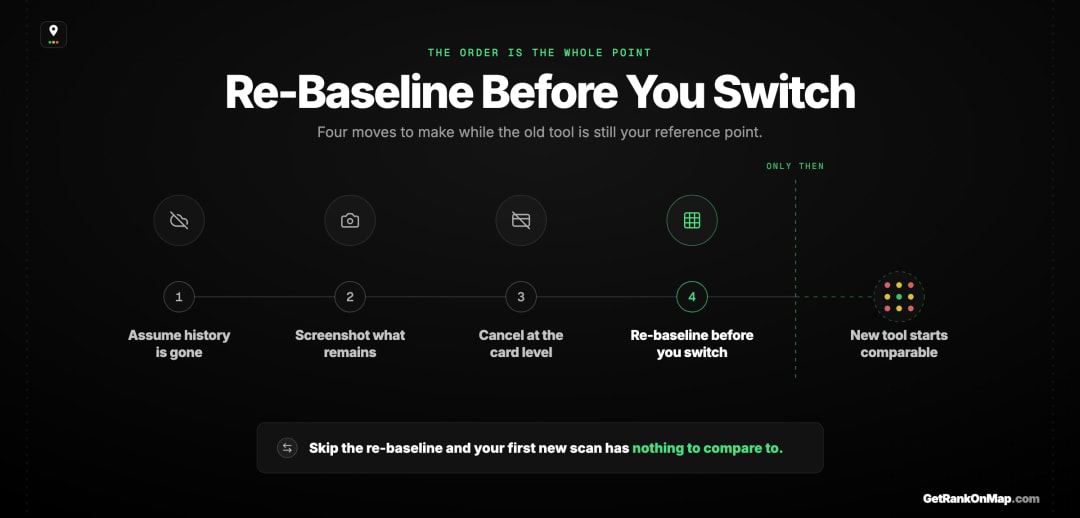
This part applies whether it's Geomapy or any other small vendor that stops answering.
Assume your history is gone. If you can't reach the dashboard, you can't export the tracking history, and that data is what made month-over-month comparison possible. Plan on re-baselining from zero with the new tool rather than hoping for a migration path.
Screenshot whatever you still have. Old reports, exported PDFs, anything sitting in email. It won't be structured data, but it beats having no record of where you stood six months ago.
Cancel the payment method properly. A subscription can keep billing long after the product stops working. Cancel at the card or PayPal level if the vendor's own cancellation page is part of what's offline.
Re-baseline immediately, before you change anything. Run your first scans on the new tool before you start any new optimisation work. Otherwise you'll have no clean "before" to measure against, and you'll spend the next quarter unable to tell whether your work is landing.
Then check what you were actually paying for. A tool going dark is an unwelcome way to find out, but it's a real opportunity to audit the stack. Run a local SEO audit before you re-subscribe to anything, because some of what you were paying to automate is work you can do once by hand.
The Uncomfortable Lesson About Small Tools
Geomapy itself never surfaces in our discourse cache — not once across the local rooms, which is part of the answer. What does surface is the shape of the problem, on other small tools. December 2025:
For the last couple of days local dominator has some issues with local pack audit. Looking for some alternatives. I'm using this only to check the map ranks for my clients and for manual reporting.
r/localseo, December 2025
Two days of a broken audit, and the owner is already shopping. That is how thin the margin is on a tool nobody else is talking about.
The local SEO tooling market has a long tail of small products, and the long tail is where most of the interesting pricing lives. A $39/month independent tool will frequently do the one job you need better than a $150/month suite does as a side feature.
The cost of that is exactly what happened here. Small vendors disappear, sometimes without an announcement, and your tracking history disappears with them. That's not an argument for always buying the biggest platform — plenty of readers are better served by the small tool and the risk it carries. It's an argument for knowing which risk you took, keeping your own exports, and never letting a single vendor be the only place your historical data exists.
When One Tool Goes Dark
Most articles that rank for "Geomapy vs BrightLocal" are comparison tables assembled from other comparison tables. None of them appear to have loaded the site.
The honest version is shorter and more useful. One of these two products cannot currently be reached, bought or evaluated through its own website, and hasn't been able to be for months. The other is a well-established suite that will suit you well if you need six jobs done and will overcharge you if you needed one.
So skip the feature comparison and answer the real question: was the map the point, or was the map one feature among several? If it was the point, buy the instrument. If it was one of six, buy the suite. And whichever you pick, keep your own copy of the data, because the case study for why is sitting right there behind an expired certificate.
For our part: RankMap is building in the measurement layer, so we're not neutral and we won't pretend otherwise. We're pre-launch and we're not asking you to wait for us instead of solving this today. But if you're rebuilding a baseline anyway, join the early-access waitlist and we'll show you what we've built when it's ready.
Frequently asked questions
- 01Is Geomapy still available?
- Not through its website. As of 2 August 2026 the domain's certificate has been expired since 16 March 2026, browsers block the page, and the server returns an empty redirect loop behind the warning. We can't confirm what's happening with the company itself, only that there's no working route to the product from its own domain.
- 02What is the difference between BrightLocal and Local Falcon?
- BrightLocal is a suite billed per location that includes grid tracking as an add-on; Local Falcon is a measurement tool billed by report credit. Suite versus instrument. We've compared [Local Falcon and BrightLocal](https://getrankonmap.com/blog/local-falcon-vs-brightlocal) in detail.
- 03What is the difference between BrightLocal and Uberall?
- Uberall is built for enterprise listings and location data management at large scale. BrightLocal is aimed at agencies and small multi-location businesses, with more emphasis on local SEO auditing and client reporting. Different buyer sizes more than different feature sets.
- 04What does BrightLocal actually do?
- Citation and listings management, review monitoring, local SEO audits, rank tracking including a grid add-on, and white-label client reporting — bundled into one per-location subscription.
- 05Should I just use a free rank checker instead?
- For a one-off look, that's a sensible first step, and we maintain a guide to [free Google Maps rank checking](https://getrankonmap.com/blog/free-google-maps-rank-checker). Free tools won't give you tracked history over time, which is the thing you're actually rebuilding after a vendor disappears.
- 06How do I avoid this happening again?
- Export your data on a schedule rather than trusting it lives safely in someone else's dashboard, and keep your own record of where you ranked. Any tool can go away. Your baseline shouldn't go with it.
Explore with AI
Share this
Map your real rank across the city.
Free for the first 50 scans. No credit card.
Join the waitlist

