Local Dominator Alternatives: Sorted by Why You're Leaving
Search for a Local Dominator alternative and two top results are its own pages. Here's the neutral version, sorted by why you're leaving.
Why You're Leaving, Sorted
- Search "local dominator alternative" and two of the top three results are Local Dominator's own pages. That's smart marketing and a bad search experience, and it's why this article exists.
- Local Dominator publishes a free tier at $0, with paid plans at $39, $59 and $97 per month as of 2 August 2026, discounted on annual billing. It's the budget entry in grid-based tracking, and that's genuinely its strength.
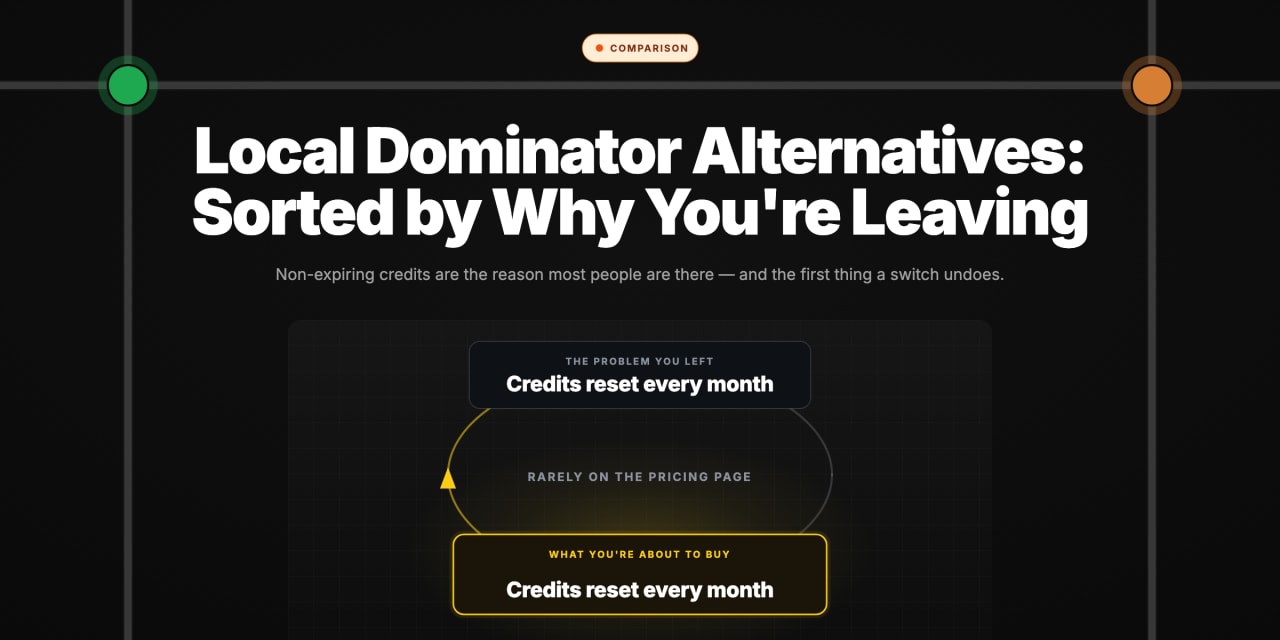
- Its own marketing leans on non-expiring credits — a direct shot at competitors whose credits reset monthly. If that's why you're there, check whether your alternative reintroduces the problem.
- The right alternative depends entirely on why you're leaving: price, accuracy doubts, missing features, or reporting. Those four reasons point to four different products.
- If you're leaving because you outgrew a budget tool, be careful not to buy a suite when what you needed was a better instrument.
First, a Note on What You'll Find Searching This
Type "local dominator alternative" into Google and the results are instructive. Reddit is top. Then two pages from localdominator.co itself — one comparing itself favourably to Local Falcon, one listing BrightLocal alternatives. Further down, competitors' pages positioning themselves as the answer.
None of that is dishonest. Vendors ranking for their own alternative queries is standard practice in this category, and Local Dominator does it well. But it means a searcher looking for a neutral shortlist has to scroll past the incumbent defending itself and several competitors selling themselves before finding anything close to an unbiased read.
We should be straight about our own position too: RankMap is building a GeoGrid rank tracker and is pre-launch as of this writing. We compete with Local Dominator. We have nothing to sell you today, which is the only reason we can lay out the alternatives without steering you toward one — but read this with our interest in mind, exactly as you should read theirs.
What Local Dominator Actually Is
Local Dominator is a grid-based local rank tracker positioned at the budget end of the market. Its published pricing on 2 August 2026 includes a free tier at $0, and paid plans at $39, $59 and $97 per month, with annual billing bringing the effective monthly rate down meaningfully.
Its own marketing makes a specific promise that's worth understanding: credits that don't expire. The headline on its BrightLocal comparison page is, essentially, keep every credit you pay for. That's aimed squarely at the frustration of credit-metered competitors where unused allowance resets at the end of each month.
If that promise is what brought you to Local Dominator, hold onto it — it's the thing most likely to be quietly reintroduced by whatever you move to. Several of the alternatives below meter credits that expire monthly, and it's rarely on the pricing page in large type.
Why Are You Actually Leaving?
Two answers turn up verbatim. The first is reliability — a December 2025 thread titled, exactly, "What are the alternatives for Local dominator?":
For the last couple of days local dominator has some issues with local pack audit. Looking for some alternatives. I'm using this only to check the map ranks for my clients and for manual reporting.
r/localseo, December 2025
The second is a gap between what is advertised and what connects. February 2026:
One of my employees suggested Local Dominator. I don't think I like it. Advertises about 70+ directories, but when I connect locations for their Citation Builder is only wants to push 23.
r/localseo, February 2026
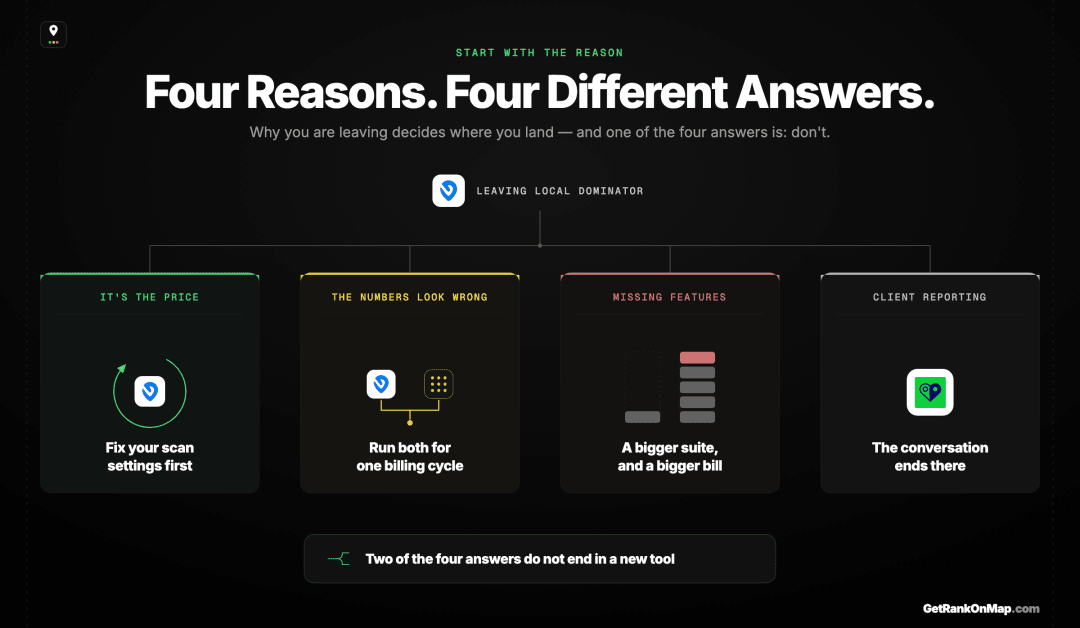
The single most useful thing you can do before shortlisting is name the reason. Four are common, and they point in genuinely different directions.
If you're leaving on price
You may not need to leave at all. Local Dominator is already the cheap option in grid tracking, and there is no meaningfully cheaper paid alternative with comparable grid capability. What exists below it is the free tier you're presumably already on, and free one-off Maps rank checking, which won't give you tracked history.
The more productive question here is whether you're paying for scanning you don't need. Smaller grids scanned more often cost less and tell you more than large grids scanned rarely. Try that before switching vendors.
If you're leaving because you don't trust the numbers
This is the most common unstated reason, and the hardest to resolve by switching, because all grid tools disagree with each other slightly. They query from different coordinates, at different moments, with different handling of personalisation. Two tools scanning the same business an hour apart will produce different heatmaps, and neither is lying.
Before you conclude your tool is wrong, check that you're not comparing a scan across changed grid spacing — a 7×7 across two miles and a 7×7 across twenty are different measurements, and it's the most common cause of "the numbers make no sense." We've written about why Maps rankings vary by location and how far your ranking actually reaches, which is usually where the confusion resolves.
If after that you still want a second opinion, running two tools in parallel for a month is the honest test. It costs a little; it settles the question permanently.
If you're leaving for missing features
Name which ones, because this is where people overbuy.
Needing citations and listings management points to BrightLocal or Whitespark, both billed per location. Needing GBP posting and scheduling points to Local Viking — whose pricing page now renders under the name Local Optics, with plans from $39 to $200 per month metered in separate keyword and GeoGrid credit pools. Needing content and technical SEO points to a full platform like Search Atlas, published at $99 to $999 per month.
Note what happens in each case: you stop buying a rank tracker and start buying a suite. That's often correct, and it's always more expensive than the thing you were replacing. Make it a decision rather than a drift.
If you're leaving because you need client reporting
This is the agency reason, and it's the clearest-cut. BrightLocal's white-label reporting is the mature offering in local SEO, and if your deliverable has to carry a client's logo every month, that requirement will outrank everything else on your list. LocalRank.so also prices for the agency end, with published tiers running up to $2,997 per month as of 2 August 2026.
The Shortlist, in Plain Terms
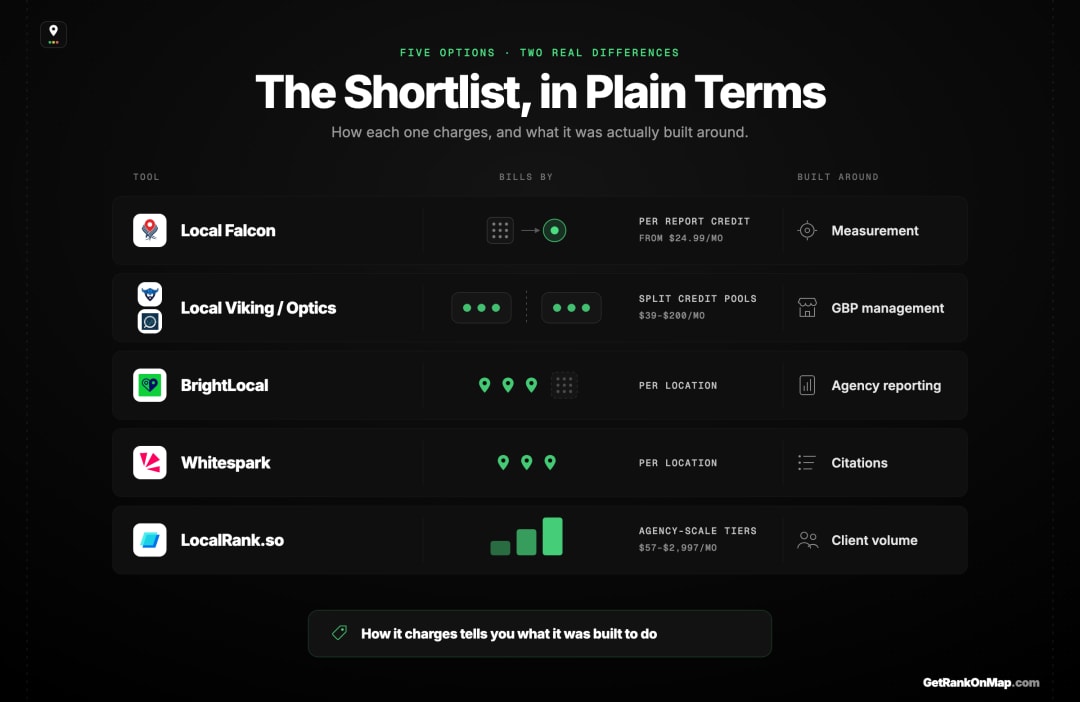
- Local Falcon — scan-on-demand grid audits metered by report credit, published from $24.99/month, grids from 3×3 to 17×17. The natural step up if you want measurement depth without a suite.
- Local Viking / Local Optics — $39 to $200/month, credits split into separate keyword and GeoGrid pools. Strong if GBP management is part of your week; watch the pool split.
- BrightLocal — per-location suite with grid as an add-on, sizes up to 21×21. The agency-reporting answer.
- Whitespark — per-location, citation-led, and the only one that will do the listing work by hand as a service. Its grid is a separately metered product on top of the subscription.
- LocalRank.so — agency-scale pricing, published $57 to $2,997/month.
Our wider comparison of local rank trackers works through these against consistent criteria, and the pricing models piece explains why their headline prices aren't comparable.
The Four Reasons, Side by Side
| Why you're leaving | Where it actually points | What it costs you |
|---|---|---|
| Price | Back to your own scan settings — there is no cheaper paid grid below this one | Nothing, if you resize the grid instead of switching vendor |
| You don't trust the numbers | A parallel test, not a new vendor — all grid tools disagree slightly | One month running two subscriptions side by side |
| Missing features | A suite: BrightLocal or Whitespark for listings, Search Atlas for content | $99 to $999 per month — several times what you were paying |
| Client reporting | BrightLocal's white-label, or LocalRank.so at agency scale | Published tiers reaching $2,997 per month at the top end |
Read down the middle column. Only one of those four reasons actually ends at a different product, and it's the last one. The other three end at a settings change, a test, or a decision to buy a category you weren't shopping for.
Before You Switch: Three Practical Steps
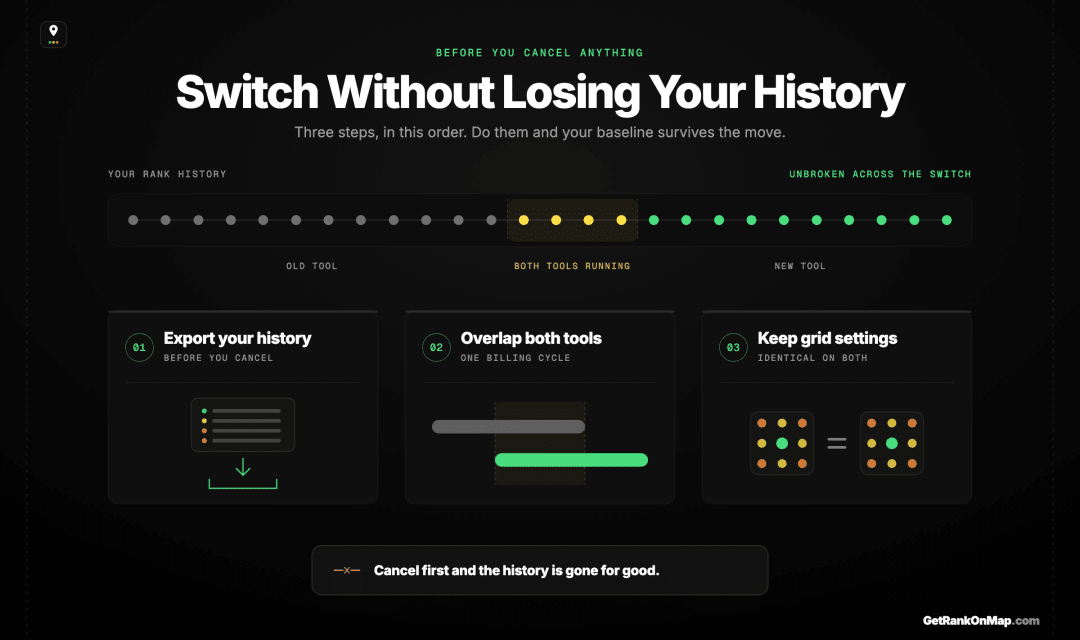
Export your history first. Whatever tracking record you have inside Local Dominator, get it out before you cancel. Your new tool starts from zero, and month-over-month comparison is the entire value of tracking. Losing eighteen months of baseline to save one month of subscription is a bad trade.
Overlap by one month. Run both tools simultaneously for a single billing cycle. You'll see how the two disagree, which tells you how to read the new one, and you'll avoid a gap in your record.
Keep your grid settings identical. Same centre point, same size, same spacing. Changing them at the same moment you change vendors makes it impossible to tell whether a shift in the heatmap is your rankings moving or your instrument moving.
Name the Reason Before You Shortlist
Most "alternative" articles hand you a ranked list and hope one of them fits. The list isn't the hard part — there are perhaps six serious grid tools and everyone writing about them names the same six.
The hard part is knowing why you're leaving, because that determines the answer completely. Price sends you back to your own settings. Distrust sends you to a parallel test, not a new vendor. Missing features send you to a suite and a bigger bill. Client reporting sends you to BrightLocal and stops the conversation.
Name the reason first. Then pick, export your history before you cancel, and keep your grid settings frozen through the switch so you can still read your own data afterwards.
For our part, we're building in this category and we're pre-launch, so we're not on the shortlist above and we're not asking to be. If measurement is the thing you're trying to get right, join the early-access waitlist and we'll show you what we've built when it's ready.
Frequently asked questions
- 01Is Local Dominator free?
- It publishes a free tier at $0 alongside paid plans at $39, $59 and $97 per month as of 2 August 2026. Free tiers in this category are typically limited on scan volume and grid size, so check the specific limits against your usage.
- 02What is the closest alternative to Local Dominator?
- On function, Local Falcon — both are grid-first measurement tools rather than suites. On price, nothing paid sits meaningfully below Local Dominator, which is its main argument.
- 03Local Falcon vs Local Dominator — which is better?
- Local Falcon is the more established product with a wider published grid range and a per-report billing model. Local Dominator competes on price and on non-expiring credits. Which matters more depends on whether your constraint is budget or depth.
- 04Do I lose my ranking history if I switch?
- Almost certainly, unless you export it first. Ranking history doesn't migrate between vendors, and this is the single most common regret people report after switching tools.
- 05Are non-expiring credits actually a big deal?
- If your usage is irregular, yes — it's the difference between paying for scans you didn't run and banking them. If you scan on a steady weekly rhythm, it matters much less, because you were going to use the allowance anyway.
- 06Should I switch to a suite instead?
- Only if you have suite problems. If your issue is citations, reviews or client reporting, then yes. If your issue is that you want to see where you rank more clearly, a suite is a more expensive way to get a worse version of what you already have.
Explore with AI
Share this
Map your real rank across the city.
Free for the first 50 scans. No credit card.
Join the waitlist

