Local Rank Tracking for Agencies: What Breaks at Thirty
At one client, any tracker works. At thirty, the billing model, seat count and what you show a client decide everything. Here's the agency read.

What Breaks at Thirty Clients
- Every local rank tracker works fine at one client. The differences only appear at scale, and by then you've already committed.
- The billing model is the biggest agency variable. Per location grows your bill on your sales team's schedule; per credit grows it on your delivery team's. Both are defensible; only one will match how your agency actually runs.
- White-label reporting is usually gated by plan tier, not included. If it's the reason you're buying, confirm it's on the tier you're pricing before you commit.
- The heatmap is a retention asset, not just a diagnostic. A visual that shows a client where they're winning and losing is the most persuasive artefact most local agencies have.
- Seats, API access and history retention are the three costs that appear after you've signed, and they're the three most agencies forget to ask about.
The Problem Only Shows Up at Scale
The reporting risk is the one agencies name themselves. July 2026:
I understand that no third-party SEO tool can be 100% accurate, but sometimes the gap is so large that it's hard to know which data to trust when making decisions or reporting to clients.
r/localseo, July 2026
That is the agency-specific failure. A solo owner with a wrong number makes a wrong decision. An agency with a wrong number has already sent it to a client.
Choosing a rank tracker for one business is easy. Almost anything works, the price is small, and if you're wrong you switch in an afternoon.
Choosing one for an agency book is a different exercise, because everything that's trivial at one client compounds at thirty. Onboarding time multiplies. The bill multiplies, but not necessarily in the way you expected. The reporting burden multiplies fastest of all. And switching gets progressively harder, because migrating thirty clients' tracking history is a project nobody has time for.
So the useful question isn't which tool is best. It's which one still works at the size you're heading toward.
The Billing Decision Is an Agency Model Decision
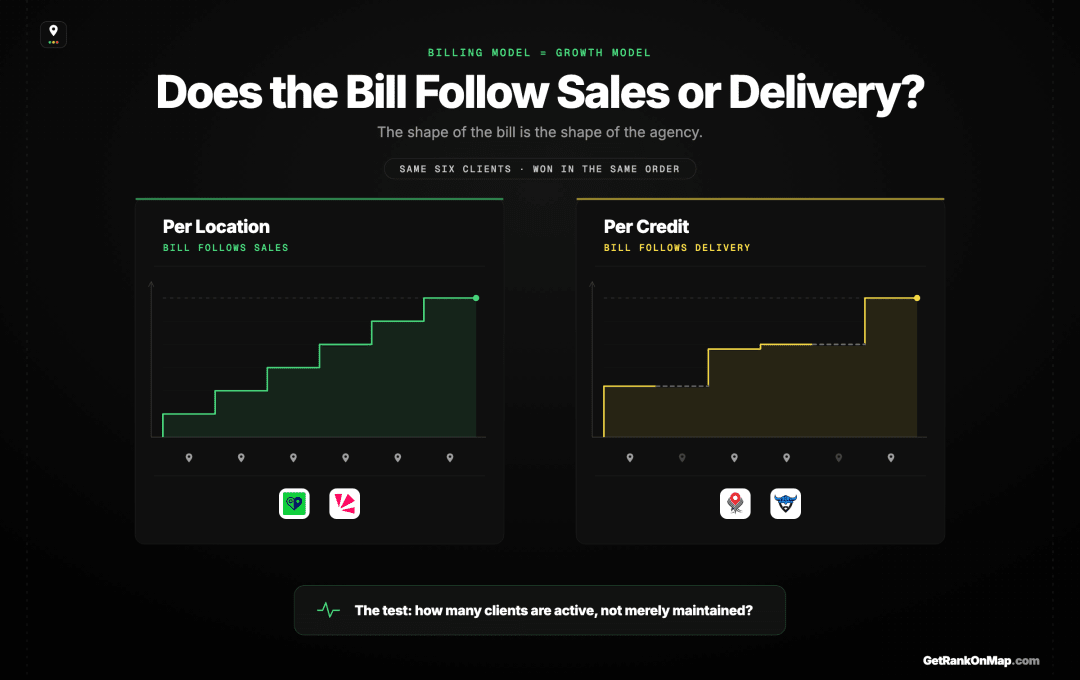
Three billing models run through this category, and choosing between them at agency scale is really a statement about how your business grows.
Per location — your bill follows sales
BrightLocal and Whitespark meter this way, read first-hand from their pricing pages (BrightLocal, Whitespark) on 2 August 2026. Every client location is a line item.
Why agencies like it: the cost is perfectly attributable. You know exactly what each client costs you to track, which makes it trivial to price into a retainer and trivial to stop paying when they churn. Scanning frequency is free, so you can check weekly without watching a meter.
Why it hurts: the bill grows every time you win business, before that business has paid you anything. And it keeps growing whether or not you're actually opening the dashboard for those clients — which, honestly, for the quiet ones on maintenance retainers, you aren't.
Per credit — your bill follows delivery
Local Falcon meters by report credit, with published plans from $24.99/month. Local Viking — whose pricing page now renders as Local Optics — meters in two separate pools, keyword credits and GeoGrid credits, with plans published from $39 to $200/month. Side by side, the two meter the same job differently enough to change your bill.
That pricing question changes again once one client owns thirty locations rather than thirty clients owning one each.
Why agencies like it: you pay for work you actually do. A book with twenty maintenance clients and five active campaigns costs what those five campaigns consume, not what twenty locations would.
Why it hurts: attribution gets messy. A single 15×15 scan is 225 searches against 25 for a 5×5, so one enthusiastic account manager can consume a disproportionate share of the month's allowance and you won't know until it's gone. And Local Viking's two-pool split adds a second way to run dry — GeoGrid credits can exhaust while keyword credits sit unused, with no way to move value across.
Which one fits you
The honest test is a ratio: how many clients do you actively work on versus how many you merely maintain?
- Mostly active, all getting frequent attention → per location. You'll use the unlimited frequency, and attribution stays clean.
- A long tail of maintenance clients with a few active campaigns → per credit. You'll stop paying for dashboards nobody opens.
Model it with your real numbers before you sign anything annual. We've written up the three models and how to price them against your own usage in detail.
The Costs That Appear After You Sign

Four line items catch agencies out with some regularity.
White-label reporting is commonly a plan-tier feature rather than a universal one. Since it's the single most common reason an agency buys local SEO software at all, confirm it's on the tier you're pricing — not on the tier above it.
Seats. Agency plans frequently charge per user, and agencies are exactly where user counts grow. Ask what a seat costs before you assume your team fits.
API access. Usually a higher tier. If you plan to pipe rankings into your own dashboard or a client portal, price that in from the start rather than discovering it during the build.
History retention. Rarely advertised, and it matters more for agencies than anyone. Your ability to show a client eighteen months of progress is what justifies eighteen months of retainer. Ask how long scans are kept and whether you can export them in bulk.
That last point deserves emphasis. Vendors in this category do disappear — one tool we track has served nothing but a browser certificate error since March 2026. If your only copy of every client's ranking history lives in one vendor's dashboard, you have a single point of failure sitting underneath your entire retention story. Export on a schedule.
What You Can Actually Show a Client

Here's the part that's specific to agencies and mostly absent from the comparison articles.
A rank tracker is a diagnostic tool for you. For your client, it's a retention artefact — and the two jobs pull in different directions.
A list of keyword positions is honest and nearly unreadable to a business owner. A heatmap of their service area, red where they're invisible and green where they're winning, is understood instantly by someone who has never heard the phrase "map pack." That difference in comprehension is worth more to your renewal rate than any accuracy improvement.
It cuts the other way too, which is the part worth thinking through before you adopt it. A grid is falsifiable in a way a single number isn't. If you show a client a heatmap in January and it looks the same in June, you've handed them clear evidence that six months of retainer didn't move anything. Some agencies find that uncomfortable enough to stay on single-point tracking, where the number can drift without anyone drawing conclusions.
We'd argue the opposite: the agencies that survive are the ones that can prove the work landed, and you can't prove it with an instrument too blunt to show movement. But it does mean you should be confident in your delivery before you make it this visible.
Setup Discipline That Saves You Later
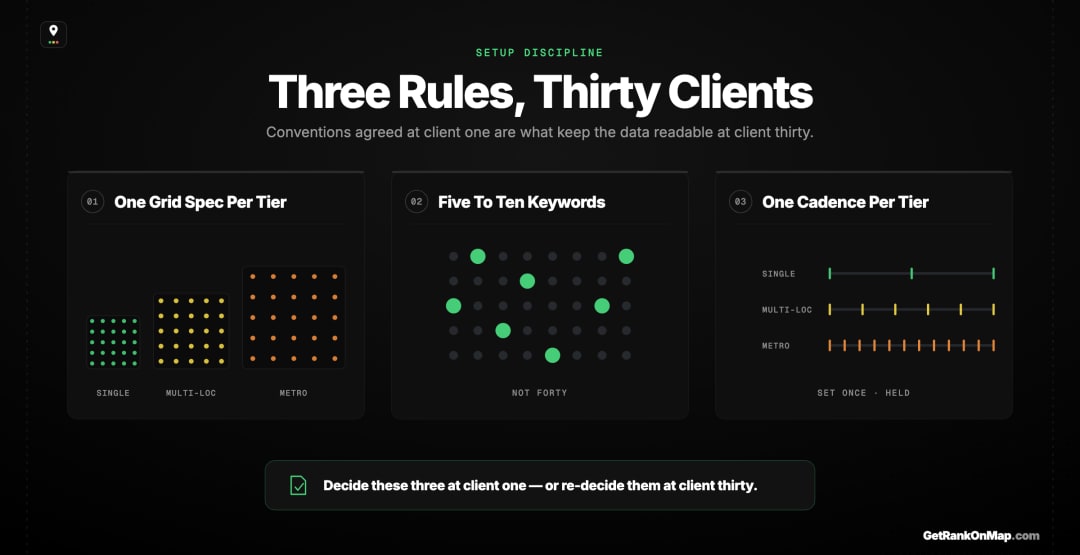
Three conventions, agreed once, that prevent a mess at thirty clients:
Standardise grid spacing per client type. A restaurant's meaningful service area and a plumber's are wildly different, and a 7×7 across two miles is a completely different measurement from a 7×7 across twenty. Set the spacing by business type, document it, and never change it mid-engagement — changing it makes your own trend line unreadable.
Standardise keyword counts. Agencies drift into tracking forty keywords per client because it looks thorough. Most of them never inform a decision, and under credit billing they're a direct cost. Five to ten that actually matter beats forty that don't.
Set a scan cadence per tier and hold it. Weekly for active campaigns, monthly for maintenance. Ad-hoc scanning is how credit budgets die, and more frequent checking mostly buys you noise rather than signal.
What Actually Scales
Agencies rarely choose a rank tracker badly. They choose one at three clients and then discover at thirty that the model doesn't fit how they grew.
So pick on the things that scale. The billing model, because it decides whether your costs follow sales or delivery. The tier gating, because white-label reporting and seats are where the real agency money hides. History retention and export, because your ability to prove eighteen months of progress is your retention story. And the client-facing artefact, because a heatmap gets understood in a way a keyword table never will.
Get those four right and the feature list barely matters. Get them wrong and you'll be migrating thirty clients in eighteen months, which is a job nobody has ever enjoyed.
Our position, stated as always: RankMap is building a GeoGrid tracker and is pre-launch, so we're not on anyone's shortlist yet and we're not neutral about this category. If the agency measurement problem is one you're actively wrestling with, join the early-access waitlist — we're building for exactly this.
Frequently asked questions
- 01What's the best local rank tracker for agencies?
- There isn't one answer, and any article that gives you one is skipping the question that matters. If white-label reporting is your deliverable, BrightLocal is the mature choice. If you have a long tail of maintenance clients, credit-metered tools like Local Falcon cost less. Our [comparison of local rank trackers](https://getrankonmap.com/blog/best-local-rank-trackers-2026) works through the field.
- 02How much should an agency budget per client for tracking?
- At small scale, a few dollars per client per month is realistic. It rises with grid size and scan frequency far more than with client count, which is the thing most agencies get backwards when forecasting.
- 03Can I white-label the heatmap itself?
- Depends on the vendor and usually on the tier. Confirm it specifically rather than assuming white-label reporting covers every asset in the product.
- 04Should I track every client or just active ones?
- Track every client at a low cadence, and actively campaign clients at a high one. The maintenance clients are exactly where an unnoticed ranking drop turns into a churn conversation you didn't see coming.
- 05How do I move thirty clients to a new tool?
- Slowly, and with an overlap. Export everything first, run both tools in parallel for a month, and keep grid settings identical across the switch so the two records are comparable. Migrating all thirty in one weekend is how agencies lose their history.
- 06Do clients actually care about grid data?
- They care about the picture, not the data. A heatmap communicates instantly; a positions table doesn't. That's the entire argument for grid tracking as a client-facing asset — and [why a single rank number misleads](https://getrankonmap.com/blog/one-rank-number-lies) is the argument for it as a diagnostic one.
Explore with AI
Share this
Map your real rank across the city.
Free for the first 50 scans. No credit card.
Join the waitlist

