How to Tell a Real Map Pack Drop From Normal Daily Fluctuation
A four-place move from one check is almost never a drop. The test that separates a real fall from daily noise, and the number of checks it takes.
If a local business owner finds their Google Business Profile lower in the Google Maps map pack, one check cannot call it a drop. Position is calculated from wherever the searcher stands, so a single profile holds several positions at once.
A genuine drop has three signatures: it appears from several separate measuring points, persists across several days, and holds at different hours. A fall failing any one of those is normal variation.
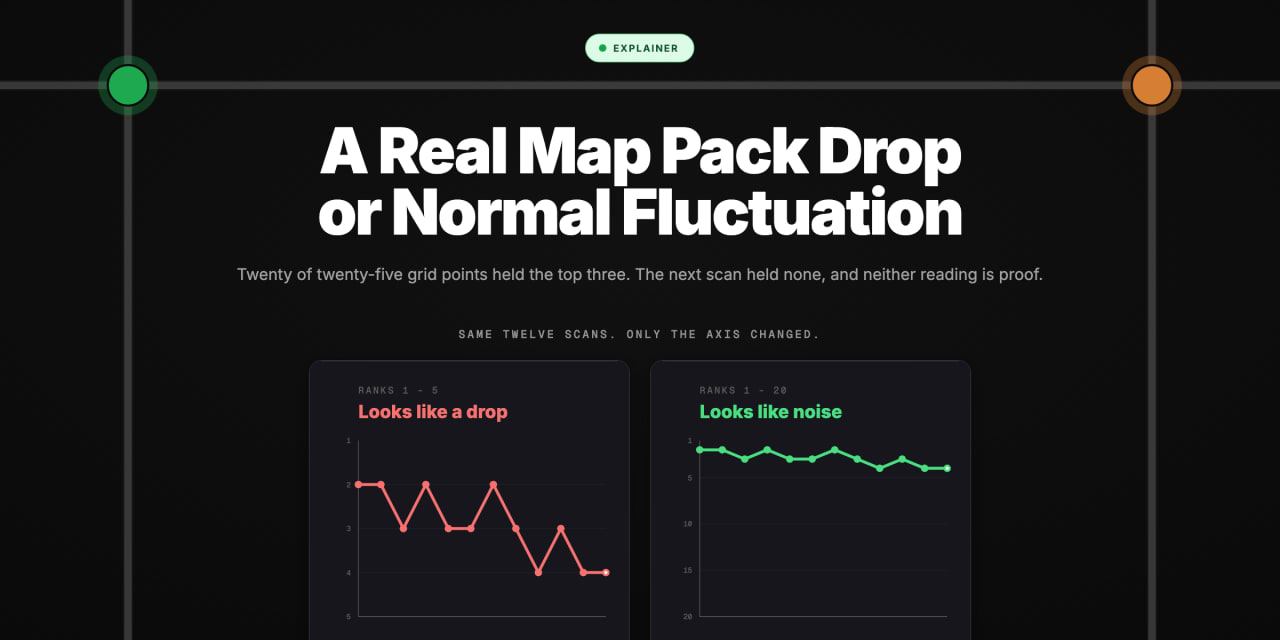
A practitioner published both halves of that test on 12 May 2026 for a carpet cleaner in Astoria: one keyword, the same 5×5 grid, scanned twice. The first scan held 20 of 25 points in the top 3. The second held none, with all 25 points at positions 4–7.
A Drop Is a Pattern, Not a Reading
A ranking drop is a pattern across measurements. A reading is one number from one place at one time, and one number cannot be a drop because it has nothing to be lower than.
The practitioner scanning that carpet cleaner in Astoria had the pattern, and still asked the room to help them read it. Their two scans, in full:
  ONE KEYWORD, ONE 5x5 GRID, TWO SCANS
  ┌──────────────────┬────────────┬────────────┐
  │ points at        │ first scan │ next scan  │
  ├──────────────────┼────────────┼────────────┤
  │ top 3            │     20     │      0     │
  │ positions 4-7    │      5     │     25     │
  │ below 7          │      0     │      0     │
  └──────────────────┴────────────┴────────────┘
  every point moved, and none moved far
They named five candidate explanations and would not choose between them: normal volatility, a proximity effect, competitor movement, something changed on the profile, or grid noise. Their reason for hesitating is the one worth copying:
I'm not trying to "fix dots." I'm trying to understand how you'd explain this to a client without overpromising. Would you wait for 2-3 more scans before making any recommendation?
r/bigseo, May 2026
That is the whole discipline in two sentences. They had 25 measuring points agreeing with each other — far more evidence than the owner who checks once from their own phone — and their instinct was still to wait for repetition across time before calling it.
A Confirmed Drop Is Not a Diagnosed One
Confirming the fall and explaining it are separate jobs, and the second is harder. An agency posted on 18 August 2026 about a drywall client that went from top 3 to grey pins across three cities over a month:
Scan data looked right, no complaints there. problem is that's where it ends [...] spent most of the day going down a list of guesses and I'm still not fully sure what caused it.
r/localseo, August 2026
The measurement was sound and the cause was still unknown at the end of a day. That is the realistic ceiling on what any tracker, ours included, gives you: it can establish that something moved and where, and it cannot tell you why.
Owners rarely get even that far. Of the 19 owner questions about a ranking drop we collected between 31 July and 19 August 2026, almost none described how they measured the fall at all, and 4 described it as sudden or overnight — which is what a single check looks like when the previous single check was taken somewhere else. Diagnosing a cause before confirming the fall is how owners end up working through the whole diagnostic list on the hub for a drop that never happened. The step being skipped is not diagnosis — it is confirming that the thing being diagnosed happened.
Why the Same Business Has Several Positions at Once
Distance from the searcher is a live input, not a stored score. That single fact produces most of what owners read as movement.
  ONE BUSINESS, ONE MOMENT, FOUR SEARCHERS
  illustrative — the mechanism, not measured data
  ┌──────────────────┬──────────┬────────────────────┐
  │ searcher is      │ you rank │ why                │
  ├──────────────────┼──────────┼────────────────────┤
  │ outside your door│    2     │ closest option     │
  │ 1 km north       │    4     │ two rivals nearer  │
  │ 3 km north       │    9     │ outside your patch │
  │ 1 km south       │    3     │ thinner competition│
  └──────────────────┴──────────┴────────────────────┘
This is why a report can move four places with nothing changed on the profile — the phrasing one owner in our corpus used verbatim. Check from your own premises and you sample the single most flattering point on that map. Check from a customer's street and you get a different, equally true answer. Neither one is the ranking — it is the mechanism behind why Google Maps ranking varies by location.
When a Small Move Is Real
The rule inverts on one thing: a small move that repeats is worth more than a large move that does not.
Read the four searchers above again. That business occupies positions 2, 3, 4 and 9 at the same instant — a seven-place spread produced by nothing except where the check was taken. Any single one of those readings, compared against any other, manufactures a "drop" or a "recovery" that never happened. It is exactly why one rank number lies.
So a seven-place fall between two checks can be pure geometry, while a two-place slide that shows up at all four points, three weeks running, is a genuine loss. Size is not the signal. Repetition across points and days is.
Fluctuation vs Drop, Side by Side
| normal fluctuation | a real drop | |
|---|---|---|
| across measuring points | differs point to point | present at every point |
| across days | bounces back | holds or worsens |
| across hours | may return by itself | unchanged by time of day |
| trigger | none you can name | often dated to an edit |
| size | tells you nothing on its own | tells you nothing on its own |
Signatures as of August 2026. "Points" means separate geographic checks, not repeated checks from one place.
The Case That Looks Like Both
The hardest case is a rival opening near you. It is one of the few genuine same-day causes, and it produces a fall that is real and geographically partial — which is exactly what variation looks like from a single point.
A new competitor changes distance for every searcher on one side of your area and for nobody on the other. Check from a street they now sit closer to and you have genuinely lost places, permanently. Check from the far side of your patch and nothing has moved at all. Both readings are correct.
  A NEW RIVAL OPENS TO YOUR NORTH
  ┌──────────────────────┬──────────────────────┐
  │ measured from        │ what you see         │
  ├──────────────────────┼──────────────────────┤
  │ north of you         │ a real, lasting fall │
  │ outside your door    │ unchanged            │
  │ south of you         │ unchanged            │
  └──────────────────────┴──────────────────────┘
  repeats daily — but in one direction only
This is the one case where the three-signature test needs a fourth question: not only does the fall repeat, but does it repeat everywhere, or only in one direction. A loss confined to one part of the map is usually a new neighbour, not a penalty — and the fix is competitive, not technical.
What to Do
- Check from at least three separate points across your service area, not three times from your desk.
- Repeat on three different days. A fall that survives all three is real.
- Fix the hour. Compare like with like, and note whether you were open.
- Write down the date of your last profile edit. A drop dated to an edit is a different problem, and the hub covers it.
- Only then start diagnosing. Most falls do not survive step 2.
If the fall survives all three tests it is real, and the next question is what caused it: work the diagnostic order on the hub.
Frequently asked questions
- 01How many places of movement counts as normal?
- There is no published threshold, and any specific number you see quoted is someone's estimate rather than a measured figure. What can be said from the mechanism: a move that changes when you move the measuring point is variation whatever its size, and a move that survives several points and several days is real whatever its size.
- 02Does checking more often help?
- Not from one place. Ten checks from your own premises tell you about one point on the map, ten times over. Three checks from three separate points across your service area tell you far more, because the thing that varies most is where the check is taken, not when.
- 03My tracker says one number. Is that wrong?
- Not wrong, incomplete. A single rank number is one point on a map reported as if it were the whole map, and the four positions above show what that hides. It is useful for spotting that something changed; it cannot tell you whether the change was everywhere or in one street.
Sources
Primary data, collected by us
- Owner discourse corpus
- every owner question about a Maps ranking drop we could find on Reddit and the Google Business Profile help forum, collected 31 July – 19 August 2026. 23 titles, 21 unique, 19 owner questions.
Cited Accessed August 2026.
- r/bigseo, 12 May 2026, volatility or a real drop? reddit.com. Supports the two 5×5 scans, 20 of 25 points in the top 3 falling to none; the five candidate causes; waiting for further scans before advising.
- r/localseo, 18 August 2026, dropped to 8th, cause unknown reddit.com. Supports a correct scan that still leaves the cause unidentified across three cities.
Checked and not used
Several published guides give a specific number of places that counts as "normal" movement. None of the ones we checked names a study, a dataset or a date, so no threshold appears on this page.
Explore with AI
Share this
Map your real rank across the city.
Free for the first 50 scans. No credit card.
Join the waitlist