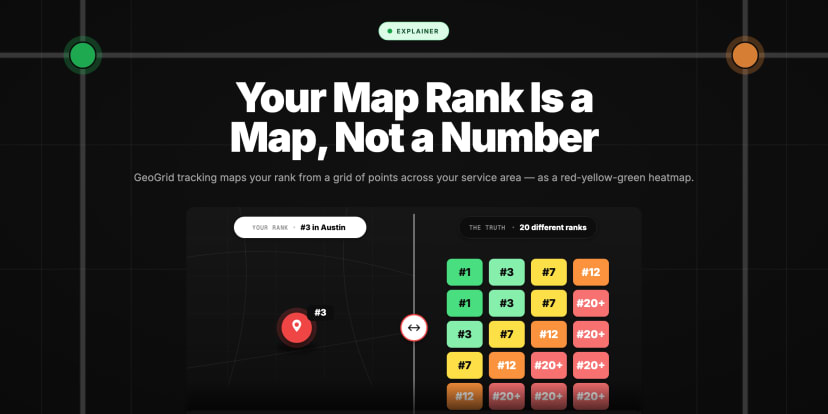
Daily vs Periodic Map Rank Tracking: How Often?
How often should you track your Google Maps ranking? Why daily checking breeds noise-chasing, when frequency is signal, how to match cadence to your goal.
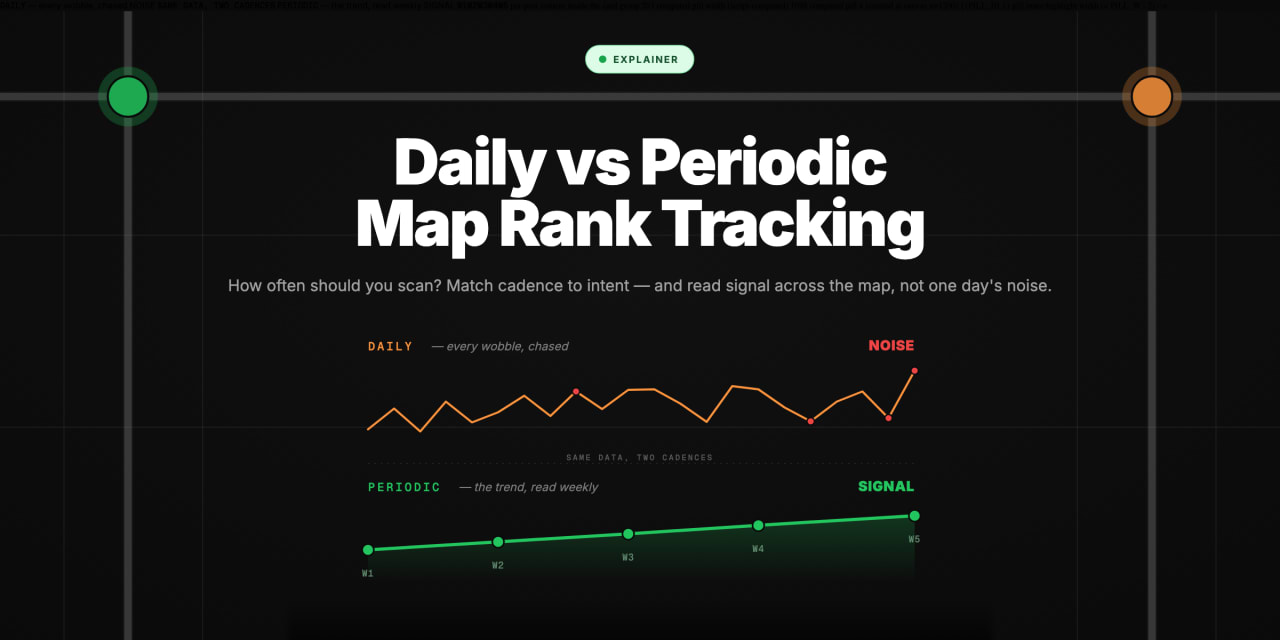
How Often Is Often Enough
-
There's no single right frequency — the honest answer to "how often should I track my map rank?" depends on what you're trying to learn, not on a fixed habit
-
Local rankings move on their own — Map Pack positions fluctuate naturally day to day, so a single day's wobble is usually noise, not a trend
-
Daily tracking is right when frequency is signal — during an active campaign, after a deliberate change, or for volatile competitive terms, checking often catches real movement early
-
Periodic tracking is right when you want the trend — for steady monitoring, weekly or monthly scans show the direction of travel without drowning you in noise
-
The common mistake is reacting to noise — panicking over one bad day, or chasing a single-point drop, wastes effort on movement that would have reversed on its own
-
Match cadence to goal: baseline first, scan more densely around changes, then settle into a periodic rhythm to watch the trend — and always read movement across the whole map, not one point
"How often should I check my rankings?" sounds like a question with a number for an answer — daily, weekly, monthly. It isn't. Track too often and you'll mistake ordinary noise for trouble, chasing wobbles that fix themselves and exhausting yourself in the process. Track too rarely and you'll miss real movement until it's expensive to fix. The right cadence isn't a fixed habit; it's a match between how often you look and what you're actually trying to learn. This piece is about reading the difference between signal and noise, and choosing a tracking rhythm that tells you something true.
Local Rankings Move on Their Own
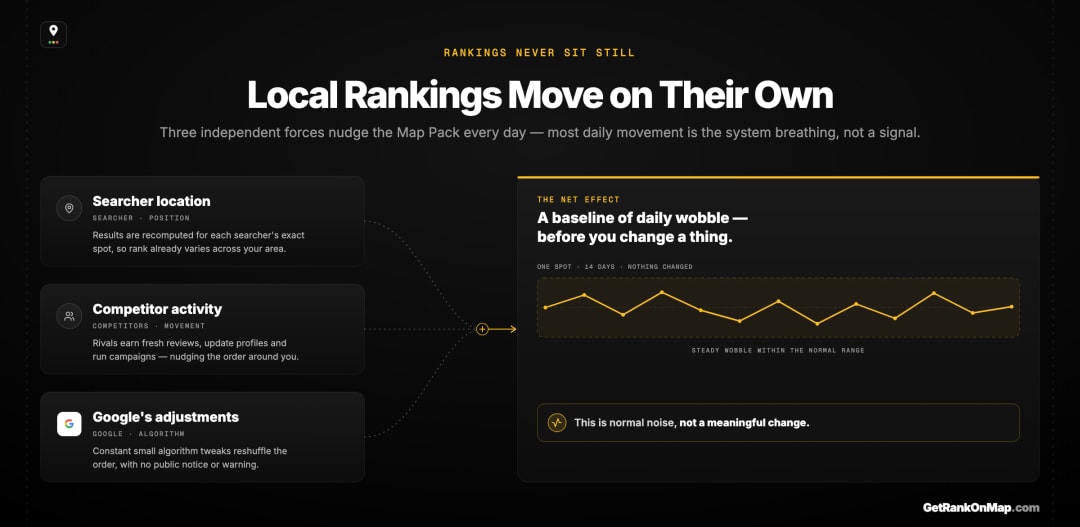
Map Pack rankings aren't static. They shift with the searcher's exact location, ongoing competitor activity, and Google's constant small adjustments — so the same search can return a slightly different order from one day to the next. A lot of day-to-day movement is simply the system breathing, not a signal that anything has changed.
Before deciding how often to check, you have to accept what you're checking. Local rankings are not a fixed number that holds still until you change something. They move on their own, for reasons that have nothing to do with your latest action.
Three forces move them, and none of them is you. The first is location: Map Pack results are recalculated for every searcher's position, so where you "rank" already varies across your area — distance from the searcher is one of the three factors Google names for local results, sitting next to relevance and prominence. The second is everyone else: competitors earn reviews, update profiles, and run their own campaigns, nudging the order around you. The third is Google itself, making constant small adjustments to how it ranks. Stack those together and a certain amount of daily wobble is simply the normal background hum of local search.
This is the foundation for everything about cadence. If you don't internalise that rankings drift on their own, you'll read every small movement as meaningful — and you'll burn your attention reacting to a system that was always going to wiggle. The job of tracking isn't to record the wiggle. It's to see through it to the trend.
Daily Tracking: When Frequency Is Signal
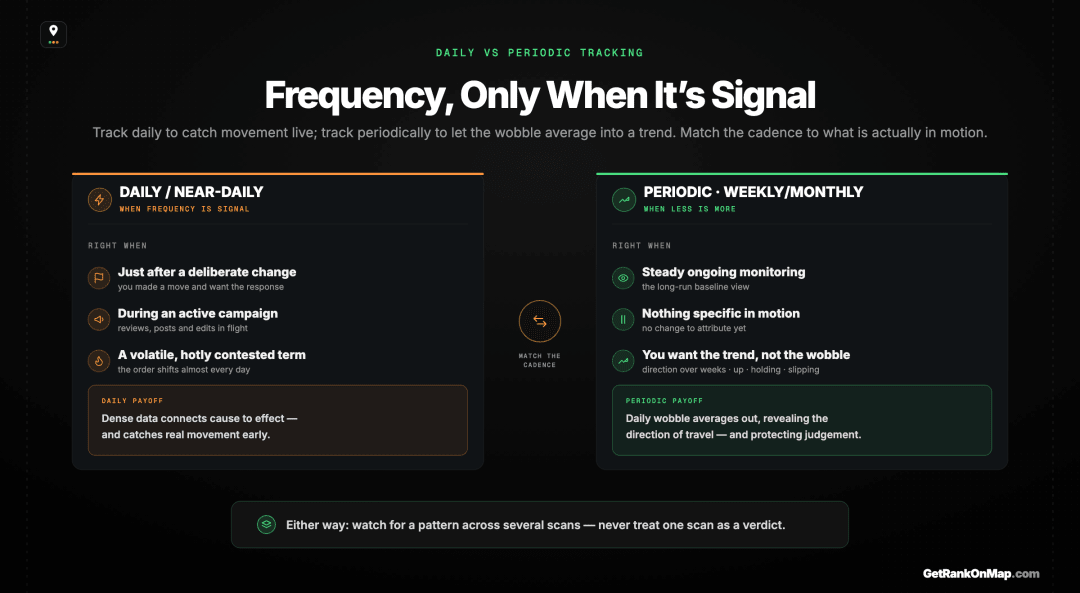
Sometimes checking often is exactly right. When you've just made a deliberate change, launched a campaign, or you're watching a volatile, fiercely contested term, frequent scans catch real movement early and let you connect cause to effect. Here the density of data is the point — you want to see the response while it's happening.
Daily — or near-daily — tracking earns its place in specific situations, and they share a feature: something is actively in motion and you want to catch it.
The clearest case is after a deliberate change. You've overhauled your profile, fixed your categories, launched a push for reviews — and you want to see whether and how the map responds. Checking frequently in that window lets you connect the change to the movement instead of guessing weeks later. Another is an active campaign, where you're investing effort and want a tight feedback loop. A third is a volatile, hotly contested term, where the competitive set shifts fast enough that real changes happen on a short timescale.
In all of these, frequency is signal: the dense data is what lets you tell a genuine response from background noise, because you can see the shape of the movement rather than two distant snapshots. The trap to avoid even here is over-reacting to any single day — you're watching for a pattern forming across several days, not treating one scan as a verdict.
Periodic Tracking: When Less Is More
For steady monitoring, frequent checking is counter-productive. Weekly or monthly scans smooth out the daily noise and show the direction of travel — whether your visibility is genuinely trending up, holding, or slipping. When nothing specific is in motion, spacing your checks out gives you a cleaner, calmer, more honest read.
Most of the time, you're not in an active-change window — you're monitoring. And for monitoring, less is more. Weekly or monthly scans let the daily wobble average out, so what you see is the trend rather than the tremor.
This is the cadence for the long game: is my visibility genuinely improving over the months as I do the work, holding steady, or quietly eroding as a competitor gains ground? Those are questions about direction, and direction only becomes visible across a longer span. Checking daily for a trend like this doesn't make it clearer — it buries it under noise and tempts you into reacting to movements that mean nothing.
Spacing your checks also protects something valuable: your judgement. A monthly heatmap you study calmly tells you more than thirty daily ones you glance at anxiously. When nothing specific is in motion, the disciplined move is to look less often and look properly.
The Mistake: Reacting to Noise
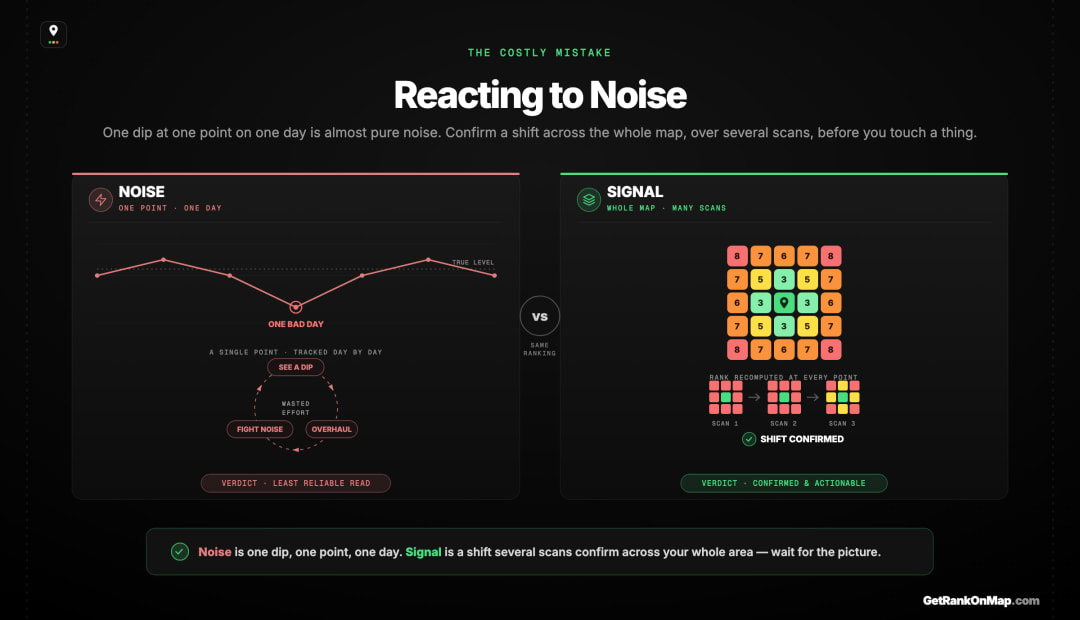
The costliest tracking error isn't checking too little — it's reacting to a single bad reading. Seeing one drop and tearing up your approach, or chasing a one-point dip at one location, spends real effort fighting movement that would often have reversed on its own. Noise feels like signal in the moment; that's exactly why it's dangerous.
The failure mode worth naming explicitly is panic-tracking: checking constantly, seeing a dip, and reacting as if the sky is falling. It's the most common way good local-SEO effort gets wasted.
Here's why it's a trap. Because rankings drift on their own, any single reading might be a transient low that would have bounced back without you touching anything. React to it — overhaul the profile again, change tack, abandon a strategy that was working — and you've spent effort fighting noise, and possibly disrupted something that was fine. Worse, a single-point check makes this far more likely, because one position is the least reliable way to read a ranking that varies across your map. One spot on one day is almost pure noise.
The antidote isn't to stop tracking — it's to track in a way that separates signal from noise: read movement across the whole map, over enough time to see a pattern, before you act. A change confirmed by several scans across your area is signal. A single dip at a single point on a single day is, almost always, just the system breathing.
Match Your Cadence to Your Goal
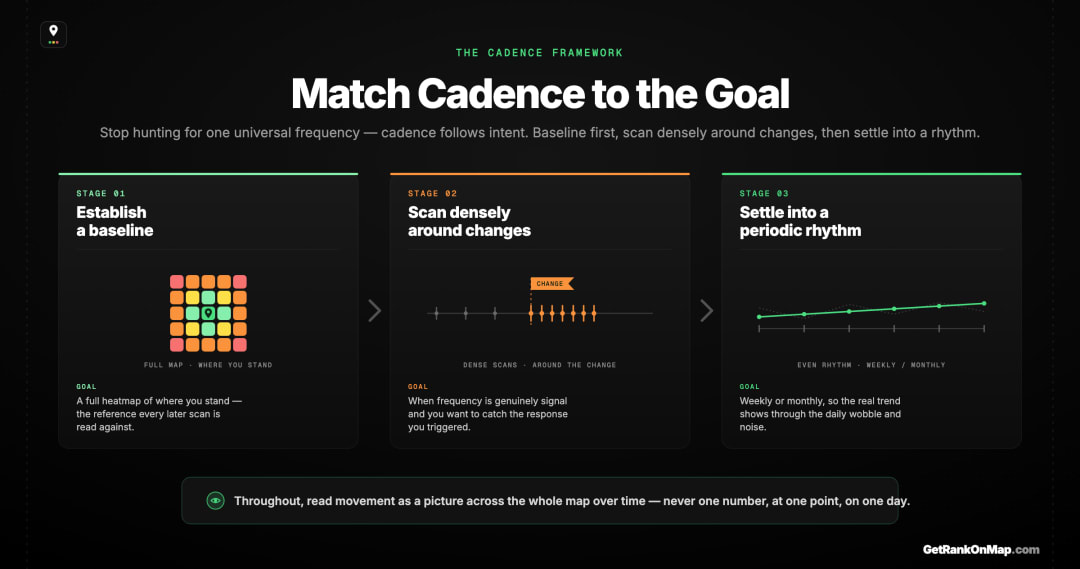
So what should you actually do? Stop looking for one universal frequency and match the cadence to the job. Establish a baseline first — a full heatmap of where you stand — so you have something honest to compare against. Scan densely around deliberate changes, when frequency is genuinely signal and you want to see the response. Then settle into a periodic rhythm — weekly or monthly — for ongoing monitoring, so the trend shows through the noise. And throughout, read movement as a picture across your whole area over time, not a single number on a single day, because that's the only way to tell a real shift from a wobble. The point of tracking the surface where local customers decide is to act on what's true — and truth in local rankings lives in the trend across the map, not the tremor of one reading.
That's exactly what RankMap is built for: tracking your Map Pack coverage over time so you can see the trend, not just today's noise. RankMap isn't live yet — we're pre-launch. Join the waitlist for early access and be first in line the day the map is ready.
What a Daily Rank Tracker Costs — and When a Free One Is Enough
Cadence isn't only a measurement decision, it's a billing one. Map rank tracking is priced per check, and a check is one keyword at one point on the grid. Daily tracking doesn't cost a little more than weekly — it costs seven times more, and the multiplier compounds against grid size.
The arithmetic is worth doing before you choose a cadence, because it's usually the thing that decides it for you.
A 7×7 grid is 49 points. Ten keywords across that grid is 490 checks per run. Run it once a week and you're buying about 2,100 checks a month. Run it daily and you're buying roughly 14,700 for the same ten keywords and the same single location. Nothing about the insight changed — only the sampling rate — and the bill moved by a factor of seven.
That multiplier is why most daily rank checkers you'll find advertised are either tracking a single point rather than a grid, or tracking organic positions rather than map positions. One point is cheap to check daily. An area is not.
Where free and cheap tools genuinely work. A free map rank checker is well suited to the question "where do I stand right now?" — a one-off grid, run when you want to see the picture, with no schedule attached. That's a real use, and it's the one most businesses actually have. It stops being enough when you need to prove a change caused an improvement, because a single snapshot has nothing to compare against.
Where paid cadence earns its price. Scheduled tracking is worth paying for when someone else is judging the work — a client, a head office, a budget review. What you're buying isn't the daily number. It's the trend line, and a trend needs consistent intervals more than it needs short ones.
Choose the interval that matches how often the decision gets made. Paying for daily data to review it monthly is buying 30 numbers to look at one.
Cadence Follows Intent
The question isn't "daily or periodic?" — it's "what am I trying to learn?" Local rankings drift on their own, so a fixed checking habit will either drown you in noise or let real movement slip past. Track densely when something is genuinely in motion and frequency becomes signal; settle into a periodic rhythm when you're watching the trend; and never let a single reading at a single point talk you into action, because that's almost always just the system breathing.
Underneath every good cadence is the same principle: read the trend across the whole map over time, not the tremor of one number on one day. That's the gap RankMap is built to close — tracking your Map Pack coverage so the signal stands out from the noise. We're not live yet, but when we are, you'll be able to tell a real shift from a wobble at a glance. Join the waitlist to be first in line.
Frequently asked questions
- 01How often should I check my Google Maps ranking?
- It depends on what you're trying to learn. Establish a baseline first, then track frequently — daily or near-daily — when something specific is in motion, like just after a change or during an active campaign, because frequency catches real movement early. For ongoing monitoring, switch to a periodic rhythm of weekly or monthly scans, which smooths out daily noise and shows the trend. There's no single correct frequency; match the cadence to the goal.
- 02Why does my map ranking change every day?
- Because Map Pack rankings aren't static. They shift with each searcher's exact location, with competitors earning reviews and updating their profiles, and with Google's constant small adjustments. A lot of day-to-day movement is simply the system breathing rather than a sign that anything meaningful has changed. That's why a single day's reading is usually noise, and why the trend over time matters far more than any one check.
- 03Is daily rank tracking worth it?
- It is in the right situation — when you've just made a deliberate change, are running an active campaign, or are watching a volatile, hotly contested term. In those windows frequent scans let you connect cause to effect and catch genuine movement early. Outside them, daily tracking mostly generates noise and tempts you into over-reacting. The risk isn't checking often; it's treating any single day's reading as a verdict.
- 04What's the biggest mistake in tracking local rankings?
- Reacting to noise — seeing one bad reading and overhauling a strategy that was working, or chasing a single-point dip that would likely have reversed on its own. Because rankings drift naturally, transient lows are normal, and a single-point check is the least reliable way to read them. The fix is to confirm movement across your whole map over several scans before acting, so you're responding to signal, not a wobble.
- 05Weekly or monthly — which is better for ongoing tracking?
- Either works for steady monitoring; the choice is about how closely you want to watch the trend versus how much noise you want filtered out. Weekly gives you a finer-grained view of direction; monthly smooths the data further and suits a slower-moving situation. Both are far better than daily for trend-watching, because spacing the checks lets the daily wobble average out so you see where your visibility is genuinely heading.
Explore with AI
Share this
Map your real rank across the city.
Free for the first 50 scans. No credit card.
Join the waitlist