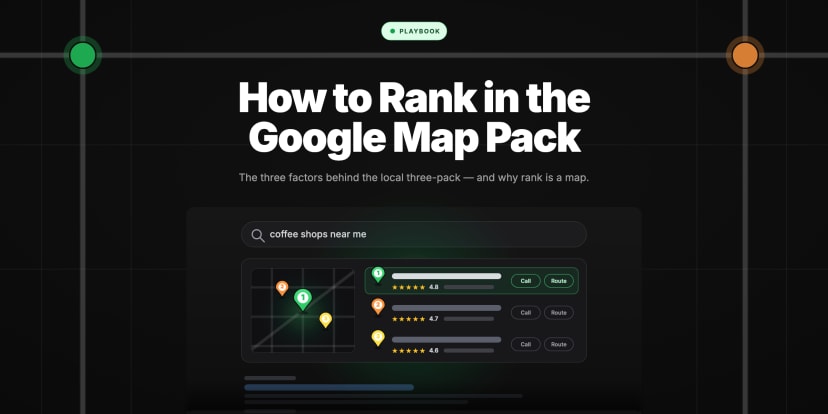
How Google Picks Which Three Businesses Enter the Map Pack
The map pack is not your Maps rank and not your organic rank. One business averaged 2.8 in the pack and 8.19 in Maps for the same keyword.

For a local business owner, the Google Maps map pack is a separate ranking from both the Google Maps app and the ordinary blue-link results below it. The same Google Business Profile, on the same keyword, in the same area, can hold three different positions at once — so "am I in the top 3" is a question about one surface, not about your ranking generally.
A local SEO practitioner published the pair on 19 September 2025: for the keyword "Dublin painters", one business averaged position 2.8 in the local pack and position 8.19 on Google Maps. Same keyword, same area, same profile.
Entering the pack is therefore two steps, not one: distance decides who is eligible, and relevance and prominence order whoever is.
  THREE SLOTS, MANY CANDIDATES
  every business in the category
    │
    ├─ too far from the searcher  → not eligible
    │
    └─ the eligible set
         │
         ├─ ordered on relevance and prominence
         │
         └─ top 3 shown · the rest behind "more places"
Three Slots, Not a Top Ten
The pack is a fixed-size shelf. Ranking fourth and ranking fortieth look identical to a customer who never taps "more places", which is why the drop from third to fourth is the only rank change in local search that feels like a cliff.
It also means the pack cannot be reasoned about as a list. Two businesses can both improve and only one can enter, because the constraint is the shelf and not the standard. The three signals that decide the order are unpacked in relevance, distance and prominence, separated.
The Pack Is Not the Maps App
Most owners check their ranking by opening Google Maps and searching. That measures a different surface from the one their customers see.
  ONE KEYWORD, TWO RANKINGS
  ┌──────────────────────┬──────────┐
  │ where it was checked │ position │
  ├──────────────────────┼──────────┤
  │ local pack           │   2.80   │
  │ google maps app      │   8.19   │
  └──────────────────────┴──────────┘
  "dublin painters" · same area · Sep 2025
The practitioner who published those figures drew the practical conclusion:
Most people search on Google and click results from the Local Pack, not by opening Google Maps. If you only track Maps rankings, you're underestimating how many customers actually see you.
r/localseo, September 2025
In that example the error runs in the owner's favour — the pack position is the better one — but it runs the other way just as often, and either way the number being watched is not the number that earns calls.
The two surfaces and why they diverge are covered in Google Search vs Google Maps ranking.
The Pack Is Not Your Organic Ranking Either
Ranking on page one of the ordinary results does not carry into the pack. They run on different inputs: the organic result is about your website, the pack entry is about your profile and your location.
A practitioner posted the exact shape of this on 31 July 2026 — page one organic for a keyword, absent from the top 3 of the map pack for the same keyword, with a competitor further away sitting above them. One reply named a second reason for the gap: Google limits how often the same business appears across both blocks of one results page, so a strong organic position can be part of why the pack slot is not also yours.
Three separate rankings, then, from one profile and one site:
| surface | ranked mainly on | what an owner usually checks |
|---|---|---|
| map pack | profile, category, distance | rarely |
| Google Maps app | profile, distance | almost always |
| organic results | website content and links | sometimes |
Why Your Dashboard Can Say You Are Visible When You Are Not
Profile performance figures are not pack positions, and reading them as if they were is a common way to conclude nothing is wrong.
  WHERE THE DASHBOARD AND THE PACK DISAGREE
  ┌────────────────────────┬────────────────────┐
  │ discovery impressions  │ every surface you  │
  │                        │ were shown on      │
  ├────────────────────────┼────────────────────┤
  │ map pack position      │ one surface, one   │
  │                        │ measuring point    │
  └────────────────────────┴────────────────────┘
  healthy impressions are not pack visibility
An agency described this on 8 August 2026: months of solid discovery impressions on category and service terms, and the client nowhere in the 3-pack for those same queries in their own city — checked on several devices, in incognito, and with spoofed coordinates. Verified profile, correct primary category, no suspension.
Their own reading was that impressions pool Maps-app views and below-the-pack appearances into one figure the dashboard never splits out. Whatever the cause, the lesson is the measurement one: impressions tell you that you were shown somewhere; only a position from a stated location tells you where. That is the gap described in the map pack tracking gap.
Eligibility First, Order Second
The two-step shape explains the results that otherwise look arbitrary.
- Eligibility is geographic. A business too far from the searcher is not competing for the third slot, however good its profile is. This is why the pack changes as the searcher moves and yours does not change at all.
- Order is earned. Among eligible businesses, the category match, the business name, the review pattern and the site behind the profile decide which three are shown.
- The set is redrawn for every search. Not daily, not per keyword — per search, from wherever it was made.
Step three is the one that breaks single-number tracking. A business is not in or out of the pack; it is in the pack across some part of its area and out across the rest, which is why no business ranks #1 everywhere.
What to Check When You Are Not in the Three
- Check the pack, not the Maps app. They gave one business positions 2.8 and 8.19 on the same keyword.
- Check from where your customers are, not from your premises, and record the location you checked from.
- Check whether you are eligible at all. If the three shown are all within a mile of the searcher and you are six miles out, order is not your problem.
- Check the primary category against the query, exactly, before touching anything else.
Frequently asked questions
- 01Why am I on page 1 of Google but not in the map pack?
- They are different rankings. Organic position is earned mainly by your website; pack entry is decided by your profile, your category and your distance from the searcher. Google also limits how often one business appears twice on the same results page, so a strong organic position can itself be part of the reason.
- 02Does ranking well on Google Maps mean I rank well in the map pack?
- No, and the gap can be large. One published example from September 2025 showed the same business averaging 2.8 in the local pack and 8.19 on Google Maps for one keyword in one area. Track the surface your customers actually use.
- 03My profile shows plenty of impressions — doesn't that mean I'm visible?
- Not in the pack. Impressions count appearances across every surface, including the Maps app and positions below the three shown. An agency reported months of healthy discovery impressions for a client who could not be found in the 3-pack from any device or location they tested.
Sources
Primary data, collected by us
- Map pack discourse cache
- 31 unique titles on map pack and top-3 ranking across r/localseo, r/bigseo and r/GoogleMyBusiness, with reply text, upvote counts and dates, collected to August 2026.
Cited Accessed August 2026.
- r/localseo, 19 September 2025, local pack and Maps are not the same reddit.com. Supports position 2.8 in the local pack against 8.19 on Google Maps for one keyword.
- r/localseo, 31 July 2026, page 1 organic, not top 3 in the pack reddit.com. Supports the two rankings diverging; the same-page appearance limit.
- r/localseo, 8 August 2026, impressions without pack visibility reddit.com. Supports discovery impressions counting surfaces the pack position does not.
- Google Business Profile Help, improve your local ranking. Supports distance, relevance and prominence as the named signals.
Checked and not used
Several guides state a fixed number of businesses shown in the pack across all query types, or a specific rate at which searchers expand it. We found no dated study behind either, so neither figure appears here.
Explore with AI
Share this
Map your real rank across the city.
Free for the first 50 scans. No credit card.
Join the waitlist