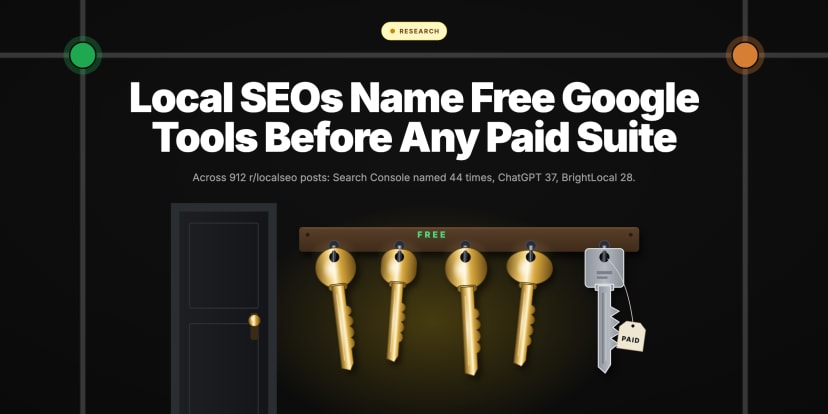
BrightLocal vs Search Atlas for Local SEO: Specialist or Suite
BrightLocal is a local SEO specialist billed per location. Search Atlas is a full SEO platform from $99/mo. Prices and local tools checked Nov 2026.

BrightLocal vs Search Atlas comes down to one question: is local SEO the whole job, or one part of it? We read both pricing pages on 9 November 2026. BrightLocal is a local specialist that bills per location, from $41 a month for one business. Search Atlas is a full SEO platform with local tools inside it, from $99 a month. For a local business owner or an agency with mostly local clients, BrightLocal costs less at every size we priced. Search Atlas earns its price only if you also need content, technical SEO and backlinks. Neither one is built around Google Maps rank measurement.
Quick answer
- BrightLocal: a local SEO specialist. Rank tracking, Local Search Grid, listings, citations and reviews, billed per location (checked 9 Nov 2026).
- Search Atlas: a full SEO platform. Content, technical audits, backlinks and AI tooling, with local SEO included in every plan (checked 9 Nov 2026).
- Entry price: BrightLocal Track is $41 a month for one location. Search Atlas Starter is $99 a month, billed monthly.
- How the price grows: BrightLocal climbs with your location count. Search Atlas climbs by plan, and each plan lists a cap on Google Business Profiles: 3, 10, 25 or 100.
- Who wins on local cost: BrightLocal, at 1, 10, 25 and 100 locations, when you match plans by location count.
- Who wins on scope: Search Atlas, if you also do national organic SEO and want one subscription.
- Grid tracking: both have it. BrightLocal's Local Search Grid is in all three plans; Search Atlas lists a Local Heatmap.
- The catch for both: map ranking is one module among many, not the centre of either product.
- Read with care: Search Atlas publishes its own guide to migrating off BrightLocal.
Specialist or platform: what each one actually is
These two get compared because both show up when someone searches for SEO software and both mention local rankings. That is roughly where the overlap ends.
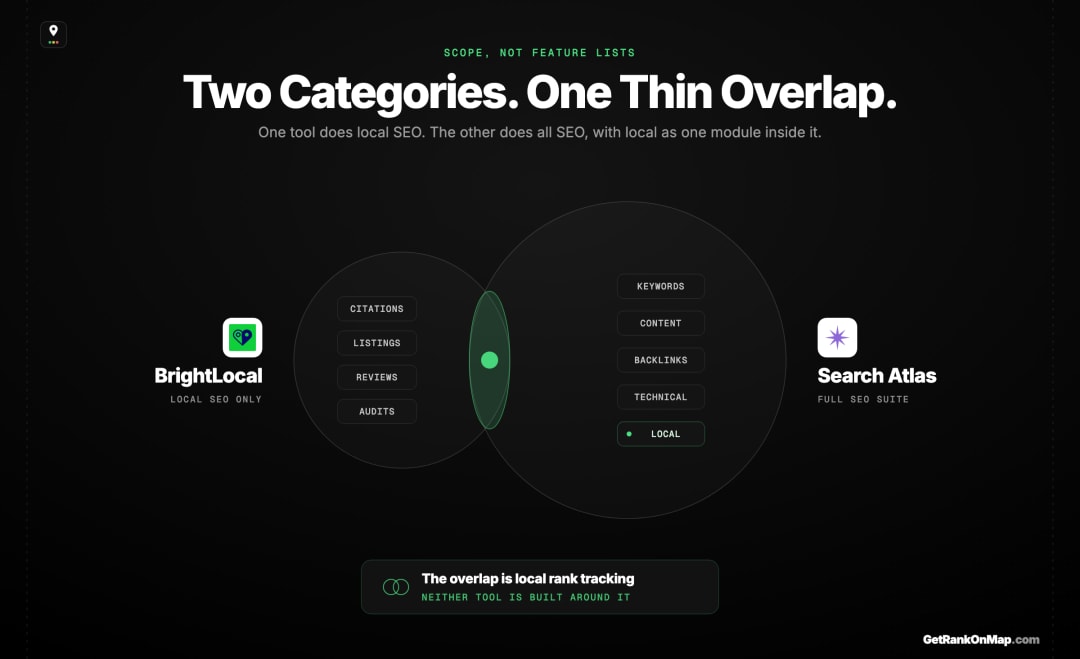
BrightLocal is a local SEO specialist. Everything in it serves businesses with a physical address or a service area. Its pricing page lists a Local Rank Tracker, Local Search Grid, a Citation Tracker, listings sync and review tools. It does not try to do national organic SEO.
Search Atlas is a full SEO platform. Its pricing page lists content tools, its OTTO SEO automation, site auditing, link building and AI visibility tracking. Local SEO sits inside that as one module, with a Google Business Profile tool called GBP Galactic. Its natural rivals are Semrush and Ahrefs, not BrightLocal.
So the real question isn't which tool is better. It's whether you're buying local SEO or buying SEO.
A dental practice with three locations has little use for national keyword research and backlink audits. It would pay for machinery it never opens. An agency running ecommerce clients next to a few local ones has the opposite problem. A local specialist alone would leave half its work uncovered. If you are weighing BrightLocal against another local specialist instead, our Whitespark vs BrightLocal comparison covers that pairing.
What each one costs in November 2026
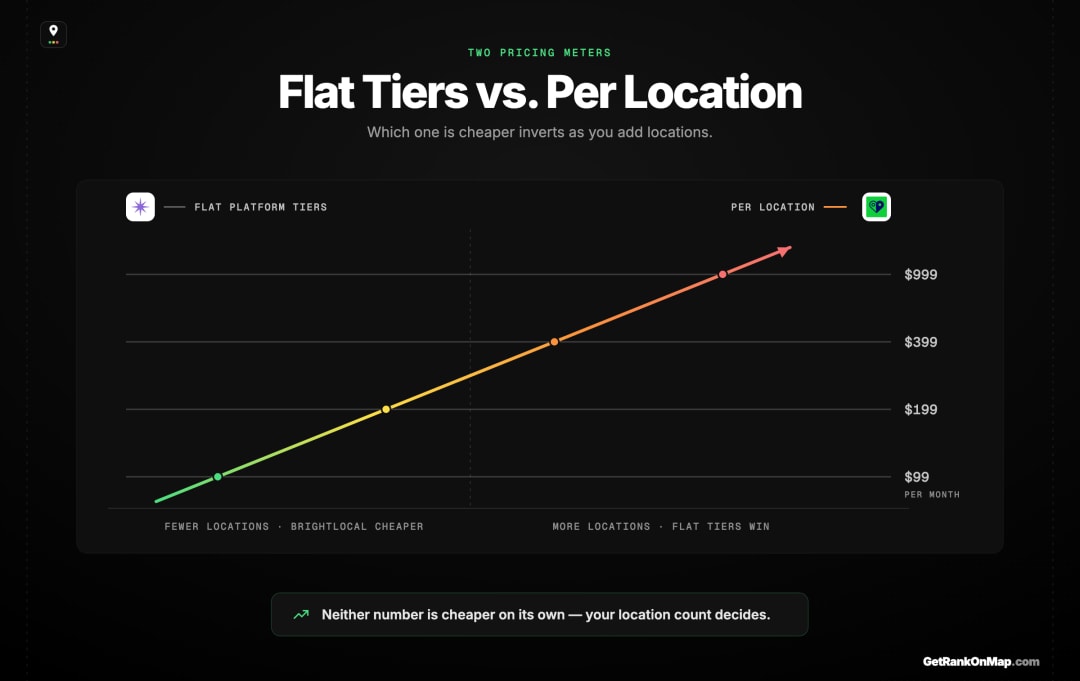
BrightLocal is cheaper for local work at every location count we priced, because Search Atlas caps Google Business Profiles per plan. Both price sheets below come from each vendor's own pricing page, checked 9 November 2026, monthly billing.
Search Atlas has four plans: Starter $99, Growth $199, Pro $399, and Agency from $999 a month. Each lists a Google Business Profile limit of 3, 10, 25 and 100. Local SEO is marked "Included" on all four. White-label delivery is only on Pro and Agency. There is a 7-day trial.
BrightLocal has three plans, Track, Manage and Grow, priced by how many locations you run. For one location they are $41, $54 and $65 a month. Paying annually brings them to $31, $40 and $49 a month. Above 100 locations the page says "Price on request".
Line the two up by location count and the gap is clear.
| Locations | BrightLocal Track | BrightLocal Grow | Search Atlas plan that fits |
|---|---|---|---|
| 1 | $41/mo | $65/mo | Starter, $99/mo (3 profiles) |
| 6–10 | $83/mo | $131/mo | Growth, $199/mo (10 profiles) |
| 21–30 | $156/mo | $296/mo | Pro, $399/mo (25 profiles) |
| 91–100 | $524/mo | $989/mo | Agency, from $999/mo (100 profiles) |
Even BrightLocal's top plan, Grow, stays under the matching Search Atlas plan at every tier: $989 against $999 at 100 locations. The crossover people talk about appears only if you ignore the profile caps. BrightLocal Track passes $99 at 11–20 locations ($104), so Search Atlas Starter looks cheaper on paper. But Starter covers only 3 profiles.
That doesn't make Search Atlas poor value. Its price buys content, technical and link tools that BrightLocal doesn't sell at all. The point is narrower: if local is all you do, you'd be paying for the rest. We break down the billing models across this whole category in what local rank trackers charge for.
What each one gives you for local work
BrightLocal goes deeper on local, while Search Atlas covers local well enough and adds everything else. The table sets out the local pieces each vendor names on its own pages, checked 9 November 2026.
| Local job | BrightLocal | Search Atlas |
|---|---|---|
| Map rank tracking | Local Rank Tracker, up to 100 keywords and 4 competitors per location | Local SERPs Viewer |
| Grid view of rankings | Local Search Grid, in all three plans | Local Heatmap, linked to GBP Galactic |
| Profile management | Google Posts scheduler, profile audit | GBP Galactic, capped by plan |
| Citations and listings | Citation Tracker, listings sync | Citation Builder |
| Reviews | Monitor and reply across sites, on Grow | Not named on the pricing page |
| Non-local SEO | Not offered | Content, audits, links, AI visibility |
The pattern holds row by row. BrightLocal names a dedicated tool for each local job. Search Atlas has a local answer for most of them, then a whole second half of the product BrightLocal doesn't touch.
BrightLocal's grid is more limited than its name suggests on the cheapest plan. Track covers "up to five keywords" on the geo-grid map. Its Local Search Grid page lists sizes of 3×3, 5×5, 7×7, 11×11 and 15×15, with adjustable spacing between points.
Reviews deserve a note, because they move rankings. In our study of the Google local pack, we compared 10,890 matched pairs of nearby businesses. The one with more reviews ranked higher 66.9% of the time. Profile completeness won 61.9%, and star rating only 52.7%. The method is on our local pack GeoGrid research page. If review count matters that much, review tools sit closer to the core of local work than most feature lists suggest.
Where each one wins
Pick on scope first and the features follow. One question settles most cases.
  WHICH ONE FITS?

  Is local SEO the whole job?
     │
     ├── yes ──> BrightLocal
     │           priced per location
     │
     └── no ───> Do you need content, audits
                 and links in one place?
                    │
                    ├── yes ──> Search Atlas
                    │
                    └── no ───> BrightLocal plus
                                the SEO tool you
                                already pay for
BrightLocal wins on these:
- Local depth. Rank tracking, grids, citations, listings and reviews are the product, not a module of it.
- Cost at small scale. One location starts at $41 a month, under half of Search Atlas's entry plan.
- Predictable growth. The price follows your location count in published tiers up to 100.
- Review work. The Grow plan monitors and replies to reviews across sites, and asks customers for new ones by email and SMS.
Search Atlas wins on these:
- Scope. One subscription covers local and national SEO instead of two.
- Content and technical SEO. Content tools, OTTO SEO and site audits are a side of the work BrightLocal doesn't sell.
- Backlinks. Link building tools sit outside BrightLocal's range entirely.
- AI visibility. Every plan lists AI visibility tracking, with bigger allowances on higher tiers.
- Agency delivery. Pro and Agency include white-label dashboards and reporting.
If neither list fits your situation, the wider field is sorted by job in our guide to the best local SEO tools.
Map rankings: what neither tool is built around
Both tools track Google Maps rankings, and neither is organised around measuring them. That matters more in local search than people expect.
A map ranking is not one number. Google ranks local results partly on how far the searcher is from the business, so your rank shifts from street to street. Our own study shows how steep that drop is. Across 300 grid cells in 12 markets, businesses appeared in the local pack in 96.4% of searches run within 500 metres of their address. Beyond 5 km, they appeared in 0%. The data is on our GeoGrid study page.
A single-point tracker can't show that. It reports one position from one spot.
  ONE PIN VS A GRID (example values)

  one point            5×5 grid, 1 km apart
                       3  3  5  9  -
  "position 3"         2  1  3  6  -
       X               1  X  2  4  9
                       2  1  3  7  -
                       4  3  6  -  -

  X = your business   - = not in top 20
The single point and the grid can both be "right" and tell you very different things. That is why GeoGrid rank tracking exists, and why both vendors added a grid view. We explain the street-to-street effect in full in why your Google Maps ranking varies by location.
The grid inside each product is still one feature among many. On BrightLocal Track it covers five keywords. On Search Atlas it sits next to dozens of non-local tools. If the map is the main thing you want to see, compare dedicated trackers in our local rank tracker comparison.
Who should pick which
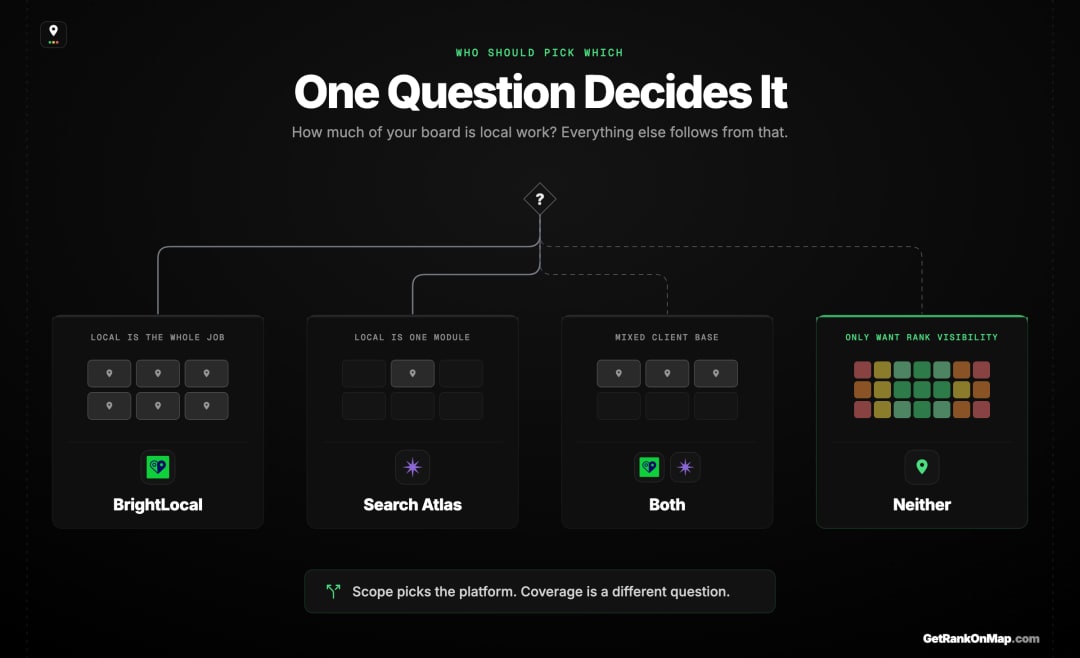
Local only means BrightLocal; local plus everything else means Search Atlas. The edge cases are where people get stuck.
| You are | Pick | Why |
|---|---|---|
| One-location business owner | BrightLocal Track or Grow | $41–$65 a month covers the local work |
| Multi-location brand, local only | BrightLocal | Per-location tiers stay below the matching Search Atlas plan |
| Agency, mostly local clients | BrightLocal | Cheaper per client, deeper local tools |
| Agency, mixed national and local | Search Atlas | One platform, white-label on Pro and up |
| Already paying for Semrush or Ahrefs | BrightLocal for local | Adds the local layer without a second full suite |
Pick both only if your agency has truly split client types and can bill each tool to the clients who use it. That's a defensible stack, as long as it's a choice and not an accident.
Pick neither if what you need is to know where you rank across your service area, precisely enough to tell whether your work is landing. Both tools solve management problems with measurement attached.
Reading other comparisons of these two
Some of what you'll find comparing these two is written by one of them. Search Atlas publishes a page titled "Migrate from Brightlocal to Search Atlas: A Comprehensive Guide" on its own blog, still live on 9 November 2026.
That's fair marketing. It's also useful context. Read vendor guides for the feature details, which are usually accurate, and discount the conclusion, which was never in doubt.
Buyers on forums already see local tools as a crowded shelf of near-identical products. One thread asking about BrightLocal against Semrush's local tools put it this way:
All these local tools, such as Local Falcon, Viking, Dominator, Whitespark, seem to prioritize the gridding and reporting.
Our own disclosure, by the same standard: RankMap is building a GeoGrid rank tracker and is pre-launch. We compete with the map-tracking slice of both products and with nothing else in either.
Bottom line
BrightLocal vs Search Atlas feels harder than it is, because the two get lined up on a feature they share instead of what each is built to do. Answer the scope question and it resolves fast. Local only: BrightLocal, cheaper at every location count we priced on 9 November 2026. Local plus content, technical and link work: Search Atlas, from $99 a month. Either way, the map number inside is a module, not a measuring instrument. If the honest answer to "where do I rank across my service area?" is a shrug, join the RankMap early-access waitlist.
Frequently asked questions
- 01Is Search Atlas good for local SEO?
- Yes, if local is one part of wider SEO work. Every Search Atlas plan includes local SEO, with GBP Galactic, a Citation Builder and a Local Heatmap. If local is your only job, BrightLocal goes deeper for less money. Its single-location plans start at $41 a month against Search Atlas's $99, checked on both pricing pages on 9 November 2026.
- 02How much does Search Atlas cost?
- Search Atlas lists four plans billed monthly: Starter $99, Growth $199, Pro $399 and Agency from $999 a month. They allow 3, 10, 25 and 100 Google Business Profiles. Extra Hyperdrive credits cost $1 each, and there is a 7-day trial. We read these from its pricing page on 9 November 2026. Check again before you buy, because prices in this category change often.
- 03How much does BrightLocal cost?
- BrightLocal prices by location count. For one location, Track is $41, Manage $54 and Grow $65 a month, or $31, $40 and $49 a month paid annually. At 91–100 locations, Track is $524 and Grow $989 a month. Above 100 locations it quotes on request. All figures are from its pricing page, checked 9 November 2026.
- 04Does BrightLocal have a Google Maps grid tracker?
- Yes. Local Search Grid is listed in all three BrightLocal plans as of 9 November 2026. The Track plan covers up to five keywords on the geo-grid map. Its feature page offers grid sizes from 3×3 up to 15×15, with adjustable spacing between points. It is a view inside a wider local suite, not a standalone grid tool.
- 05What are BrightLocal's main competitors for local SEO?
- For local-only work, the usual alternatives are Whitespark, Local Falcon and Local Viking, which now prices under the name Local Optics. For broader SEO with local included, Search Atlas and Semrush come up most. Pick by what you are leaving BrightLocal for: price, grid depth or scope. Our BrightLocal alternative guide sorts the options by that reason.
- 06Should I migrate from BrightLocal to Search Atlas?
- Only if your work has outgrown local. Moving platforms costs setup time and often your ranking history, so a change in scope should drive it, not a comparison article. That includes the migration guide Search Atlas publishes on its own blog. If you do move, export your BrightLocal history first so the trend line survives.
Sources
Primary data, collected by us
- Local pack GeoGrid study
- 300 grid cells across 12 markets. Local pack appearance 96.4% within 500 m of the business, 0% beyond 5 km. Across 10,890 matched pairs, higher review count won 66.9%, profile completeness 61.9%, star rating 52.7%. Published on our local pack GeoGrid research page.
- Pricing check
- we read the BrightLocal and Search Atlas pricing pages on 9 November 2026 and priced each at 1, 6–10, 21–30 and 91–100 locations.
Cited Accessed 9 November 2026.
- BrightLocal pricing brightlocal.com. Supports track, Manage, Grow prices by location tier; Local Search Grid in all plans; five grid keywords on Track; review tools on Grow.
- BrightLocal Local Search Grid brightlocal.com. Supports grid sizes 3×3 to 15×15, adjustable spacing.
- Search Atlas pricing searchatlas.com. Supports starter to Agency prices, GBP limits, local SEO included, white-label on Pro and Agency, 7-day trial.
- Search Atlas GBP Galactic searchatlas.com. Supports local Heatmap, Citation Builder, Local SERPs Viewer.
- Search Atlas migration guide searchatlas.com. Supports the vendor's own guide to leaving BrightLocal.
- r/localseo thread, February 2026 reddit.com. Supports buyers see local tools as near-identical.
Explore with AI
Share this
Map your real rank across the city.
Free for the first 50 scans. No credit card.
Join the waitlist