Do Backlinks Matter More in Local Organic or the Map Pack?
Backlinks weigh far more in local organic results than in the map pack. Local links are the exception: they feed both lists at once.
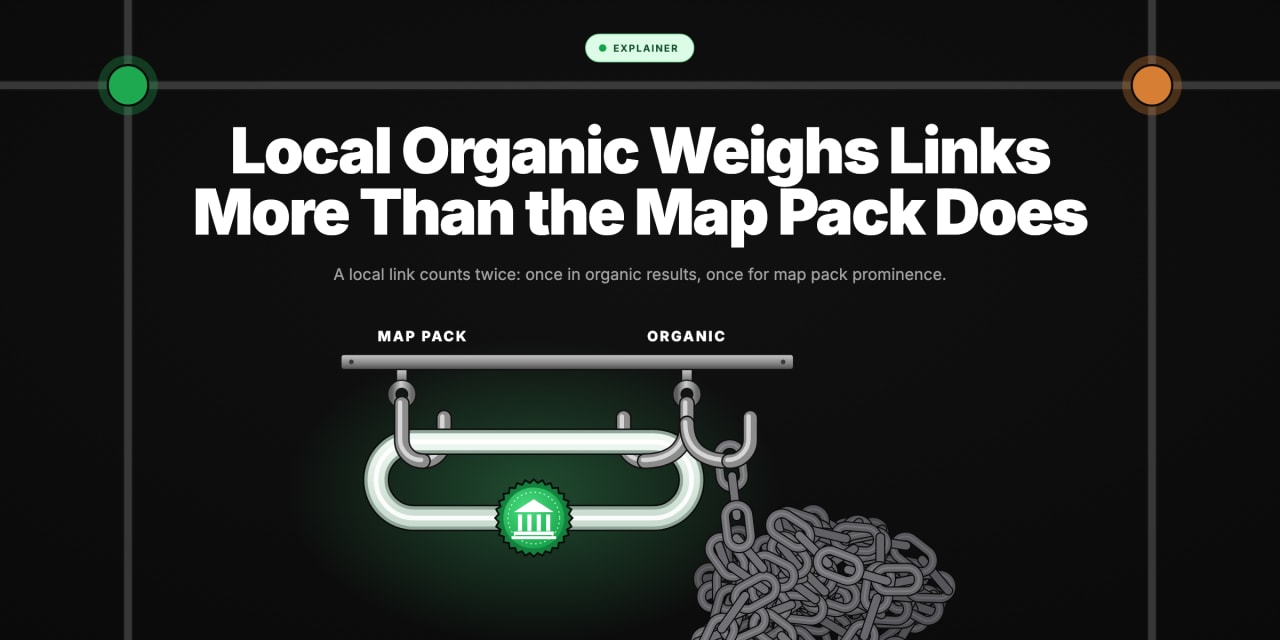
Backlinks matter much more in local organic results, the website links under the map pack, than in the map pack itself. In Whitespark's 2026 survey of 47 local search experts, link quality ranked as the #3 factor for local organic and only #31 for the map pack. The pack is led by Business Profile signals: category, distance to the searcher and keywords in the business name. Local links are the useful exception, because Google also counts links toward a business's prominence in local results. Our own study of 10,890 close business pairs found review count, not links, the clearest map pack lever we measured. For an owner or agency, the first question is which list you are losing. This holds as of November 2026.
Quick answer
- Links lead in local organic. Experts rated link quality the #3 local organic factor, behind service pages and local content.
- Links sit mid-table for the map pack. The highest link factor in the pack list ranked #25 of 187.
- The pack runs on the Business Profile. Primary category, distance and keywords in the business name top that list.
- Strong on-page work can still lose in organic. A rival with a much stronger link profile can outrank a better page.
- Local links count on both sides. Google says prominence uses "how many websites link to your business".
- A few local links rarely close a big authority gap alone. They narrow it, and they help the pack too.
- Reviews moved the pack in our data. The business with more reviews ranked higher in 66.9% of close pairs.
- Diagnose the list before the fix. Organic loss and map pack loss need different work.
One local search returns two ranked lists
A local search on Google usually shows two separate rankings on the same page. At the top sits the map pack: three businesses under a small map, ranked as Business Profiles. Below it sit the organic results, the blue links to websites, ranked as web pages. They answer the same words with different systems.
  ONE LOCAL SEARCH, TWO RANKED LISTS
  search: "roofer chicago"
        |
        +--> MAP PACK: 3 Business Profiles
        |      led by category, distance,
        |      name keywords, reviews
        |
        +--> LOCAL ORGANIC: web pages
               led by service pages, local
               content, inbound links
  source: Whitespark 2026 expert survey
The split matters for links. A link points at a website, so it plugs straight into the organic ranking. The map pack ranks a profile, so a link reaches it only through the business's general standing on the web. Google's pack and organic results also differ on distance, reviews and the area searched, which we cover in how Google Search and Google Maps rank you differently. This page takes the narrower question: how much links weigh in each list.
How much links weigh in each list
Links score 33% to 54% higher for local organic than for the map pack, by expert scoring. Whitespark's Local Search Ranking Factors report, 2026 edition, published 6 November 2025, asked 47 local search experts to score 187 factors from 0 to 5. Each factor got a separate score for map pack impact and for local organic impact. The scores were summed and ranked.
The same link factors land very differently on the two lists:
| link factor | local organic rank (score) | map pack rank (score) | how to read it |
|---|---|---|---|
| Quality or authority of links to the domain | #3 (187) | #31 (122) | A top-three organic factor, mid-table for the pack |
| Links from industry-relevant domains | #5 (175) | #39 (114) | Trade links do most of their work in organic |
| Links from locally relevant domains | #13 (167) | #27 (125) | The smallest gap of the four, so closest to useful on both |
| Total number of links to the domain | #23 (147) | #56 (102) | Raw count matters least on either list |
Read across each row and the pattern holds every time. The organic score is higher, by 42 to 65 points. The gap is smallest for locally relevant links, which is the practical point of this page.
  LINK QUALITY: EXPERT SCORE BY LIST
  each # = 10 points, Whitespark 2026
  organic   ###################   187  (#3)
  map pack  ############          122  (#31)
  #1 pack factor, primary category: 227
These are expert opinions, not measurements. None of the 47 contributors has access to Google's code, and the report says so. The report has run since 2008, and its organic versus pack split for links holds across every link factor in the table.
What leads the map pack instead of links
The map pack is led by the Business Profile and by where the searcher stands. Whitespark's top five pack factors for 2026 are:
- Primary GBP category, score 227. The same factor ranked #85 for organic.
- Distance from the searcher to the business, score 225. It ranked #41 for organic.
- Keywords in the business name, score 223, and #83 for organic.
- A physical address in the city searched, score 213.
- Being open at the time of the search, score 189.
Google's own help page on local ranking says local results are "mainly based on relevance, distance, and popularity". The heading for the third factor still reads Prominence, with the same meaning: how well known a business is. The three are separated in relevance, distance and prominence explained.
Our own study shows what moves the pack. We ran the same searches from every point of a 5×5 grid, 1 km apart, in 300 grid cells across 12 markets. Distance came first: businesses appeared in 96.4% of searches made within 500 metres and in none beyond 5 km. Among 10,890 pairs of businesses within 100 metres of each other, the one with more reviews ranked higher 66.9% of the time. A more complete profile won 61.9%, and a higher star rating won 52.7%. The method and figures are in our local pack GeoGrid study. We did not test links, so we can't put links on that scale.
Yes, strong on-page work can still lose in local organic
On-page work gets a page into contention for local organic results, but it rarely settles the order on its own. A practitioner put the question to r/localseo on 19 August 2026, after looking at a published breakdown of local organic factors:
Does it stand to reason that even if you absolutely NAIL on-page, you can still be outranked by someone who has more backlinks? Or does the QUALITY of the backlinks come into play? For example if some site had thousands of backlinks, but you came in with relevant local specific links (thinks chamber of commerce, local youth sports teams, etc.) could you out-rank them?
r/localseo, 19 August 2026
The answer to the first half is yes. In the Whitespark list, the top two organic factors are on-page: a dedicated page for each service (210) and city or neighbourhood relevance of the content (190). Link quality comes third, at 187, almost level with them. So when two sites have both done the on-page work, links are one of the strongest remaining reasons one page sits above the other.
That is why a well-written page can lose to a weaker page with far more authority behind it. The page did nothing wrong. The other site has signals from outside the page that it does not.
Do a few local links beat thousands of generic ones?
A handful of local links rarely cancels a gap of thousands of links on its own, unless most of those thousands are junk. The second half of the question is about quality, and quality is exactly what a link count hides.
Local links are the kind practitioners recommend. A chamber of commerce, a sponsored youth team or a local paper is relevant, hard to fake, and in the same place as the customers. What they rarely do is outweigh a real authority gap built from trade publications over years.
How few local links practitioners treat as enough shows up in case write-ups. One r/localseo post from 10 December 2025 describes an 8-month ranking turnaround for a roofing company in Chicago. It lists two local links: one on the city's chamber of commerce website and one on a small Chicago news site. The post says the agency "negotiated the price" for them, so they were paid placements, not earned links. The same work list includes citations on 60 more directories, a page for each neighbourhood and a fully filled Business Profile. It is one agency's report, with results shown as a screenshot, not a controlled test, and the links were a small part of it.
Before deciding whether local links can close the gap, look at what the competitor's links really are. Open their referring domains in any backlink tool and check:
- How many separate sites link to them. Thousands of links from a few dozen domains is a much smaller gap than the headline count.
- Whether those sites are real. Directories, scraped copies and unrelated blogs add little.
- Whether the links are from their trade. Industry links scored #5 for organic, so a trade-heavy profile is a real gap.
- Whether any are local. If the rival has none, your local links add something they lack on both lists.
If most of the rival's links come from thin sites, the real gap is small and local links close it faster. If they come from real publications in the trade, local links alone won't close it in a quarter.
Local links are the ones that count twice
A local link is one of the few things that helps both lists at once. On the organic side, it is a link to your website like any other. On the map pack side, Google's help page says prominence is "based on info like how many websites link to your business and how many reviews you have." A link from your chamber of commerce feeds that too.
  ONE LOCAL LINK, TWO JOBS
  chamber of commerce links to your site
        |
        +--> ORGANIC: a link to your domain
        |      locally relevant links: #13
        |
        +--> MAP PACK: feeds prominence
               "how many websites link
               to your business" (Google)
  ranks from Whitespark 2026, organic list
The survey agrees in its own way. Locally relevant links scored 167 for organic and 125 for the pack, the narrowest gap of the main link factors. A thousand generic links do most of their work in organic. Ten local ones do some work in both, and for a local search the map pack usually sits above the organic results.
How much a link adds to prominence is not published. Google gives no weights, and we have not tested links as a prominence input. The safe reading is that links count on both lists, and count for more in organic.
Find which list you are actually losing
The fix depends on which list you are losing, so check that before touching links. The right work aimed at the wrong list moves nothing.
| what you see | which list | where to start |
|---|---|---|
| In the map pack, missing from organic page one | Local organic | Service pages, local content, then links to the domain |
| Strong organic rank, never in the top three | Map pack | Primary category, reviews, profile completeness |
| Missing from both | Both | Profile and site basics, then local links that help both |
| In the pack near the office only | Map pack, distance | A grid check of your area; this is rarely a link problem |
Read the last row carefully. A pack that only shows you near your own address is distance at work, not weak links. Links can't move the point Google measures from.
Work through it in order:
- Look at the real results page for the main keyword, searched from the client's area. Note whether the loss is in the map pack, in organic, or both.
- If it is organic, compare the pages that outrank you. Check service pages and local content first, then the linking domains, not the total link count.
- If it is the map pack, links are one input among several. Start with category and reviews, then follow the full order in why you are still not in the map pack top 3.
- Build local links either way. They are the link type that helps on both lists.
- Measure each list the way it works. Track organic as one position per keyword. Track the pack from many points across the area with a GeoGrid scan, because it changes every few streets.
Distance can hide what is working. In our study, review count looked almost unrelated to rank across the whole dataset, a correlation of −0.095. Once distance was held fixed, it rose to −0.377, four times stronger. The detail is on our research page. A single pack check from one spot can hide a real gain in the same way, whatever caused it.
Where this breaks
The organic versus pack gap for links is well supported as expert opinion, but it has limits worth saying plainly.
- The survey is opinion. It sums the judgement of 47 experts. It is not a measured test of Google's systems.
- We did not test links. Our study measured distance, reviews, completeness and rating in the map pack. Links as a prominence input are not tested by us.
- Niches differ. In a trade where every rival has a strong link profile, links may decide organic order more than any table suggests. In a town with few competitors, on-page work alone can win.
Bottom line
Backlinks weigh much more in local organic results than in the map pack. Experts rank link quality third for organic and thirty-first for the pack, where the Business Profile, distance and reviews lead. Strong on-page work can still lose in organic to a site with real authority, and a few local links rarely close a large gap alone. What local links do is count on both lists, as organic links and as part of the prominence Google uses for the pack. Find which list you are losing first, then spend on the work that list rewards.
RankMap shows the map pack side as a map: where you rank across every neighbourhood you serve. We're pre-launch. Join the waitlist for free early access.
Frequently asked questions
- 01Can good on-page SEO be outranked by a competitor with more backlinks?
- Yes, in local organic results. On-page work gets a page into contention, and links help decide the order among pages that have all done it. In Whitespark's 2026 survey, link quality ranked third for local organic, close behind service pages and local content. A rival with a much stronger link profile can sit above a better-written page. The map pack works differently and leans on Business Profile signals.
- 02Are backlinks a Google map pack ranking factor?
- Indirectly. Google says prominence, one of its local ranking factors, is based partly on how many websites link to your business. Experts rate links well below profile signals for the pack, though. The best-placed link factor sat at #25 of 187 in the 2026 survey, while primary category, distance and keywords in the business name led the list. We have not tested links ourselves.
- 03Do local links like the chamber of commerce help more than generic backlinks?
- They rarely cancel a large authority gap on their own. Their value is that they count on both lists: as links to your website for organic, and as part of prominence for the map pack. In the 2026 survey, locally relevant links had the smallest organic versus pack gap of the main link factors. A thousand generic links mostly help organic.
- 04Why do I rank in the map pack but not in organic results?
- The two lists use different signals. The map pack rewards a strong Business Profile, nearby searchers and reviews. Organic rewards your website: a page for each service, local content and links to your domain. A busy, well-reviewed profile can hold the pack while a thin website barely ranks for the same words. Fix the website side for organic.
- 05How many local links does a small business need?
- There is no published number, and we have not tested one. One r/localseo case from December 2025, a Chicago roofer, credited a turnaround partly to just two paid local links, alongside 60 directory citations and neighbourhood pages. Treat that as one report, not a rule. Compare your linking domains with the rivals who outrank you, and close that gap first.
- 06What matters most for ranking in the map pack?
- Experts in the 2026 Whitespark survey put primary category, distance to the searcher and keywords in the business name at the top. In our own study of 10,890 close pairs, the business with more reviews ranked higher 66.9% of the time, and distance decided whether a business appeared at all. Links help through prominence but are not the main lever there.
Sources
Primary data, collected by us
- Local pack GeoGrid study
- collected July 2026. 300 grid cells (5×5, 1 km spacing) across 12 markets. Appearance by distance: 96.4% under 0.5 km, 0% beyond 5 km. Matched pairs within 100 m in the same cell: review count won 66.9%, profile completeness 61.9%, star rating 52.7% of 10,890. Review count vs rank correlation −0.095 across the corpus, −0.377 with distance held fixed. Links were not tested. Published on our research page, linked twice in the body above.
- Search Console query pull
- queries that showed this page in Google, 90 days to 9 November 2026: "local vs organic links" 1 impression at position 99.0. Pulled 9 November 2026.
Cited Accessed November 2026.
- Whitespark, Local Search Ranking Factors 2026 whitespark.ca. Supports 47 experts, 187 factors scored 0–5, published 6 November 2025; link factor ranks and scores for local organic and map pack; top pack and organic factors.
- Google Business Profile Help, tips to improve your local ranking support.google.com. Supports "relevance, distance, and popularity"; the Prominence heading; links and reviews as prominence inputs.
- r/localseo, 19 August 2026 reddit.com. Supports the quoted question on on-page work versus backlinks and local links.
- r/localseo, 10 December 2025 reddit.com. Supports 8-month Chicago roofing case: two paid local links, 60 more directory citations, neighbourhood pages.
Explore with AI
Share this
Map your real rank across the city.
Free for the first 50 scans. No credit card.
Join the waitlist