Discovery Impressions but No Map Pack: Why Both Can Be True
Google counts a search whenever your profile appears, with no position and no location. A map pack check tests one slot from one spot. Both can be true.
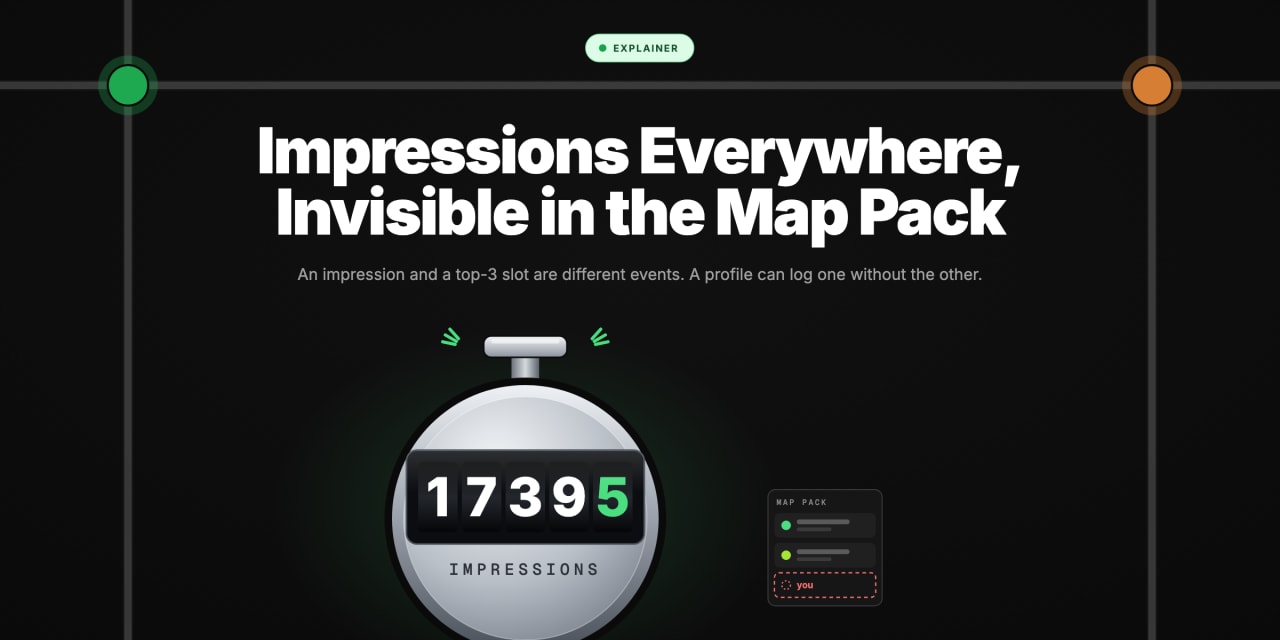
A Google Business Profile can log healthy search numbers on category terms while the business never shows in the map pack when you search those terms yourself. Both readings can be true. Google counts a search whenever the profile appears for it, and its Performance report gives no position and no searcher location. A map pack check tests one slot, on one page, from one spot. In our own study, a business appeared in 96.4% of searches made within 500 metres of it and in none beyond 5 km. So a profile can collect its numbers in a small area your spot checks never reach. For an agency facing a client who says "we're invisible", the next step is measuring from many points. This holds as of November 2026.
Quick answer
- The numbers and the empty pack don't contradict each other. One counts appearances anywhere. The other checks the top three from one place.
- "Discovery" is an old label. Google's former Insights report defined discovery searches as category, product or service searches. The current report just lists search terms.
- The report shows no rank. Google's help page lists searches, views, calls, website clicks and directions. Position isn't one of them.
- The report shows no location either. You can't tell which streets the searches came from.
- Ads are counted too. Google says the data includes views and searches from Google Ads, not only organic results.
- A few spoofed points are a sample, not a map. Pack results change within a few streets, so two or three checks can all miss the area where you show.
- The usual checklist only proves eligibility. Verified, right category and no suspension mean the profile can rank. They don't say where it does.
- Split the search terms first. Brand and near-brand terms are not a map pack question. Category terms are.
- Then check from a grid. The pattern across the area tells you whether distance, relevance or prominence is the cause.
What "discovery searches" meant, and what the report counts now
The word most agencies still use comes from a report Google has since replaced. Google's archived About Insights page, captured in May 2021, split searches into three kinds. Direct searches were when "a customer directly searched for your business name or address." Discovery searches were when "a customer searched for a category, product, or service that you offer, and your listing appeared." Branded searches covered "your brand or a brand related to your business."
The current help page on Business Profile performance no longer uses those labels. It lists the search terms instead, and says: "Search queries show up whenever your Business Profile appears for a certain search." That sentence is the whole definition. Appearing is enough. It doesn't say where on the page, in which list, or at what position.
| metric | how Google defines it | what it can't tell you |
|---|---|---|
| Searches | The terms people used to find your business, listed whenever the profile appears for a search | Your position, the surface it appeared on, or where the searcher was |
| Views | Unique visitors who viewed the profile on Search and Maps, each counted once a day | Whether they saw you in the top three or further down |
| Calls, website clicks, directions | Taps on the call button and website link, and direction requests | Which search or which street the action came from |
| Discovery vs direct | Only in the older Insights report, archived in 2021 | Not shown in the current report as a separate split |
Read the table from right to left. Every metric answers "did something happen?" None answers "where did we rank?" That is why a strong count and an empty pack can sit side by side without either one being wrong. The same gap comes up when you try to use these numbers for tracking, covered in why profile impressions aren't map pack tracking.
Two smaller details shape the counts. The searches metric, Google says, "is updated at the start of each month" and can take up to 5 days to show. And the page states that performance data "includes views, searches, and actions from both organic search results and Google Ads." If the client runs ads, some of the visibility in the report was paid for.
  ONE SEARCH TERM, TWO DIFFERENT QUESTIONS

  Performance report        your spot check
  ------------------        ---------------
  did the profile appear?   is it in the top 3?
  any list, any street      one page, one street
  no position given         one position seen
  a monthly total           one moment
         |                        |
         v                        v
  "solid numbers"           "invisible"

  both answers can be true at the same time
An appearance is not a map pack position
A counted search means the profile was shown to someone. A map pack position means it was one of the three businesses on the results page, for that searcher, at that spot. The first is much wider than the second.
Google's definition of a search names no position, so an appearance below the top three fits it. Here is what that leaves room for, based on the definition rather than any breakdown Google publishes:
- Lower in the list. A profile can appear at position 6 in the Maps app or the full list of places and still match "appears for a certain search."
- Near the address only. Searches made close to the business may account for most of the count, while the rest of the city never sees it.
- Near-name terms. A term that looks generic in the list may include the business's own name or street.
- Paid placements. Views and searches from Google Ads are included in the same report.
Google doesn't split the count by any of these, so you can't confirm from the dashboard which one is driving it. You can only test it from outside.
A real case: solid numbers, "actually invisible"
On 8 August 2026 an agency described this exact situation on r/localseo. The client's profile was verified, the primary category was correct, there were no suspensions, the reviews were decent and the business sat inside the city. They had checked from different devices, in incognito, and from spoofed locations. The client was not 4th or 5th. They described the business as "actually invisible." Then they offered a theory:
Best I can figure is GBP is lumping Maps app searches and below-the-pack results into the same impression count, which would explain the gap. But the dashboard doesn't break any of that out so I can't actually confirm it.
That theory fits Google's own definition, and the last sentence is the real problem. The report has no position and no location, so the theory can't be tested from inside it.
The same split showed up in another report a few weeks earlier. On 15 July 2026 a practitioner working for a personal injury law firm on r/localseo reported about 1.17 million Business Profile impressions over three months. Search Console showed near-zero click-through on the firm's top terms. When they searched by hand, the profile sat in the local pack and the website's organic listing was pushed below it. Two dashboards, two surfaces, and neither one said where the business appeared on the page.
Why a few spoofed points can't find the business
Checking from two or three locations is a sample, and map pack results change too fast across a city for a small sample to find a small cluster. If the check points fall outside the area where the profile shows, every check says "invisible", and that is the true answer for those points. It isn't the answer for the whole city.
We measured how quickly visibility fades with distance. We ran the same searches from every point of a 5×5 grid, 1 km apart, around 2,590 businesses in 12 markets. Only the search location changed between points. A business appeared in the pack in 96.4% of searches made within 500 metres of it, and in none beyond 5 km. The full method is in our local pack GeoGrid study.
  ONE KEYWORD, 25 SEARCH POINTS, 1 KM APART
  (illustrative layout, not client data)

     X   .   .   .   .     . = not in the top 20
     .   .   8   .   .     3 = in the pack
     .   6   3   9   .     6 = shown, below the pack
     .   .   5   .   .     X = where you spot-checked
     .   .   .   .   X

  the counted searches come from the centre
  the two checks landed on corners: "invisible"
A profile like the one drawn above would log searches every month from the centre cluster, where it holds the pack at one point and sits just below it nearby. Two spoofed corners would find nothing. The reason results move this fast across a city is laid out in why Google Maps ranking varies by location.
This also explains why "inside the city" isn't the reassurance it sounds like. Being in the city makes the business eligible for city searches. It doesn't put it within a kilometre of every searcher.
Why the usual checklist doesn't close the gap
Every item on the agency's list was already clear, and none of them answers where the profile ranks. Verification, the right primary category, no suspension and decent reviews make a profile eligible to show. Position comes from how it compares with rivals for each searcher. Google's page on improving your local ranking says local results are "mainly based on relevance, distance, and popularity." Further down, the same page still heads the third factor "Prominence". Treat the two words as the same factor.
More profile work at this stage is a guess about a problem nobody has measured yet. It's the same trap covered in still not in the map pack top 3: fixes get picked before anyone has looked at the map.
Distance can also hide what is working. In our study, the correlation between review count and rank was −0.095 across all the data, close to nothing. Once we held distance fixed, it became −0.377, about four times stronger. Both figures are in the study's findings. A check from the wrong spot doesn't just miss where you show. It can make real strengths look useless.
Before blaming the profile, rule out three quieter causes:
- Near-name terms in the list. Read the top terms one by one. A term with the street name, the owner's name or a misspelling of the brand is closer to a direct search than a category search.
- Ads in the totals. Ask whether the client ran Google Ads in the period. Google says those views and searches are in the same report.
- A filter, not a rank. If the profile shows for its own name but never for broad terms anywhere, it may be filtered rather than outranked. That case is covered in why a Business Profile drops out of the map pack.
What the grid pattern tells you
Once you check from a grid instead of a few points, the shape of the result points to the cause. The table below is how we read a grid, using Google's three factors.
| what the grid shows | likely cause | what to look at next |
|---|---|---|
| In the pack near the address, missing further out | Distance | Normal for most businesses. Report coverage honestly, and don't promise the whole city |
| Below the pack everywhere, close to the top three | Prominence | Review count and profile completeness against the three rivals above |
| Missing everywhere, including next door | Relevance or a filter | Primary category, the exact search terms, and a name search for duplicates |
| In the pack in one direction only | A nearby rival | The businesses on that side, their distance and their reviews |
The first row is the most common answer to "solid numbers, invisible in the pack". The profile isn't broken. It is visible to the people closest to it, and those people generate the count.
Among close rivals, our data also says which strengths matter most. We matched 10,890 pairs of businesses within 100 metres of each other, for the same search from the same point. The one with more reviews ranked higher 66.9% of the time. A more complete profile won 61.9%. A higher star rating won 52.7%, close to a coin flip. If the grid puts the client just below the pack, those are the levers in order.
What to do when the numbers and the pack disagree
- Export the search terms for the last three months and sort them into brand, near-brand and category terms. Only the category group is a map pack question.
- Take the top three category terms and check each from a grid of points across the service area, not from two spoofed spots. A GeoGrid scan does this from many points at once.
- Keep the grid fixed. Same centre, same spacing, same number of points, so next month's check compares fairly.
- Read the pattern with the table above. Near the address but nowhere else means distance. Nowhere at all means relevance or a filter.
- Change one thing at a time if the grid shows a real gap, and re-run the same grid afterwards.
How to report this to the client
The client call usually starts with "we're invisible" and a screenshot from one search. Answer it with a map, not a defence of the dashboard. A single position hides the cluster the counts come from, a point made at length in why one rank number lies.
What a useful monthly report puts side by side:
- Category search terms from the profile. The count, dated, with brand terms taken out.
- Grid coverage for the same terms. Where the profile is in the pack, below it, or missing.
- Actions. Calls, website clicks and direction requests, as Google counts them.
- What changed. Profile edits, new reviews, new rivals and any ad spend in the period.
Shown together, the numbers stop contradicting each other. The client can see that the searches come from the area where the profile is visible, and where the growth would have to come from.
Bottom line
Strong discovery numbers and an empty map pack are not a reporting bug. Google counts a search whenever the profile appears for it, with no position and no location attached. A spot check tests one slot from one place. In our study, visibility faded within a few kilometres for almost every business, so a profile can earn its whole count from a small area that a few spoofed points never touch. The way out is a grid check on the category terms, read for its pattern, before anyone changes the profile.
RankMap is built to show that pattern: where a profile holds the pack and where it drops out, across the whole service area. We're pre-launch. Join the waitlist for early access.
Frequently asked questions
- 01What are discovery searches in Google Business Profile?
- Discovery searches were a label in Google's older Insights report. An archived 2021 version of the help page defined them as searches where "a customer searched for a category, product, or service that you offer, and your listing appeared." Direct searches were searches for the business name or address. The current Performance report lists the search terms people used instead, without that split, so you have to sort brand and category terms yourself.
- 02Why can't I find my client in the 3-pack when their profile's search numbers look healthy?
- Most likely the counted searches come from a small area near the address, or from lists below the top three. Google counts a search whenever the profile appears, at any position. In our study, businesses appeared in 96.4% of searches within 500 metres and none beyond 5 km. A few spoofed checks can easily miss that cluster. A grid of checks across the service area shows where the profile actually appears.
- 03Does the Business Profile Performance report show where a profile ranks?
- No. Google's help page lists searches, views, calls, website clicks, directions, messages and bookings. None of them is a position, and none says where the searcher was standing. Searches are listed whenever the profile appears for a term, and views count unique visitors once a day. To learn where the profile ranks, you need checks from stated locations outside the dashboard.
- 04Do Google Ads count in Business Profile performance numbers?
- Yes. Google's help page says performance data "includes views, searches, and actions from both organic search results and Google Ads." If a client ran ads during the period, part of the visibility in the report may be paid. Ask about ad spend before reading a strong month as an organic map pack win, and note it on the report so the comparison with grid checks stays fair.
- 05How many points do I need to check before calling a profile invisible?
- More than two or three. Pack results change within a few streets, so a handful of spoofed spots can all fall outside the area where the profile shows. Our own study used a 5×5 grid with 1 km between points around each business. Whatever size you choose, keep the same centre, spacing and point count every time, so each check compares fairly with the last.
- 06Should I keep optimising the profile if the numbers are good but the pack is empty?
- Not until you've seen a grid. If the profile holds the pack near its address and fades further out, that is distance, and more profile edits won't change it. If it sits just below the top three everywhere, compare review count and completeness with the rivals above. If it's missing even next door, check the category, the terms and possible duplicates first.
Sources
Primary data, collected by us
- Local pack GeoGrid study
- collected July 2026. 300 grid cells (5×5, 1 km spacing) across 12 markets, 2,590 businesses. Appearance: 96.4% of searches within 500 m of the business, 0% beyond 5 km. Matched pairs within 100 m in the same cell: review count won 66.9%, profile completeness 61.9%, star rating 52.7% of 10,890. Review count vs rank correlation −0.095 across all data, −0.377 with distance held fixed. Published on our research page, linked twice in the body above.
- Search Console query pull
- queries that showed this page in Google, 90 days to 9 November 2026: no query rows returned. Pulled 9 November 2026.
Cited Accessed November 2026.
- Google Business Profile Help, understand your Business Profile performance support.google.com. Supports searches listed whenever the profile appears for a search; views as unique visitors once a day; calls, website clicks, directions; monthly update; Google Ads included; no position metric.
- Google My Business Help, About Insights (archived 15 May 2021) web.archive.org. Supports the old definitions of direct, discovery and branded searches.
- Google Business Profile Help, tips to improve your local ranking support.google.com. Supports relevance, distance and popularity as the local ranking factors, with the third still headed "Prominence".
- r/localseo, 8 August 2026 reddit.com. Supports the case; the checklist already cleared; devices, incognito and spoofed checks; the quoted theory.
- r/localseo, 15 July 2026 reddit.com. Supports about 1.17 million Business Profile impressions in 3 months; near-zero organic CTR; the pack sitting above the organic listing.
Explore with AI
Share this
Map your real rank across the city.
Free for the first 50 scans. No credit card.
Join the waitlist